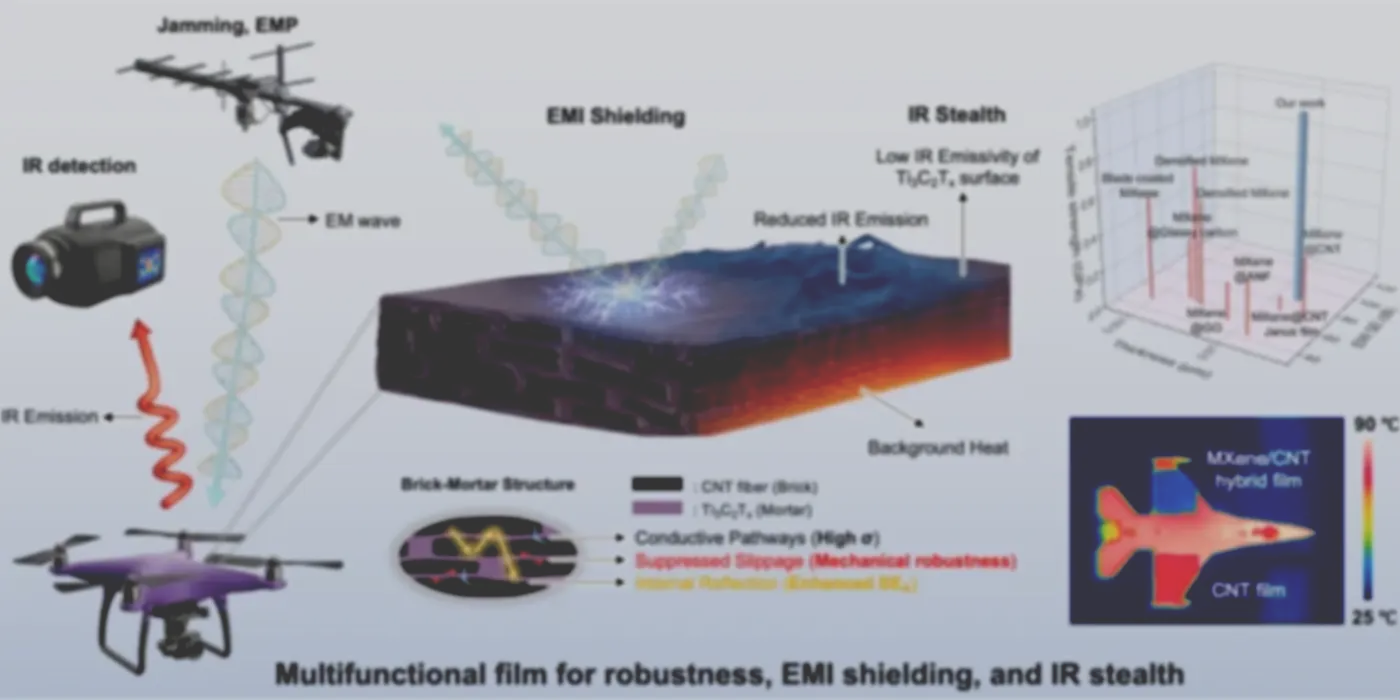
Carbon Nanotube Has EMI And Hides Heat
Researchers have developed a composite film that combines electromagnetic interference shielding, infrared stealth, and high mechanical strength using carbon nanotube fibers and MXene.
Researchers have developed a composite film that combines electromagnetic interference shielding, infrared stealth, and high mechanical strength using carbon nanotube fibers and MXene.


For the past six weeks, parents have been able to keep a watchful eye over what they are feeding their children at mealtimes. However, with the back-to-school season fast approaching, most parents will once again face the constant dilemma of choosing which healthy, exciting, tasty and nutritious products they should give their children. Parents face the difficult choice of what to buy for their children as packaging can be misleading.
This report focuses on a selection of popular fruit juice drinks and fruit based desserts which can be found in a typical child's lunchbox.
FRUIT JUICE DRINKS
Fruit Juice Content

The tunic believed to have been worn by Saint Francis of Assisi preserved in the Church of Saint Francis in Cortona (Province of Arezzo) dates back to the period in which the saint lived, whereas the tunic preserved in the Church of Santa Croce in Florence was made after his death.
Carbon 14 measurements, which allow a relic to be dated, show that the tunic in Santa Croce dates back to some time between the late 13th century and late 14th century and thus could not have belonged to the “Poor Man of Assisi”, who died in 1226.
Autism spectrum disorders cover a wide span of conditions and symptoms, from severe mental retardation to mild social impairment. In general, people with autism have problems with social interactions, such as maintaining eye contact or reading body language. They may also exhibit stereotypical behavior, such as being obsessed with lining up objects. In the movie “Rain Man,” the title character was unable to form social bonds and became distressed when his normal routine was disrupted, yet he could perform exceptional mental mathematics.
About 1.5 million people in the United States have autism spectrum disorders, with boys affected more often than girls.

The release of sulfur and nitrogen into the atmosphere by power plants and agricultural activities--commonly referred to as acid rain--plays a minor role in making the ocean more acidic on a global scale, but the impact is greatly amplified in the shallower waters of the coastal oceans, according to new research.
The most heavily affected areas tend to be downwind of power plants (particularly coal-fired plants) and predominantly on the eastern edges of North America, Europe, and south and east of Asia.
Ocean acidification occurs when chemical compounds such as carbon dioxide, sulfur or nitrogen mix with seawater, a process which lowers the pH and reduces the storage of carbon.
There has been a lot of recent discussion about recovery from depression, sparked by the results of the largest ever treatment trial (STAR*D) and its indicator that more and new combinations of antidepressant drugs for an increased level of remission were essential.
Some Italian investigators interpert the same data in a different way: the more you use antidepressant drugs, the worse is the long-term outcome, they say.
Giovanni A. Fava and associates (University of Bologna) have published this new analysis in the September issue of Psychotherapy and Psychosomatics.
Studies with rats have revealed the potential in an entirely new class of antidepressants that take effect after only days of treatment versus the weeks required for current drugs.
The researchers, Guillaume Lucas and colleagues, said that they hope their findings will spur development of such new antidepressant drugs so that clinical testing can begin quickly.
Depression can be treated by enhancing the action of the neurotransmitter serotonin in the brain. Such neurotransmitters are the chemical signals that one neuron launches at another to trigger a nerve impulse in the target neuron.
Airline passengers and crews who gripe about poor cabin air quality could have a new culprit to blame: the oils on their skin, hair and clothing. A new study suggests interactions between body oils and ozone found in airplane cabins could lead to the formation of chemical byproducts that might worsen nasal irritation, headaches, dry eyes and lips, and other common air traveler complaints.
In simulated flights lasting four hours, American and Danish researchers placed two groups of 16 volunteers in a mockup of an airline cabin and then exposed them to varying levels of ozone and air flow, including levels typically experienced in real flights.
In experiments with mice, Lennart Mucke and colleagues have discovered a mechanism by which the toxic brain protein produced in Alzheimer’s disease (AD) could contribute to the cognitive deficits that are its hallmark. They found evidence that the toxic protein, called Aβ peptide, triggers overexcitation of neurons in the brain’s learning centers, inducing compensatory rewiring of brain circuitry in the centers—all of which could cause deterioration of neural function.
The researcher wrote that their results showed the need for studies to explore whether blocking that overexcitation might prevent such neurological deficits in AD.
Scientists at MIT’s Department of Civil and Environmental Engineering and the Technion Israel Institute of Technology have for the first time recorded the entire genomic expression of both a host bacterium and an infecting virus over the eight-hour course of infection.

In work that could lead to safe and effective techniques for gene therapy, MIT researchers have found a way to fine-tune the ability of biodegradable polymers to deliver genes.
Gene therapy, which involves inserting new genes into patients' cells to fight diseases like cancer, holds great promise but has yet to realize its full potential, in part because of safety concerns over using viruses to carry the genes.
The new MIT work, published this week in Advanced Materials, focuses on creating gene carriers from synthetic, non-viral materials.
Prions – an abbreviation for proteinaceous infectious particles – work as a trigger to a set of diseases of the brain and nervous system, the so-called spongiform encephalopathies. These include BSE in cattle, scrapie in sheep and Creutzfeldt Jakob’s Disease in humans. Prions are structural variants of a normal protein found in healthy tissues – especially in the brain.
The devastating effect of infectious prions is that, once they have entered the organism, they can modify the normal "healthy" prion proteins to create more infectious prions, and thus cause the illness to progress.
Gene therapy, a field of intense research for nearly 20 years, involves inserting new genes into patients' cells to fight diseases like cancer. It holds great promise but has yet to realize its full potential, in part because of safety concerns over the conventional technique of using viruses to carry the genes - more than 1,000 gene-therapy clinical trials have been conducted and most trials use viruses as carriers, or vectors, to deliver genes.
However, there are risks associated with using viruses. To date there are no FDA-approved gene therapies. As a result, many researchers have been working on developing non-viral methods to deliver therapeutic genes.