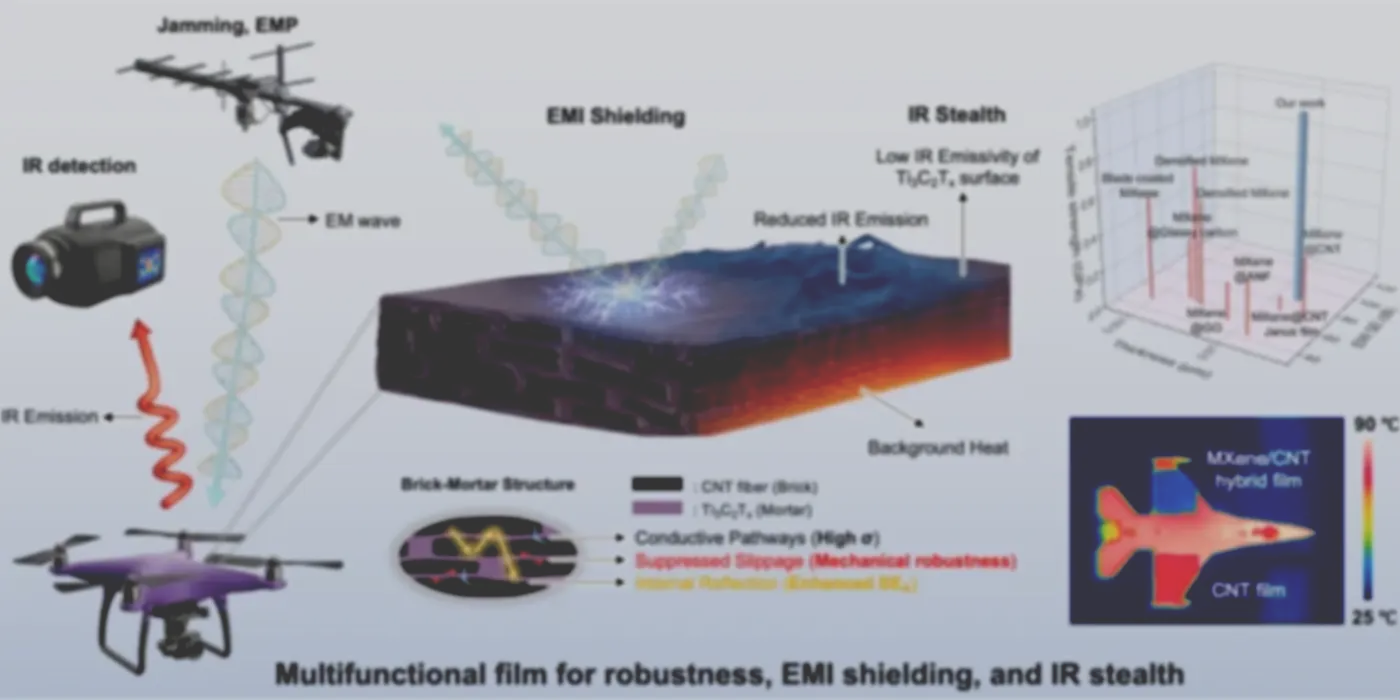
Carbon Nanotube Has EMI And Hides Heat
Researchers have developed a composite film that combines electromagnetic interference shielding, infrared stealth, and high mechanical strength using carbon nanotube fibers and MXene.
Researchers have developed a composite film that combines electromagnetic interference shielding, infrared stealth, and high mechanical strength using carbon nanotube fibers and MXene.


Does the time of year in which a child is conceived influence future academic achievement? Yes, according to research by neonatologist Paul Winchester, M.D., Indiana University School of Medicine professor of clinical pediatrics.
Dr. Winchester and colleagues linked the scores of 1,667,391 Indiana students in grades 3 through 10 who took the Indiana Statewide Testing for Educational Progress (ISTEP) examination with the month in which each student had been conceived. The researchers found that ISTEP scores for math and language were distinctly seasonal with the lowest scores received by children who had been conceived in June through August.
Most Americans are familiar with the popular city rankings of the fattest cities, the fittest cities, the most livable cities and the most expensive cities. Now, in the first-of-its-kind survey, the American Academy of Dermatology (Academy) has identified the cities that take sun protection seriously and those that fail to make the grade despite repeated health warnings.
The growing premature birth rate in the United States appears to be strongly associated with increased use of pesticides and nitrates, according to work conducted by Paul Winchester, M.D., professor of clinical pediatrics at the Indiana University School of Medicine.
Railway sleepers made from waste plastic, including recycled bumper scrap and old computer cases could be putting in an appearance on UK railway tracks soon, writes Patrick Walter in Chemistry & Industry, the magazine of the SCI.
UK company Micron, which makes sleepers from waste polystyrene and polyethylene, has already approached UK rail track operator Network Rail with the aim of forming a partnership. Polystyrene is commonly used in disposable coffee cups, and polyethylene is more likely to be seen hanging from trees in the form of carrier bags. But the longevity of this plastic means that railway sleepers made using it can potentially last for centuries. This compares to a few decades for sleepers made from wood or concrete.
Exposure to trauma may create enough changes in the brain to sensitize people to overreact to an innocuous facial gesture years later, even in people who don’t have a stress-related disorder, says new research. It appears that proximity to high-intensity traumas can have long lasting effects on the brain and behavior of healthy people without causing a current clinical disorder. But these subtle changes could increase susceptibility to mental health problems later on.
According to a new brain study, even people who seemed resilient but were close to the World Trade Center when the twin towers toppled on Sept. 11, 2001, have brains that are more reactive to emotional stimuli than those who were more than 200 miles away.
That is the finding of a new Cornell study that excluded people who did not have such mental disorders as post-traumatic stress disorder (PTSD) or major depression. One of the first studies to look at the effects of trauma on the brains of healthy people, it is published in the May issue of the journal Emotion.
Some high blood pressure medicines may help protect older adults from declines in memory and other cognitive function, according to new research from Wake Forest University School of Medicine, reported today at the annual meeting of the American Geriatrics Society in Seattle.
When we have a conversation with someone, we not only hear what they say, we see what they say. Eyes can smolder or twinkle. Gazes can be direct or shifty. “Reading” these facial expressions gives context and meaning to the words we hear.
In a report to be presented May 5 at the International Meeting for Autism Research in Seattle, researchers from UCLA will show that children with autism can’t do this. They hear and they see, of course, but the areas of the brain that normally respond to such visual cues simply do not respond.
Amnesty International USA is using powerful satellite cameras to monitor highly vulnerable villages in war-torn Darfur – the first-ever technological capability by human rights defenders to track possible targets of attack, prevent new atrocities and save lives. The human rights organization is inviting ordinary people worldwide to help protect 12 villages by visiting the Eyes on Darfur project website (www.eyesondarfur.org) and put Sudanese President al-Bashir on notice that the areas are being watched around the clock.
A new variety of corn developed and patented by Michigan State University scientists could turn corn leaves and stalks into products that are just as valuable as the golden kernels.
Right now, most U.S. ethanol is made from corn kernels. This is because breaking down the cellulose in corn leaves and stalks into sugars that can be fermented into ethanol is difficult and expensive.
In the mid-1990s, scientists at the University of Parma, in Italy, made a discovery so novel that it shifted the way psychologists discuss the brain.
After researchers implanted electrodes into the heads of monkeys, they noticed a burst of activity in the premotor cortex when the animals clutched a piece of food. In a wonderfully fictitious account of the discovery, neuroscientist Giacomo Rizzolatti was licking ice cream in the lab when this same region again fired in the monkeys. In an equally wonderful truthful account, the neurons in this region did, in fact, fire when the monkeys merely watched researchers handle food.
There seems to be something new under the sun -- in the sky, specifically -- that could complicate scientists' efforts to get a fix on how much the world will warm in the future. Greenhouse gases are not the only things in the air that influence the temperature of our atmosphere. Clouds and small airborne particles called aerosols also play an important and complicated role. And now a new ingredient has been discovered: an extensive and previously unseen "twilight zone" of particles that represents a gradual transition from cloud droplets to dry particles.