Carbon Nanotube Has EMI And Hides Heat
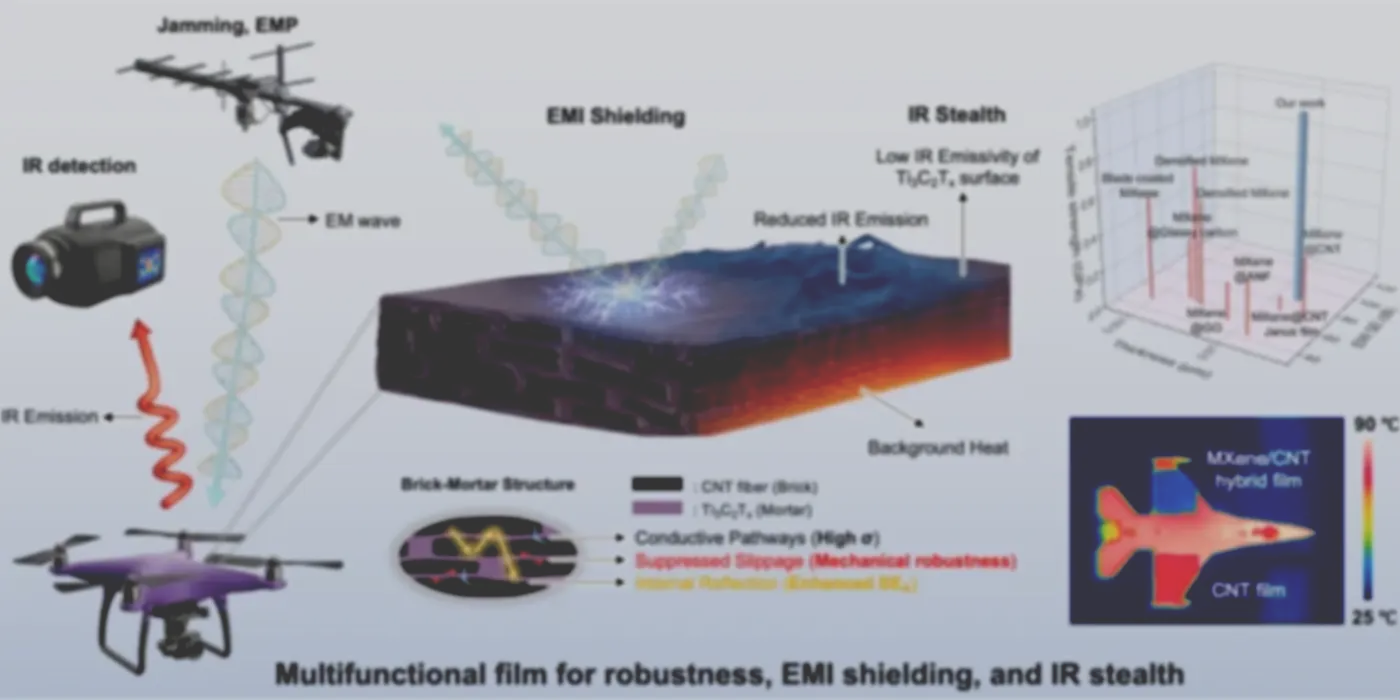
Researchers have developed a composite film that combines electromagnetic interference shielding, infrared stealth, and high mechanical strength using carbon nanotube fibers and MXene.
Researchers have developed a composite film that combines electromagnetic interference shielding, infrared stealth, and high mechanical strength using carbon nanotube fibers and MXene.


As climate change becomes more and more a central issue in local, national, and international discussions, understanding the global carbon budget, and how it influences trends in global warming, will become increasingly crucial.
The carbon cycle is related to climate and climatic change because it controls carbon dioxide, the most important of the greenhouse gases. Dr. R. A. Houghton has authored a synthesis paper on the topic, summarizing what is known about the global carbon budget and why it is important. The work is featured in the current issue of the Annual Review of Earth and Planetary Science.
In the eternal conflict between friends and parents, friends will often win because they highlight the positive aspects of sex.
Parental communication more often than not focuses on the negative aspects of sex, write Marina Epstein and L. Monique Ward from The University of Michigan.
Juicing up your cell phone or iPod may take on a whole new meaning in the future. Researchers at Saint Louis University have developed a fuel cell battery that runs on virtually any sugar source - from soft drinks to tree sap - and has the potential to operate three to four times longer on a single charge than conventional lithium ion batteries, they say.
For consumers, that could mean significantly longer time to talk and play music between charges. The new battery, which is also biodegradable, could eventually replace lithium ion batteries in many portable electronic applications, including computers, the scientists say.
A fundamental genetic mechanism that shuts down an important gene in healthy immune system cells has been discovered that could one day lead to new therapies against infections, leukemia and other cancers. Results of a University of Pittsburgh School of Medicine study on the mechanism, called a somatic stop-codon mutation, are being reported today in the online journal PLoS ONE.
Sales of herbal dietary supplements have skyrocketed by 100 percent in the United States during the last 10 years, but most people don’t consider evidence-based indications before using them, according to a University of Iowa study.
Two-thirds of people who use herbs don’t do so in accordance with guidelines, according to the article. Meanwhile, sales of herbal supplements reached $18.8 billion in 2003, up 100 percent from $8.8 billion in 1994. Those sales are subject to minimal federal regulations.
Researchers have discovered a new fact about hooded seals, a mysterious mammal that spends all but a few days each year in the ocean.
An international team of researchers led by Dr. David Coltman, an evolutionary geneticist at the University of Alberta, have learned that all the hooded seal populations in the world share the same genetic diversity. The researchers reached their conclusions after analysis of more than 20 years of DNA samples taken from hundreds of hooded seals from around the world.
"These results mean that if you brought me a DNA sample of a hooded seal, I wouldn't be able to tell you where in the world you got that sample because of the genetic similarity between populations," Coltman said.
A new study by NASA scientists suggests that greenhouse-gas warming may raise average summer temperatures in the eastern United States nearly 10 degrees Fahrenheit by the 2080s.
"There is the potential for extremely hot summertime temperatures in the future, especially during summers with less-than-average frequent rainfall," said lead author Barry Lynn of NASA's Goddard Institute for Space Studies and Columbia University, New York.
A new study examines the use of tissue-engineered scaffolding made of cartilage cells, which have a limited ability to heal naturally, to replace defective cartilage tissue. Cartilage cells are extracted and seeded to the scaffold which is implanted into the body, where new cartilage tissue is grown along the structure. The study appears in the journal Artificial Organs.
A new vaccine aimed at preventing cervical cancer is nearly 100 percent effective against the two types of the human papillomavirus (HPV) responsible for most cases of cervical cancer. Results of a nationwide study of the vaccine will be published in the May 9 issue of the New England Journal of Medicine.
Cervical cancer is the second most common cause of cancer deaths in women worldwide, resulting in nearly half a million diagnoses and 240,000 deaths each year. Every day in the United States ten women die from cervical cancer, according to Kevin Ault MD, associate professor of obstetrics and gynecology at Emory University School of Medicine, and one of the study authors.
Researchers at the Johns Hopkins Kimmel Cancer Center have conclusive evidence that human papillomavirus (HPV) causes some throat cancers in both men and women. Reporting in the May 10 issue of the New England Journal of Medicine, the researchers found that oral HPV infection is the strongest risk factor for the disease, regardless of tobacco and alcohol use, and having multiple oral sex partners tops the list of sex practices that boost risk for the HPV-linked cancer.
An international team, led by researchers at the Broad Institute of MIT and Harvard, and supported by the National Institutes of Health (NIH), today announced the publication of the first genome of a marsupial, belonging to a South American species of opossum. In a comparison of the marsupial genome to genomes of non-marsupials, including human, published in the May 10 issue of the journal Nature, the team found that most innovations leading to the human genome sequence lie not in protein-coding genes, but in areas that until recently were referred to as "junk" DNA.
Using an innovative statistical approach, a research team from Washington University School of Medicine in St. Louis and the University of California, Los Angeles, has identified two regions of DNA linked to autism. They found the suspicious DNA with a much smaller sample of people than has been used traditionally in searches for autism genes.