Brain Circuit Linked To Pregnancy Food Cravings Identified
Pregnant women have experienced exotic food cravings since recorded history began. This may be why.
Pregnant women have experienced exotic food cravings since recorded history began. This may be why.


The first sector of CERN* 's Large Hadron Collider (LHC) to be cooled down has reached a temperature of 1.9 K (-271°C), colder than deep outer space! Although just one-eighth of the LHC ring, this sector is the world's largest superconducting installation. The entire 27-kilometre LHC ring needs to be cooled down to this temperature in order for the superconducting magnets that guide and focus the proton beams to remain in a superconductive state. Such a state allows the current to flow without resistance, creating a dense, powerful magnetic field in relatively small magnets. Guiding the two proton beams as they travel at nearly the speed of light, curving around the accelerator ring and focusing them at the collision points is no easy task.
Scientists using NASA satellite data have found strong evidence that a major earthquake can lead to a nearly immediate increase in regional volcanic activity.
The intensity of two ongoing volcanic eruptions on Indonesia’s Java Island increased sharply three days following a powerful, 6.4-magnitude earthquake on the island in May 2006. The increased volcanic activity persisted for about nine days.
In a study appearing in the March 22 New England Journal of Medicine, scientists supported by the National Institutes of Health’s National Institute of Arthritis and Musculoskeletal and Skin Diseases (NIAMS) have discovered a connection between a specific gene and the inflammatory skin condition vitiligo, as well as a possible host of autoimmune diseases.
Vitiligo is a chronic condition in which melanocytes (the cells that make pigment) in the skin are destroyed. As a result, white patches appear on the skin in different parts of the body. Similar patches also appear on both the mucous membranes (tissues that line the inside of the mouth and nose), and perhaps in the retina (inner layer of the eyeball).
The 11,000 members of three scientific societies with its roots in agriculture have been closely watching the reports coming out of the Intergovernmental Panel on Climate Change (IPCC).
It is the IPCC’s 4th Assessment Report released on April 6, "Climate Change 2007: The Physical Science Basis" that points to the direct consequences of climate change. Leading scientists from all over the world contributed to the latest installment of this report that attributes ecosystem changes to human-induced global warming. Following the release of the report, the presidents of the American Society of Agronomy (ASA), Crop Science Society of America (CSSA), and Soil Science Society of America (SSSA) issued this statement today:
Marine scientists recently published a research paper in the science journal, biology letters, that found humpback whales migrate over 5,100 miles from Central America to their feeding grounds off Antarctica; a record distance undertaken by any mammal.
Kristin Rasmussen, a biologist with Cascadia Research Collective, and lead author in the study, finds the record-breaking migration interesting, but is most pleased that the study validates a long held assumption that humpback whales travel to warm water areas during the winter.
Got milk? Weightlifters will want to raise a glass after a new study found that milk protein is significantly better than soy at building muscle mass.
The study, conducted by a team of researchers at McMaster University’s Department of Kinesiology, was recently published in the American Journal of Clinical Nutrition. It compared how much muscle protein young men gained after completing a heavy weight workout followed by consumption of equivalent amounts of protein as either fluid skim milk or a soy drink.
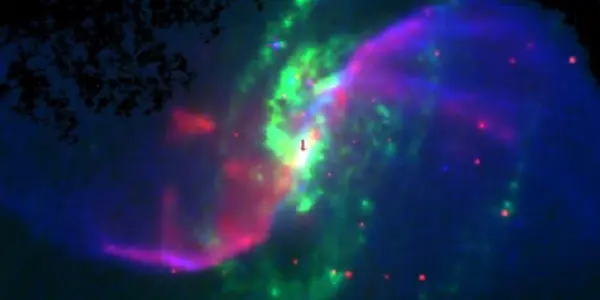
Using a trio of space observatories, astronomers may have cracked a 45-year old mystery surrounding two ghostly spiral arms in the galaxy M106 (NGC 4258).
The results, obtained by a team from the University of Maryland (USA), took advantage of the unique capabilities of the European Space Agency’s XMM-Newton X-ray observatory, NASA’s Chandra X-ray Observatory, and NASA’s Spitzer Space Telescope.
This is a composite image of spiral galaxy M106 (NGC 4258). Optical data from the Digitized Sky Survey is shown in yellow, radio data from the Very Large Array appears purple, X-ray data from Chandra is coded blue, and infrared data from the Spitzer Space Telescope appears red.
In the first nationally representative study to examine the relationship between survey measures of household firearm ownership and state level rates of suicide in the U.S., researchers at the Harvard School of Public Health (HSPH) found that suicide rates among children, women and men of all ages are higher in states where more households have guns. The study appears in the April 2007 issue of The Journal of Trauma.
"We found that where there are more guns, there are more suicides," said Matthew Miller, Assistant Professor of Health Policy and Management at HSPH and lead author of the study.
People watching the Super Bowl who saw how much they had already eaten -- in this case, leftover chicken-wing bones -- ate 27 percent less than people who had no such environmental cues, finds a new Cornell study.
The difference between the two groups -- those eating at a table where leftover bones accumulated compared with those whose leftovers were removed -- was greater for men than for women.
"The results suggest that people restrict their consumption when evidence of food consumed is available to signal how much food they have eaten," said Brian Wansink, the John S.
Society’s disapproval of alcohol, tobacco and gambling means that some investors -- mostly public institutions -- lose out while other investors gain on these undervalued “sin stocks,” according to a study conducted by the Sauder School of Business at the University of British Columbia.
Sauder Prof. Marcin Kacperczyk and co-author Prof. Harrison Hong of Princeton University analyzed stock markets and the impact they feel from society’s framework of morals, traditions and laws.

University of Oregon scientists have identified molecular features that determine the light-emitting ability green fluorescent proteins, and by strategically inserting a single oxygen atom they were able to keep the lights turned off for up to 65 hours.
The findings, published online this week by the Proceedings of the National Academy of Sciences, likely are applicable to most photoswitchable fluorescent proteins, said S. James Remington, professor of physics and member of the UO Institute of Molecular Biology.
Graphic shows models of the on and off structural alignments of a photoswitchable fluorescent protein. Credit: Courtesy S. James Remington
Planting and protecting trees—which trap and absorb carbon dioxide as they grow—can help to remove carbon dioxide from the atmosphere. But a new study suggests that, as a way to fight global warming, the effectiveness of this strategy depends heavily on where these trees are planted. In particular, tropical forests are very efficient at keeping the Earth at a happy, healthy temperature.
The researchers, including Ken Caldeira of Carnegie’s Department of Global Ecology and Govindasamy Bala at Lawrence Livermore National Laboratory, found that because tropical forests store large amounts of carbon and produce reflective clouds, they are especially good at cooling the planet.