We take thousands of steps each day and we never think about the evolutionary and cultural advantage it represents.
We may have been able to travel farther for exploration, and obtain food, thanks to the benefit it brings. It may be why we run the world rather than chimpanzees or some other primate. A new study combined video equipment and a 36-foot-long walkway that measured impact forces and determined we are less similar than believed. When walking on two legs, chimps most often land on the balls of their feet, but sometimes on the side and sometimes with a heel-strike.
Humans naturally land with a heel-strike and the metabolic energy savings were as much as 41 percent, which made traveling farther possible, but our earliest human ancestors walked more like chimps and it limited their range. Yet it also created higher impact forces, which led to stronger bones and joints. Those eventually also became competitive advantages.
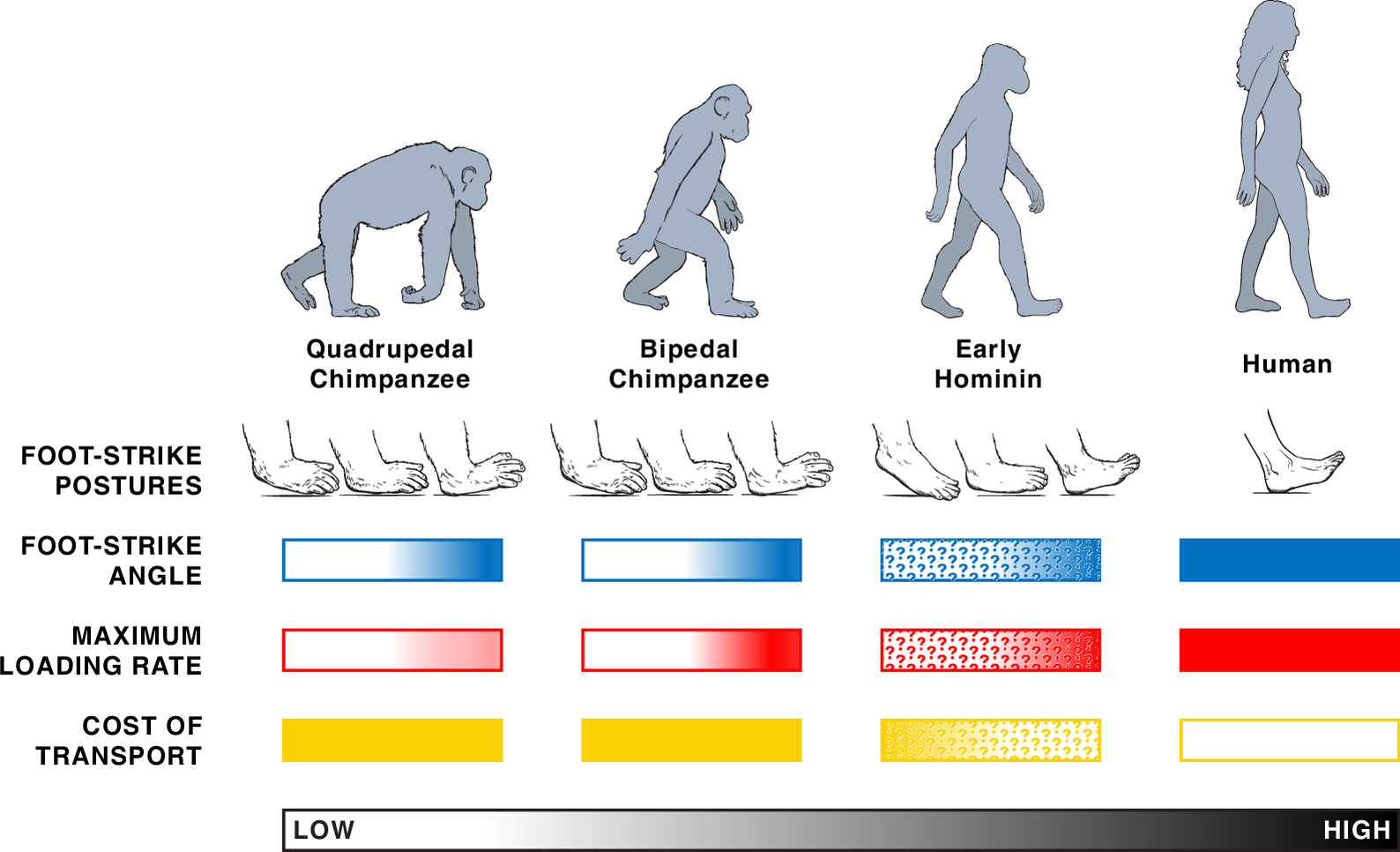
Effects of foot-strike postures on loading rates and walking costs in chimpanzees, humans, and early hominins (non-Homo hominin species from the late Miocene and the Pliocene). Color gradients in bars indicate magnitudes of variables, with darker shades indicating higher values.
If you want to walk quietly, you probably walk on the balls of your feet. You know it creates less noise because the force is in a smaller area. You may also know it creates faster fatigue doing so. The prevalence of the heel-toe strike may have been cultural at first - people who did it could go longer distances for food - but it became biological over time.
They drew their conclusion using data from 15 chimpanzees, three using their own setup and the rest from others, plus 12 humans. Nine of the humans walked with no shoes, only reflective markers, and walked normally or using the balls of their feet before bringing down the heel. Their oxygen consumption and carbon dioxide exhalation were measured as a proxy for energy.
The chimps walking on two legs used fewer heel strikes than when they were used four limbs to move, and 2.4 to 8.6 times greater ranges of foot-strike angles than the human participants, while heel-strikes generated higher forces than midfoot-strikes in both species; 138 percent higher chimp for heel-strikes than midfoot-strikes and 162 percent higher for humans. Humans walking with heel-toe expended 26 to 41 percent less metabolic energy than midfoot-strikes.
Developing stronger bones and joints might even have meant why we optimize travel with hard, paved roads.
Citation: Nicholas B. Holowka, Matthew C. O’Neill, Vincent Bhandal, Otto Lam, Zacchariah M. Apolito, Caleb A. Massimi, Kevin G. Palmisano, Steven Worthington, Brigitte Demes, and Nathan E. Thompson, Heel-strike mechanics reveal evolutionary trade-offs in hominin bipedalism, Proc. Natl. Acad. Sci. U.S.A. 123 (37) e2533918123, DOI:10.1073/pnas.2533918123 (2026).