Some areas are known to be subjective, like art. After the Sylvester Stallone movie Rocky premiered 50 years ago, critics in elite-catering publications like Wall Street Journal and The New Yorker dismissed it. The New York Times called it a "sentimental little slum movie" but the public loved it.(1)
As Taoist philosopher Zhuangzi said thousands of years ago, a frog living at the bottom of a well can see the same sky as us but its experience is limited to the opening of the well. That is why people interested in more competitive sports dislike competitions in the Olympics that are just judges handing out scores. It feels too subjective.
Imagine if painting or opera were included. Or wine tasting. They are all famously subjective, in experiments renowned experts can't distinguish elite from mediocre - unless they already know something is elite or mediocre. A new paper tries to tackle "classical" singing and wants to push beyond judge terms like "warm" or "focused" to see if there is anything consistent in what experts claim to like.
Marginalizing Music Mysticism
The work involved a simulated competition in a real concert hall, so they could try and map subjective scores with science. Like a study we highlighted here showing you can learn a dance that will get you out of any club in the world with your dignity intact, the authors found that artistic quality can be quantified numerically.
The team had 12 female and 10 male classical singers perform "Caro mio ben" a cappella and five experts rated each on a 100-point scale plus vocal attributes such as voice quality, pitch, and intonation on a seven-point scale. The researchers documented loudness units, singing power ratio, and vibrato quality. Then they correlated their readings to scores.
It seems there is something definable coaches can use beyond 'sound more orange.' Loudness itself did not seem to matter but singers with vocal efficiency, called the "singer's formant" and defined as the ability to be heard without a microphone while an orchestra plays, in the range of 2 to 4 kilohertz scored better. Vibrato mattered, more for female singers than men, with a wider variation meaning higher scores, while basic intonation made little difference.
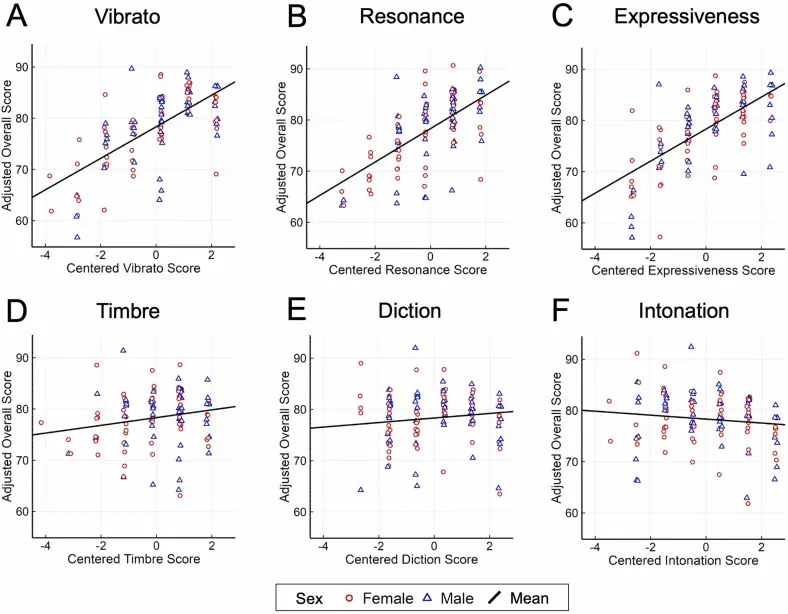
Partial regression plots showing the associations between the judge-rated vocal attributes and the adjusted overall score, estimated using the linear mixed-effects model (LMM). Each panel (A–F) shows the association between one grand-mean-centered vocal attribute (x-axis) and the adjusted overall score (y-axis). For each panel, the adjusted overall score was obtained by subtracting from the observed overall score the fitted contributions of all other terms in the model, leaving the contribution of the attribute shown, its interaction with sex, and the residual. The model included the six vocal attributes, sex, and the interactions between each attribute and sex as fixed effects, with the judge as a random intercept. Open red circles represent ratings of female singers, and open blue triangles represent ratings of male singers. The solid black line indicates the marginal slope averaged across sex; sex-specific slopes are not shown because none of the interactions between the vocal attributes and sex was statistically significant. DOI: 10.1016/j.jvoice.2026.09.070
Instead of 'let it ring', the authors note, singers can instead be given something more tangible, like the frequency spectrum where they were going to be judged best. It will be better for competition scoring as well if coaches are trained in the natural laws that shape our likes and dislikes. Maybe then singing can get into the Olympics. Breakdancing did.
Citation: Haruka Kondo, Sotaro Kondoh, Shinya Fujii, Vocal Evaluation of Classical Singing in a Concert Hall: erceptual and Acoustic Associations with Overall Scores in Male and Female Singers, Journal of Voice, DOI: 10.1016/j.jvoice.2026.09.070
NOTE:
(1) It became the highest-grossing film of the year, won awards and spawned a franchise that still exists. As does Godzilla, the longest-running franchise in cinema history with 72 years and counting but often dismissed by critics. Today, critics at papers that dismissed Rocky then don't want to be left behind again so they are gushing that the biopic about Stallone and the making of the film is as good as the actual film.