After President Bill Clinton ordered his US Department of Agriculture to make a government "organic" marketing designation for products that used older pesticides and genetic engineering, the industry took off and is now $150 Big Food segment in its own right. With the surge in popularity, concern about high levels of pesticides certified organic, like copper and Copper Sulfate, also increased. Copper-based products are older, which means they are less effective. Copper is also an important micronutrient to maintain healthy plants. It requires far more product to achieve the same effect as modern products, and since it is worse for aquatic life, greater risk.
On the modern side one of the most popular products is glyphosate, known in home use as Roundup. It uses less chemicals per calorie of food than organic products, by a lot, but conventional farming dwarfs alternative lifestyle methods in popularity and that means more absolute chemical volume.
No one cares about using the fewest pesticides like farmers, both conventional and organic, because their land is their greatest asset, and they want to keep expenses as low as possible. Some farmers even grow organic and conventional products side-by-side, depending on profitability of each crop, and a new paper says the two pesticides combined can be problematic.
The chemicals are not the issue, 'chemical cocktail' hysteria was manufactured by the same predatort legal groups that sue family dry cleaning stores over a wheelchair ramp being the wrong grade by a fraction of an inch. The volume matters, though. A new paper that used earthworms (Eisenia fetida) finds that biochar, popular over the last 15 years for soil remediation, can help.
Credit: João Ricardo Sousa, Carolina Matos, Tiago Azevedo, Elisabete Nascimento Gonçalves, Vishnu D. Rajput, Abhishek Singh, Karen Ghazaryan, Francisco Saraiva, Tao Zhang & Rupesh Kumar Singh
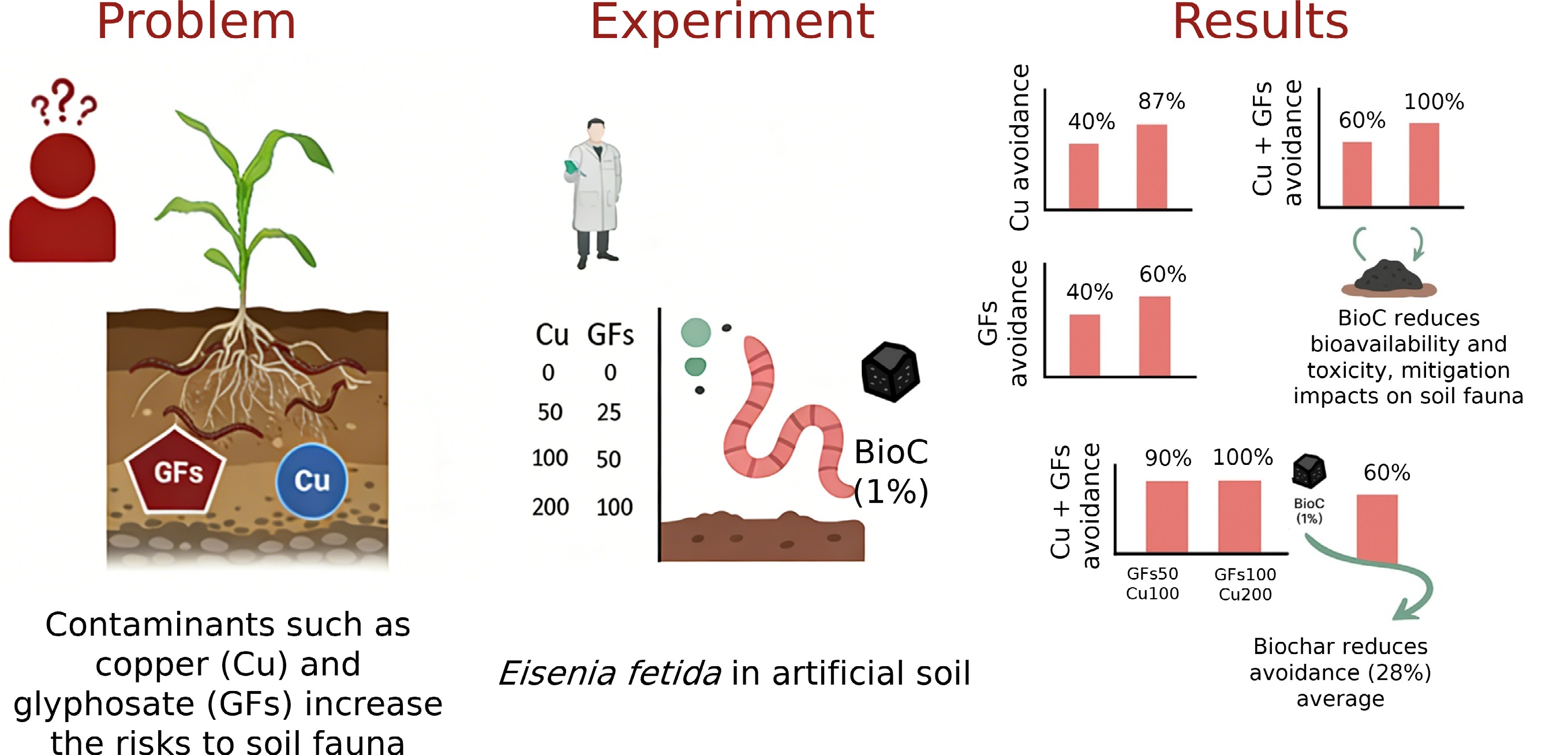
Biochar is basically charcoal, long known for ability as a filter, except biochar doesn't have additional chemicals needed to bind and then burn it. It has the same high porosity and can absorb toxins. Worms, along with fruit flies and mice, are staples in the basic research community for exploratory studies to try and find real-world effects. The new paper demonstrated that earthworms in soil exposed to high levels of combined glyphosate and copper were less likely to avoid it.
The researchers used a 48-hour avoidance test where earthworms could move between soil with no added chemicals and soil with copper sulfate, glyphosate, and then both compounds.
No one is surprised that the worms avoided the toxic levels but even at the 60 percent level of the combined products the avoidance was noticeable. They speculate that it's because glyphosate can bind copper while high copper sulfate concentrations reduce that microorganisms that degrade glyphosate naturally.
Then they added biochar created using pyrolysis (high heat with no oxygen - how the entire charcoal industry is based) equal to about 20 metric tons per hectare. Results were that it reduced earthworm avoidance by 27 percent in the most highly contaminated soil.
That is good news but it is a test environment, natural soil has a lot more going on, so the real benefit of biochar will be in actual toxic soil, not what's common in domestic organic or conventional farming. The levels simply don't get that high. Farmers are out in front making sure they use as few chemicals as needed. Anyone who claims otherwise is selling you something.
Citation: João Ricardo Sousa, Carolina Matos, Tiago Azevedo, Elisabete Nascimento Gonçalves, Vishnu D. Rajput, Abhishek Singh, Karen Ghazaryan, Francisco Saraiva, Tao Zhang & Rupesh Kumar Singh, Mitigating the effects of copper and commercial glyphosate formulations with biochar: insights from Eisenia fetida avoidance assays. Biochar X 2: e015 doi: 10.48130/bchax-0026-0013