Thinking used to be so fast that it was the pinnacle of speed to people. In 1849, Hermann von Helmholtz set out to make the mystical quantifiable and measured nerve impulses. They were electrical and electricity could be measured. He did just that, with frogs. It turns out that speed of thought is far lower than the speed of sound, even slower than the speed of a small Cessna training airplane.
It was electricity running along a wire, except the wire was biological and the distance was short enough it seemed instantaneous.
A hundred years later, engineers wanted to solve the problem of 'hiss' and degradation of sound using physical albums and tapes and found that by encoding data into 1s and 0s, they could recreate it with no degradation, Futurists immediately began to speculate that the world of humans might be digital, but scientists told them the storage cost would be extreme. Even 20 years later, when CDs became common, it was going to take a stack of them as high as a skyscraper to store just one brain's information.
And that wouldn't include consciousness.
Scientists have long pursued how electrical circuits become thought and have focused on the synapses that rewire our brain circuits as we go. A new paper seeks to posit how large groups of neurons take up the slack in real-time sensory events - by taking the waves generated by waves and calculating everything everywhere all at once in parallel. A fantastic leap over the linear sequence of digital 0s and 1s.
If they are right, it can be clinically relevant; the long-time goal of electro-shock therapy only a lot more precise than the past, the way GMOs are far safer than older Organic-certified products made using Mutagenesis chemical baths blasted by radiation.
The notion of "mixed selectivity” says that our brains evolved (maybe thank sugar and pregnant women for that) to use low-frequency waves, e.g. alpha (Would female orgasms kill men?) and beta, for memories and longer-term efforts while high-frequency gamma waves handle the faster, real-time influx of billions of data points and decide what is important.
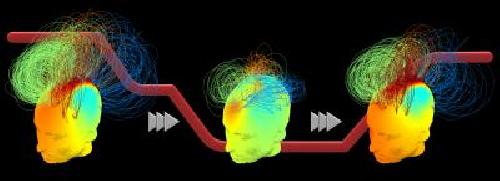
“Synapses store representations, while wave dynamics help determine which representations are active at any given time,” the authors write and in their hypothesis the coordinated surges result from shared local electric fields - no synaptic chemistry involved, it is basically extra-cellular; ephaptic coupling.
Helmholtz would be very proud but his next sentence would likely be, "Beweisen Sie es."
Citation: Earl K. Miller, Scott L. Brincat, Jefferson E. Roy, 'Analog Cognition and Consciousness', Journal of Neuroscience 19 August 2026, 46 (33) e0711262026; DOI: 10.1523/JNEUROSCI.0711-26.2026