A new paper posits that rather than being the random chaos theory colloquially known by things like the Butterfly Effect, recurrent coastal floods actually occur at very predictable times.
The tides have always mattered, of course, Galileo was the last person in science to deny what every illiterate sailor understood (1) but this paper goes beyond the chaos of unpredictable weather phenomena and argues that damaging floods are actually predictable.
The work involves going beyond how people usually think about floods. Currently, if you live near a river or on the coast you might think of "flood days" per year, but that ignores when they happen. The new work used existing tide data and the timing of recorded flood events in the the U.S. and the U.K. and say there are obvious patterns. A flood in southern California is often in the morning.
From Scotland to Boston, flooding was predictable.
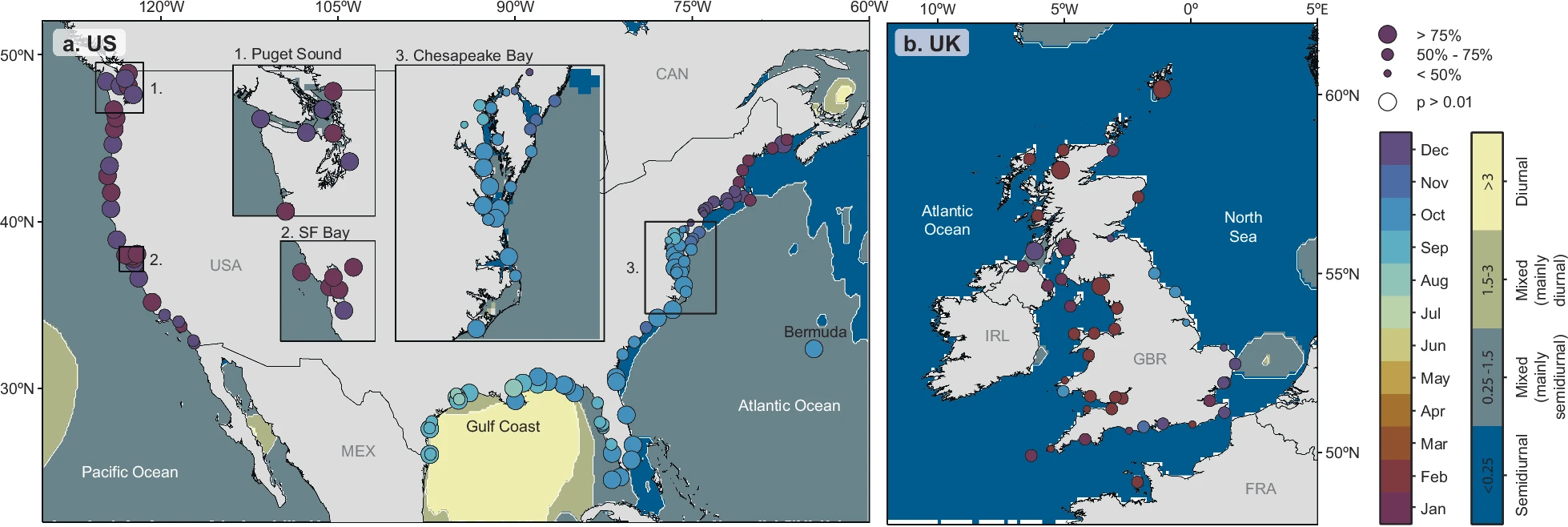
Marker color indicates the time of year of the dominant intra-year peak, while marker size reflects its prominence, defined as the percentage of annual exceedance events occurring within 1.5 months of the peak modal time. White-filled markers indicate locations where the distribution of peak dates is not significantly different from uniform (p > 0.01). The background shading shows the tidal form factor (F), calculated as (K1 + O1)/(M2 + S2), which reflects the relative influence of diurnal versus semidiurnal tidal constituents. Coastlines and political boundaries from the Global Self-consistent, Hierarchical, High-resolution Geography database.
Not everywhere, though. The Gulf Coast, whether you call it Golfo de Nueva España like the Spanish, Gulf of Mexico like the English once they took Florida, Gulf of America like Republicans, or nothing at all like natives there did, was very on brand in being impossible to predict.
And it is due to the tides. As referenced before, Galileo stated that according to his calculations tides only happened once per day if they happened at all, they happened at the same time every day, and that the moon had nothing to do with them, but scientists are a lot smarter now. Scientists now know that tides happen multiple times per day, and flood risk with them. Diurnal tidal systems, one high tide and one low tide per day, were predictable just like semidiurnal, which their two high tides and two low tides.
There was still a lot of variation between regions, as you'd expect but it was consistent, predictable variation. The Pacific Northwest has strong diurnal inequality but that led to a really predictable range of flood peak times.
What really matters is that peak times in regions are not due to random effects, they were consistent with basin-scale propagation and standing-wave behavior. Since estuaries and rivers will have greater exposure to land use changes and sea level changes, it could mean more flooding. That doesn't make it "Act of God."
So former Vice-President, Nobel laureate and Academy Award winner Al Gore could end up being right about flooding, even though the science basis he used for claims decades ago remain unfounded. Like Galileo, you only have to be correct once for other numerous errors to be washed away with the tides.
Citation: Joris G. W. Beemster, Stefan A. Talke, Ivan D. Haigh, Ben S. Hague, Grace C. Levins, Dirk S. van Maren & Antonius J. F. Hoitink. Coastal flooding at predictable hours. Nat Commun 17, 6814 (2026). DOI: 10.1038/s41467-026-75710-5
NOTE:
(1) Not to be too hard on him, people are still in denial today. Nearly 100 percent of environmental activists still don't understand what illiterate peasants in the days of Paracelsus already knew; "the dose makes the poison." Which is why they shriek that homeopathic levels of a chemical that can kill a rat in obscene doses must be harming us. Like weedkillers, microplastics, PM2.5, food coloring, and cell phones. There would be a lot more trust in science if they still only believed the moon doesn't impact the tides.