Square Root of Not

Steve Schuler

Steve Schuler

Twitter: @SteveSchuler20. You may try my hacks AT YOUR OWN RISK. Kids use adult supervision. There are infinitely many ways to injure persons and damage property—I can’t think of them all. I am not responsible for any damage or injuries obtained whil…
RSS Feed
Celebrate Science Indiana

Celebrate Science Indiana

If you live in Indiana, or at least near Indianapolis, you should go to the Celebrate Science Indiana science festival in the Blue Ribbon Pavilion at the Indiana State Fairgrounds Saturday 3 October 2015 from 9:30am-5:30pm—it’s free.

Lego Optics Lab: Laser Interferometer

Lego Optics Lab: Laser Interferometer

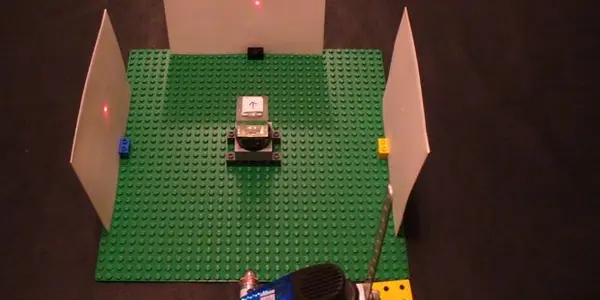
Last week the European Space Agency announced the launch of its Lisa Pathfinder mission later this year to test if laser interferometry can be used in space to detect gravitational waves. It's fairly easy to build a laser interferometer so I decided to build one for my Lego optics lab.

A table-top interferometer will not be able to detect gravity waves because there is too much noise in the surrounding environment and you need a really big laser interferometer to distinguish between gravitational waves and such mundane things as earthquakes, traffic passing by, or someone dropping a coffee mug in the kitchen. The LIGO, or Laser Interferometer Gravitational-Wave Observatory, is an interferometer whose arms are four kilometers (well-nigh 2.5 miles) long.

The Spread Of Life Among The Stars

The Spread Of Life Among The Stars

One day, it might be possible to detect the spread of life among the stars through panspermia--a hypothetical process of life distributed throughout the Milky Way by asteroids, comets, and even spacecraft. Henry Lin and Abraham Loeb of the Harvard-Smithsonian Center for Astrophysics propose, “If future surveys detect biosignatures in the atmospheres of exoplanets,” it ought to be possible to detect the spread of life between stars even without knowing how life spread from host star to host star. That is, we probably wouldn’t be able to detect the mechanisms of panspermia such as asteroid, spacecraft, or what have you.

1859 Balloon Voyage

1859 Balloon Voyage

My wife and I went to see Big Bad Voodoo Daddy (“You and Me and the Bottle Makes Three”) Saturday at Conner Prairie, part of the Indianapolis Symphony Orchestra Symphony on the Prairie summer series. We got there a bit early and ended up sweating in the hot, hot sun waiting for the concert to start.

Polariscope

Polariscope

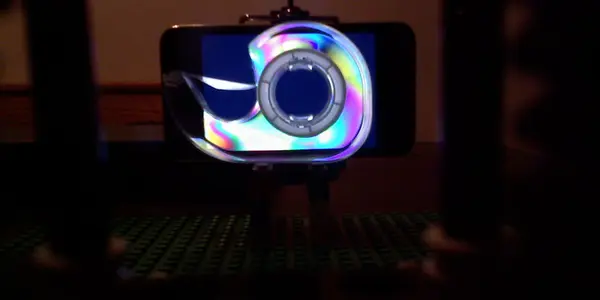
I decided to build a polariscope for my Lego optics lab. On occasion you might need a mechanism to rotate filters such as a polarized filter and a polariscope is a simple and fun way to view the rainbow colors in clear plastic objects such as flatware, tape dispensers, etc.

Lego Optics Lab: Large Lens Holder

Lego Optics Lab: Large Lens Holder

For my Lego Optics Lab I have so far built a beam splitter, and a small lens holder. The beam splitter article got a link on io9 (my name is misspelled) and on Scientific American.

Lego Optics Lab: Small Lens Holder

Lego Optics Lab: Small Lens Holder

In my previous article, I started building a Lego optics lab with a dichroic prism I salvaged from an old computer projector that I took apart (I used the prism to build a beam splitter). I also salvaged several lenses, mirrors, and filters. To continue the Lego Optics Lab project I’ll demonstrate how I built a lens holder for the several small lenses from the projector. My lens holder uses mostly standard Lego parts except for the shock absorber brick.

Lego Optics Lab: Beam Splitter

Lego Optics Lab: Beam Splitter

 I finally took apart a broken computer projector. Some of the optics were burned or broken but I managed to salvage several lenses, mirrors, filters, and a curious little glass cube.  

LaserOscope

LaserOscope

Build a laser oscilloscope using Lego, littleBits, Erector set, and the Kano Computer. In honor of The International Year of Light I’ll demonstrate how use the Kano computer to drive a littleBits motor with an optical coupler, or optocoupler. An optocoupler, according to Wikipedia, "is a component that transfers electrical signals between two isolated circuits by using light." The Kano Computer is one isolated circuit and the littleBits Light Sensor/Motor is the second isolated circuit.

DIY Titration Lab Ware

DIY Titration Lab Ware

You often see demonstrations of titration using an expensive glass burette, but you can build titration lab ware using a disposable serological pipette, a solder sucker bulb, and a ring stand or support stand. For this build I’m using the tripod stand from the Thames and Kosmos Chem C3000 chemistry set.

Titration is the process of determining the unknown concentration of a solution by adding a known amount of a solution with a known concentration.

The Tyndall Effect

The Tyndall Effect

You can use a simple cat toy (laser pointer) to demonstrate the Tyndall effect. “The Tyndall effect, also known as Tyndall scattering,” according to Wikipedia, “is light scattering by particles in a colloid or particles in a fine suspension.” You can use the laser to test three different mixtures: colloids, suspensions, and solutions. I’ll demonstrate Tyndall scattering in a colloid (milk), in a suspension (dirt), and a solution (sugar) with a cat toy (Laser pointer).

Don’t forget to follow me on Twitter @SteveSchuler20.

Parts needed:

Erector Set Magnetic Optical Mount For Laser Pointer

Erector Set Magnetic Optical Mount For Laser Pointer

I’ll demonstrate how to build a simple magnetic optical mount for a cat toy (laser pointer). Though it is simple—that is, there aren’t any fine tuning mechanisms one would find on an optical bench—it is, nonetheless, inexpensive and flexible enough to use for simple optical experiments such as demonstrating the Tyndall effect, .

I used a magnetic chip clip to clamp the laser pointer switch (a press switch) in the on position and attach the laser pointer to the Erector set mount.