




When you read something in a book, do you believe it?
You might say, “Of course not if it’s fiction,” but well-researched historical or science fiction can offer plenty of accurate information, entertainingly packaged. Nonfiction, on the other hand, might seem true by definition—but what about memoirs? Polemics? Even textbooks tend to be outdated at best, if not outright biased.
“We can never be privy to the elusive ‘whole story,’ as it’s ever usurped by legend,” writes Matthew Gavin Frank in Preparing the Ghost, a book which is kind of about giant squid and kind of about the nature of narrative, the existentialism of fact, the reigning subjectivity of our existence. Frank divides the text between obsessively hunting down the precise facts surrounding the first photograph of a giant squid, and gleefully muddying said facts with his own vivid imagination.
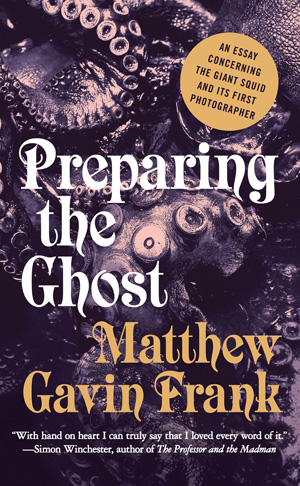
The tantalizing title is explained in the final quarter of the book: “An infant giant squid is called a paralarva, and it’s the size of a cricket. In Latin, para means to make ready, to prepare, and a larva is a ghost, a spectre.”
I’ve spent a bit of time studying paralarvae, and I’m also an amateur classics nut, and these roots didn’t match what I thought I knew. I hied to the American Heritage Dictionary, which told me that larva originally meant demon or ghost, but also came to mean mask. “Larva is therefore an appropriate term for that stage of an insect’s life during which its final form is still hidden or masked, and New Latin larva was thus applied in 1691 by Carolus Linnaeus.”
Para, in addition to being a form of the verb “to prepare,” is also a Latin preposition that has become an English prefix, as in paramilitary. “The prefix ‘para’ is Latin for ‘almost’ or ‘nearly,’” wrote squid scientists Richard Young and Robert Harman when coining the word paralarva in 1988.
Up until then, scientists had been rather liberally applying the word “larvae” to baby squids, a word that many felt should be limited to creatures like caterpillars that undergo metamorphosis, breaking down a baby body and using the parts to construct a nearly unrecognizable adult form. Squid don’t do that.
But neither do fish, and ichthyologists have been writing happily about larval fish with no compunctions for centuries. Although fish cease being larvae when they grow scales, which is a pretty drastic change if not a proper metamorphosis . . . Young and Harman sidestepped this quandary by inventing a new word, a word that eschewed anatomical change for behavioral. “We define paralarva as ‘a cephalopod of the first post-hatching growth stage that is pelagic in near-surface waters during the day and that has a distinctively different mode of life from that of older conspecific individuals.’”
Anyway. I queried Frank about the prepositional para over e-mail, and he responded: “I do know about the 'near' definition, though in discovering that para is also the 3rd singular present of the Latin verb parare (to prepare, or to ward off), I thought that, given the context of the book, ‘Preparing the Ghost’ made sense as a title and governing principle (at least, lyrically-speaking), as we're dealing with an animal that, in its larval state, already holds within it the code that will eventually yield a beast that is larger-than-life, that spans the actual and the mythological; in its larval state, it is already ‘preparing’ to become a thing of mythical proportions, a giant tool in our giant narratives. Given our associative brains (and my love of etymology), I wondered: can we really consider one ‘para’ without considering the other?”
I think this gives you a pretty good idea of both Frank’s writing style and the book’s governing thesis.
Preparing the Ghost creates a deliberately blurry view by seamlessly juxtaposing the actual with the mythological, both in the author's words and in quotations from historical characters. Revered Moses Harvey, first photographer of the giant squid, epitomizes the dual human drive to document fact and to create myth. He loves science, capturing the giant squid for posterity with a flash and a chemical burn, yet freely injects wild speculation into his written accounts of the creature.
In presenting the idea that the giant squid “is the semimissing link between vertebrates and invertebrates,” Frank quotes Harvey: “the glassy internal pen . . . and the calcareous internal ‘bone’ . . . are held to foreshadow the spinal column of higher animals.” This is nonsense; ancestral vertebrates likely evolved from something like a larval tunicate, which has a stiff “notochord” analogous to our spines. Squid “pens” or “bones” are analogous to the shells of snails and clams.
Harvey was a hobby naturalist in the 1800’s; his errors are understandable. But I was puzzled that Frank would present them to the modern reader without editorial comment. I wrote to him, “I couldn't tell whether you thought [the scientific inaccuracies] were true, or if you were happy to be ‘usurped by legend’.”
Frank wrote back, with what I imagine to be maniacal laughter, “Ha! I am happy to be usurped by legend! . . . [These] inconsistencies derive from our very real (and ever-evolving) engagement with the animal over the course of many centuries and via various lenses (science, pseudo-science, religion, literature, etc.). So, yes, of course: some of these are inflamed, and feverish, and delightfully wrong-headed, but all represent our very real relationship with the giant squid over the many years (which has been, in stages, delightfully wrong-headed), and are culled from historical (and sometimes delightfully wrong-headed) sources.”
An author’s note at the beginning of the book reads, “Though I’ve taken imaginative leaps with many scenes in this book, all quotations and historical facts, unless otherwise indicated, are as accurate as possible.” Frank sought to be historically accurate to the entirety of human thought about giant squid, and in so doing he chose not to call out which of these thoughts have held up to scientific inquiry, and which have not.
As a scientist, I can’t deny that this jumbling of (what we now know to be) fact and fiction makes me uncomfortable. But as a writer, I was often moved and charmed by the beauty of Frank’s prose. He writes, in a whimsical one-line deconstruction of neurobiology’s model system, that the giant squid “has the world’s largest nerve axon, or nerve fiber, or cellular jump-rope, the plaything of the dendritic schoolchildren who snort nodes of ranvier between recess and electricity class.”
However, describing the smell of a dead squid on the beach as "sweet, throat-inflaming mustard" went a little too far beyond my own (frequent) experiences of dead squid on the beach. I inquired about his inspiration for these words, and Frank responded:
“It’s always a struggle for me—a holy one—trying to determine to what degree I should signal to a reader that I’m speculating, that I’m imagining, that I’m caught up. Usually, my initial instincts are that I should not overtly signal at all. That context will do its job; that a reader will figure it out. And if it’s muddy in the book—this blurry line between fact and conjecture—that’s because it’s actually muddy. Supposedly factual historical research yields varying—and often conflicting—narratives. Once we impose narrative(s) onto a fact, it ceases to be a hard fact. It softens. It’s shapeable. Like boiling water into which we dissolve sugar teaspoonful-by-teaspoonful, it doesn’t become another thing completely. Until we add that ultimate spoonful which supersaturates the solution, it’s still water, still maintains the integrity of water. It still maintains the shape of the original fact. It’s just sweeter. So, this is a long-winded way of saying that I blame the ‘sweet, throat-inflaming mustard’ description on me getting caught up, and surrendering to an imaginative flight of fancy.”
I’m reminded of a science writers’ debate about literary nonfiction, in which Ann Finkbeiner calls out “the contract with the reader that the fiction writer doesn’t have and the nonfiction writer does, the contract that a beauty-obsessed nonfiction writer can easily slight.”
But the nonfiction she’s concerned with is science writing, a category which doesn't really contain Preparing the Ghost. Could any contract apply to this work, which seems to be a species of creative nonfiction nearly as far removed from just-the-facts reporting as it is from fiction? Frank is neither pure professor nor pure entertainer; he’s an eccentric storyteller who offers you bits of lyrical language to savor while you try to figure out if he believes his own story.





Comments