The Chatter Box

Patrick Lockerby

Patrick Lockerby

Retired engineer, 73 years young. Computer builder and programmer. Linguist specialising in language acquisition and computational linguistics. Interested in every human endeavour except the scrooge theory of accountancy.
RSS Feed
The Icebreaker Yermak

The Icebreaker Yermak

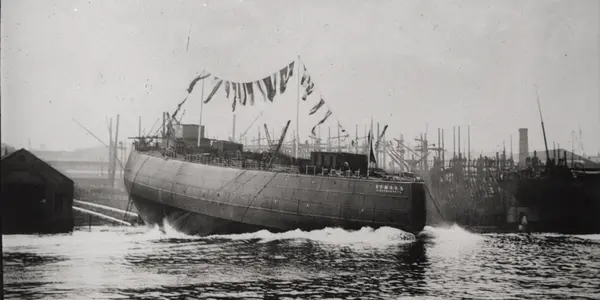
The Icebreaker YermakVice-Admiral S. Makaroff of the Imperial Russian Navy was primarily an oceanographer.   His paper On some Oceanographic Problems, Proceedings of the Royal Society of Edinburgh Vol. XXII, contains, amongst detailed reports of his oceanographic investigations, an explanation of why the icebreaker Yermak* was built.  Quite simply, the ship was intended to promote seaborne commerce where Arctic ice had always been a barrier.  It seems that Makaroff had an idea that perhaps, one day, after much experience had been gained, an icebreaker might just possibly reach the North Pole.

Dethinking The Unpossible

Dethinking The Unpossible

Dethinking The UnpossibleA closed mind is totally incapable of being shown real world facts.  Lead a person with a closed mind step by step through a very logical process; show them a simple experiment in actual progress; show them what every kid learns in science class: what happens?  The closed mind, having seen proof that a thing is real, must employ a strange chain of illogic to show that the proof was not merely impossible but unpossible.  A thing which has just been shown to be possible can only be shown to be unpossible by a reverse logic in which thoughts themselves are shown to be unpossible.  It takes a special thinking process to deconstruct a scientific proof and replace it with diametrically opposed dogma.

Arctic Ice October 2011

Arctic Ice October 2011

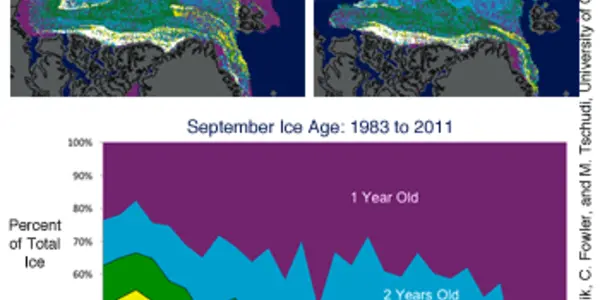
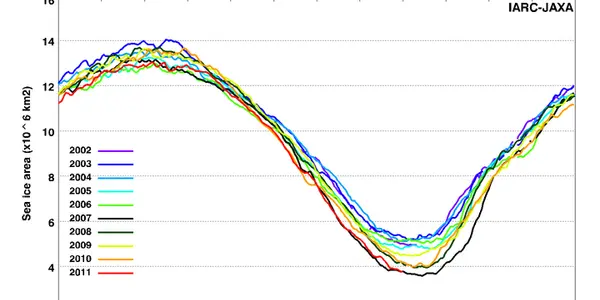
Arctic Ice October 2011Ice extent, as measured down to 15% concentration, was only slightly above 2007 levels at the end of this year's melt season.  The ice is now about as thin as in 2007, or thinner, and the age of remaining ice continues to decline.  [edit: inserted missing clause - bolded.]The summer sea ice melt season has ended in the Arctic. Arctic sea ice extent reached its low for the year, the second lowest in the satellite record, on September 9. The minimum extent was only slightly above 2007, the record low year, even though weather conditions this year were not as conducive to ice loss as in 2007. Both the Northwest Passage and the Northern Sea Route were open for a period during September.

Hard Times For Unscientific Blogging

Hard Times For Unscientific Blogging

Hard Times For Unscientific BloggingPseudo-skeptic claims of Arctic ice recovery have been followed by further losses in the real world.  Evidence of global warming is accumulating to such an extent that the web's unscientific bloggers have to work really hard to find anything to write about.  Times are so hard that Anthony Watts was recently reduced to writing a very lengthy anacoluthon-style dust-speck-spotting article about how Al Gore didn't make a video in one take.  Horror of horrors!  And what are we to conclude from Watts' analysis?  The experiment portrayed is valid!

Laws Of Nature And Natural Justice

Laws Of Nature And Natural Justice

Laws of Nature and Natural JusticeWhat are the 'laws of nature', the natural laws which underly the thing which we perceive as natural justice?Aristotle discussed natural justice in terms of what 'ought to be'.  His view was that if particular rules of procedure are followed then the outcome of a procedure will be just.  There is a great deal of circularity in this form of argument.  Circular arguments and arguments about what 'ought' to be are not scientific arguments.

Arctic Ice September 2011

Arctic Ice September 2011

Arctic Ice September 2011My March 2011 forecasts were quite wide of the mark.  For the first part of the Arctic summer much of the western Arctic saw lower than expected temperatures.  Despite the low temperature start-off, the Arctic is about to see either the lowest ever end of season extent, or the 2nd lowest since 2007.In June, I wrote:Much depends on the Arctic weather, but it looks likely that the September ice minimum will be amongst the three lowest.  If the melt in July and August proceeds as it has done on average over the last decade, then the 2007 record minimum may well be beaten.

The Moon And The Telephone

The Moon And The Telephone

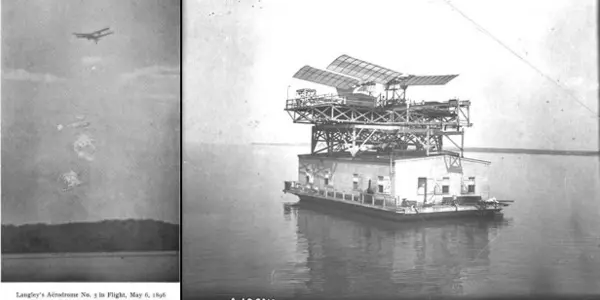
The Moon And The TelephoneIn the history of the discovery of climate change and its causes, there are many pioneers whose work in relevant areas is all but forgotten.  Some of these people are not widely known.  Others are widely known, but their climate-related work tends to lie forgotten in the archives.  For example: Edison is famous as an inventor and Langley is famous as an aviation pioneer, but both men made little-known contributions to our knowledge of heat.

Émilie Du Châtelet - An Essay On Heat - 1739 - #3

Émilie Du Châtelet - An Essay On Heat - 1739 - #3

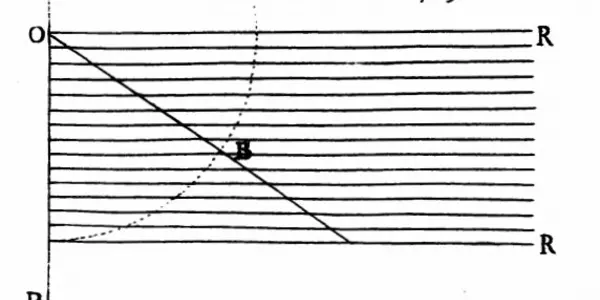
Émilie Du Châtelet - An Essay On Heat - 1739 - #3This is a plain text transcription of Dissertation sur la nature et la propagation du feu - Part 2.For introductory comments, please see Émilie du Châtelet - An Essay On Heat - 1739 - #1.[edit - inserted image at page 55 and corrected a few minor typos.]Transcription of part 2 follows below this page break............................................................................    -  51  -    DU FEU    SECONDE  PARTIE.

Émilie Du Châtelet - An Essay On Heat - 1739 - #2

Émilie Du Châtelet - An Essay On Heat - 1739 - #2

Émilie Du Châtelet - An Essay On Heat - 1739 - #2This is a plain text transcription of Dissertation sur la nature et la propagation du feu.For introductory comments, please see Émilie du Châtelet - An Essay On Heat - 1739 - #1.Transcription of part 1 follows below this page break.................................................................DISSERTATIONSUR LA NATUREETLA PROPAGATIONDU FEU______________________Ignea convexis vis, & sine pondere coeliEmecuit, summâque locum sibi legit in arce.Ovid.______________________

Émilie Du Châtelet - An Essay On Heat - 1739 - #1

Émilie Du Châtelet - An Essay On Heat - 1739 - #1

Émilie du Châtelet - An Essay On Heat - 1739 - #1In 1739 the Paris Academy of Sciences proposed a question: what is fire?  A prize was offered for the best response. Entries were to be presented anonymously. The prize was awarded to Euler.  Voltaire, who had also entered the competition, did not know until the list of entrants was published with the prize award notification that his entry had been in competition against one from his lover.  Although Émilie du Châtelet did not win the prize, her entry was considered so remarkable that, at the request of Réaumur, the Academy decided to have it printed at its own expense.

Other Suns, Other Colors

Other Suns, Other Colors

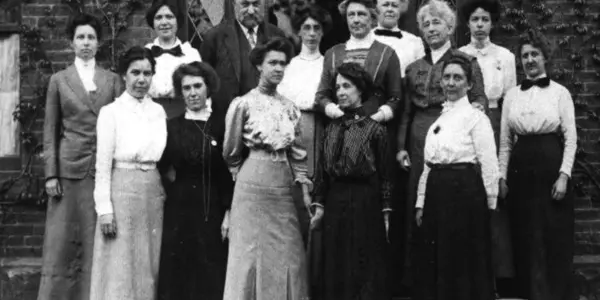
Other Suns, Other Colors    It seems to be a law of universal application that if a task is boring and low paid, it should be given to a woman.  Many of the women given such tasks in the past performed them with such skill and dedication that their work has become part of the strong foundations of modern science.  It seems to me to be a matter of great shame that many people today do not know the names of these women.