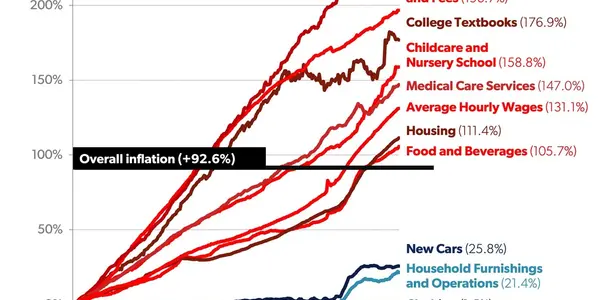
Even With Unlimited Student Loans, College Is Unaffordable
In the 1980s, universities lobbied Congress to make student loans unlimited, so everyone could get a college education and have higher earnings. Now, college is more unaffordable than ever.
At 3 pm on Christmas Eve, millions of radios around the world will be tuned to the Festival of Nine Lessons and Carols from King’s College Chapel in Cambridge in time to hear the pure voice of a single boy chorister singing one of the hardest solos of the church calendar, the first verse of “Once in Royal David’s City”.For many, this signals the start of Christmas. Broadcasts of the Christmas Eve service from King’s began in 1928, but arguably it was under the guidance of Sir David Willcocks, who died in September 2015, aged 95, that the service – and the choir – became household names.
We don’t need to be Christian to celebrate Christmas. That’s been true for a long time. We don’t even need to be religious. Considering the commercialization of the holiday, that might be an advantage.But there is no way to get around the religious iconography. Jesus, nativity scenes and Christian symbols are everywhere. So how do you explain this to your children – or someone else’s children – if you and they are not religious?
Every year, almost without thinking about it, we incorporate certain plant species into our Christmas celebrations. The most obvious is the Christmas tree, linked historically in England to Prince Albert – but its use in British homes goes back to at least 1761 when Charlotte wife of George III put up a tree at the royal court. (It’s probably worth noting here that the first artificial-brush Christmas tree was produced using the same machinery that was originally designed to produce toilet brushes.)
During winter it can sometimes feel that the whole day passes in the blink of an eye and that evening darkness comes far too quickly. While more daylight would be a lovely thing, the early darkness has one big advantage: the stars. On a clear evening you can look up and see far into space. I’ve spent many winter evenings with my children, on our way home from activities, looking for Orion (and other constellations), following its path through the seasons.Stars and space are two of the most popular science topics, whatever the age of the child.
It’s that time of year when we raise a glass to celebrate Christmas, the beginning of holidays, the new year, or simply to join with our friends. Many of us will pay a price, even if it’s “just” in the form of a hangover.
Christmas has become a cultural event, associated with the giving of gifts and lavish meals with friends and family.But the traditional understanding of Christmas is that it’s a Christian celebration of the birth of Jesus.The idea of giving gifts may be traced to the Bible, in which the infant Jesus was presented with gold, frankincense and myrrh by the Three Wise Men, named in apocryphal texts as Caspar, Balthasar and Melchior.This received a boost in the Middle Ages, when Boxing Day, December 26, became a holiday when masters gave their apprentices and other employees “boxes” – that is, gifts.
When we look out at the universe – even with the most powerful of telescopes – we can only see a fraction of the matter we know must be there. In fact, for every gram’s worth of atoms in the universe, there is at least five times more invisible material called “dark matter”. So far scientists have failed to detect it, despite spending decades searching.The reason we know it exists is because of the gravitational pull of galaxy clusters and other phenomena we observe.
The thalidomide tragedy, which resulted in thousands of deaths and disabilities in the late 1950s and early 1960s, changed medicine forever. One of its outcomes was the establishment of more robust mechanisms for the regulation of medicines and medical devices.
More women than men suffer from chronic pain, described as pain that persists for more than six months. In addition, much of this pain remains undiagnosed or untreated.As well as the pain associated with menstruation or the bearing of children, waiting rooms of pain physicians, rheumatologists and gastroenterologists show clear majorities of women.
Earlier this year, I visited the library at the Australian National University with my son so he could borrow some books for an essay on Chinese history. Wandering past shelf after shelf, he asked me, “How does it feel to be writing another book that no-one will read?”It was just another teenage jibe, but in policy terms it was a prescient analysis.In recent weeks there have been reports that the government is considering making publication output much less important in the formulae that allocate research funding to universities.
The clinical potential and ethical difficulty posed by gene-editing technology, which can “find and replace” targeted genes, is seemingly endless.But while public attention is focused on whether we should use it to change the genes of embryos, application of the technology to genetically modify pig tissues and organs for transplantation into humans could potentially have a bigger and more immediate impact on human health.
There have been recent high-profile claims suggesting genetics and neuroscience are set to radically change the way we think about crime and punishment. Author Sam Harris, for example, argues that recent discoveries in neuroscience undermine our notion of free will, while Adrian Raine states there is a “biological basis also to recidivistic violent offending”.But are our notions of blame and responsibility really heading for a revolution?