Yesterday I was delighted to receive in my mailbox another radiation spectrometer for testing, the Radiacode 110. Radiacode produces several radiation counters and spectrometers for personal / monitoring / security / recreational use, but these devices are clearly built by scientists and engineers who care for high-performance measuring instruments - as we will see, although one can have infinite fun with these counters, they are no toys at all.
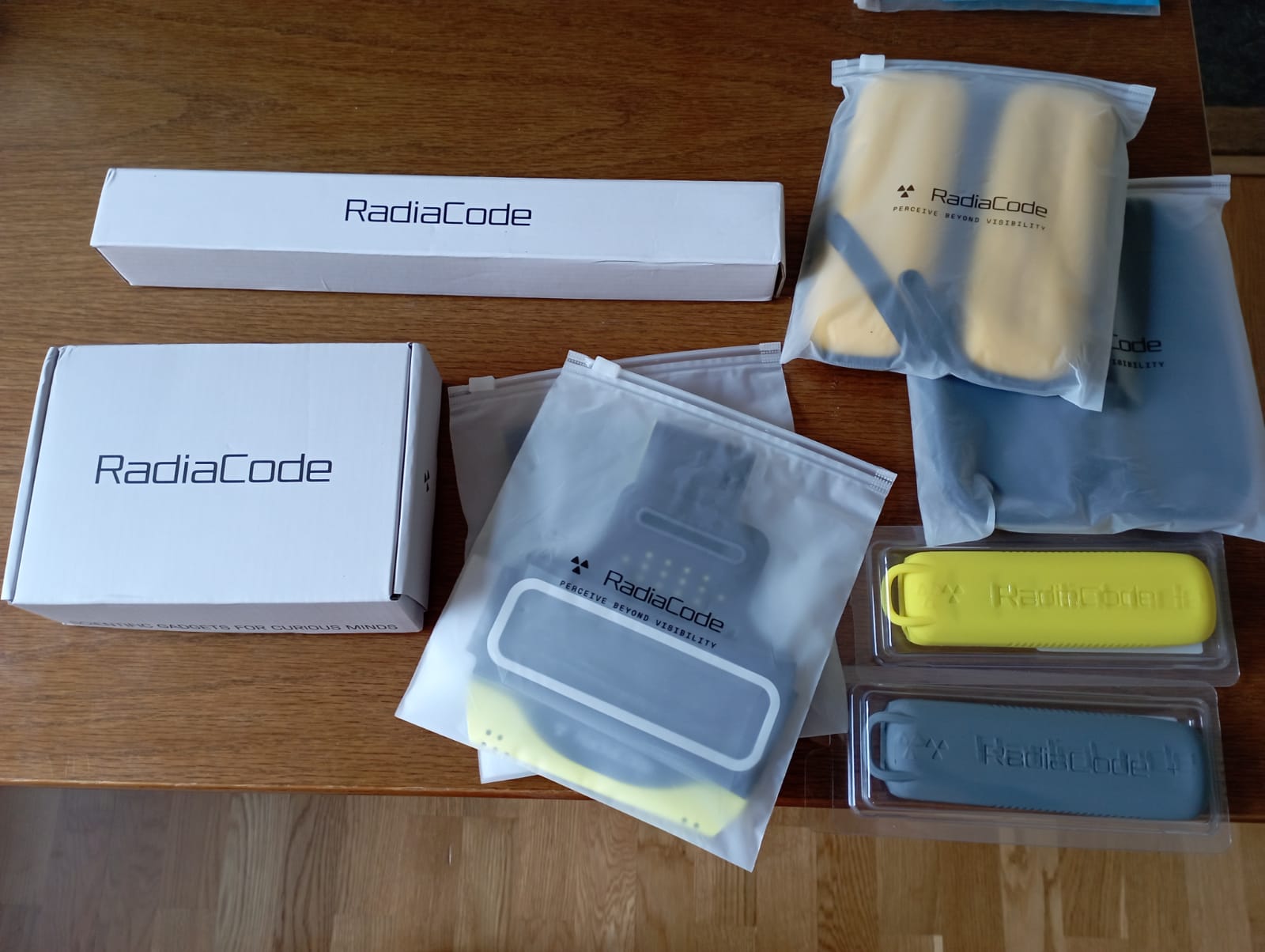
[Above, the contents of the box, including the radiacode proper, and a few other gadgets as I received them.]
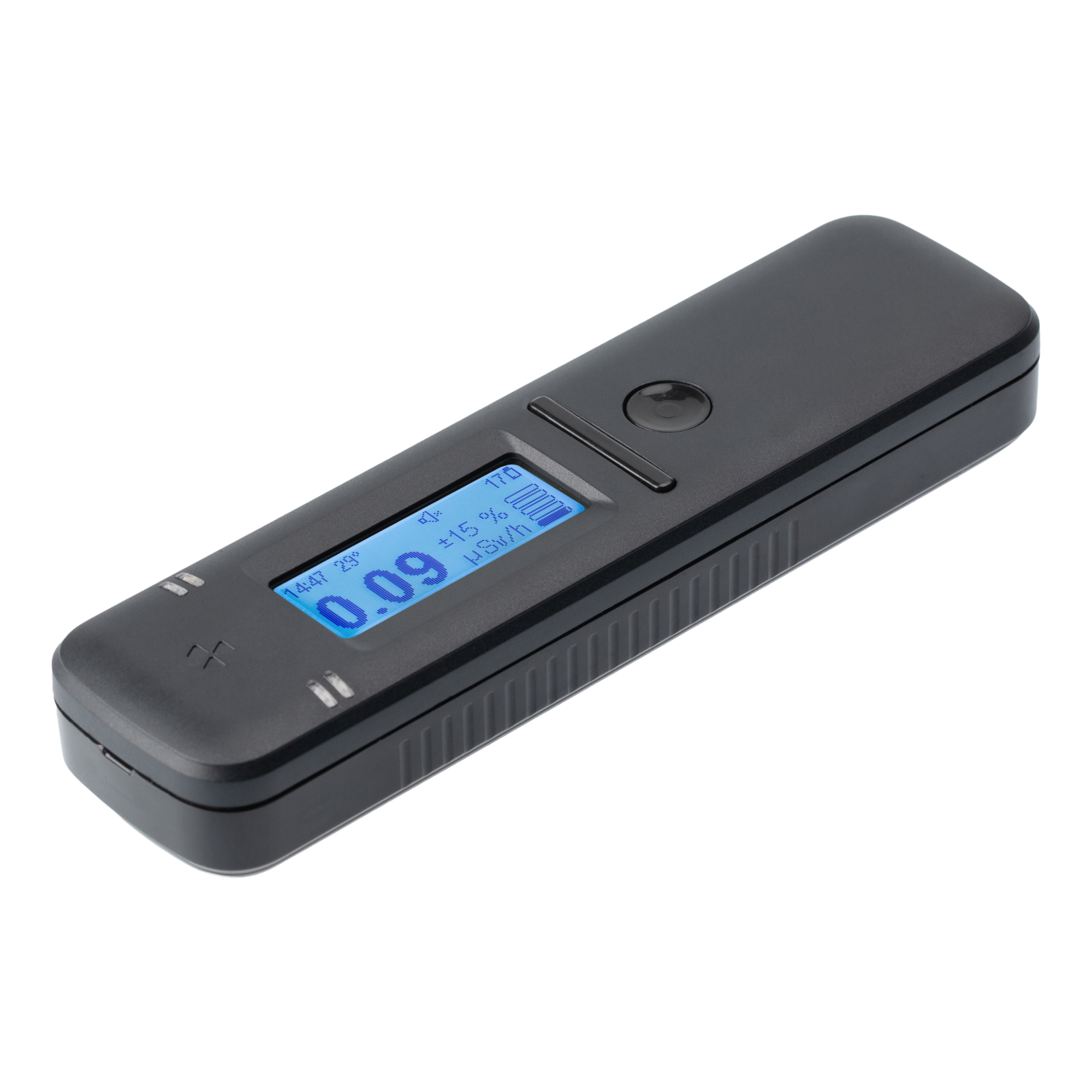
[Above, the Radiacode 110]
In these pages I have in the past reviewed two other Radiacode instruments, the 103 and the Zero. The 110 has the stronger build of the Zero, but packs the harder punch of the 103 - augmented by a threefold increase in sensitivity and a higher battery life. In this and a few other posts I hope I can give the reader some feel of how this instrument works and what one can get from it.
At a price of 399 USD, the 110 may look costly as a gadget to use to impress friends, but the technology you are putting in your pocket is worth every penny spent. The instrument uses a cubic Tellurium-doped Cesium Iodide scintillator to detect x-rays and gamma rays and precisely measure their energy, such that you get real-time measurements of the radiation field you are sitting in, and in addition a clean way to understand what radionuclide is responsible for the radiation you get. Such a feature is absent in other pocket radiation counters, and it is here that the instrument excels.
In this first assay-like piece I will concentrate on the effect of crystal size, the one important feature that makes the 110 the instrument of choice if you are serious about fast detection of radionuclides, or if you just want to understand what more you buy if you unfork the extra 80 USD from the cost of the 103.
Understanding count rates from different sensitive element dimensions
If we consider the different volumes of the sensors in the two instruments - 1x1x1 cm^3 crystal of the 103 versus the 1.4x1.4x1.4 cm^3 crystal of the 110 - we immediately understand why the latter is more sensitive: a larger volume will capture more gamma rays in unit exposure time... But is that really so? Let us consider.
If you had some material that, once crossed by a gamma ray, recorded a hit with 100% efficiency, then it would not be volume what matters for counting rate purposes, but effective area - the cross section under which a stream of rays intercepts the material. For isotropically distributed rays you would then expect roughly the count rate to scale with the square of the dimension, i.e. 1.4x1.4 = 1.96 if we compare R110 to R103 rates. However, a gamma ray has a small probability of being detected in a 1-cm path through our scintillator, and this probability is energy-dependent. Let's leave the energy dependence aside for a second, and consider: if you have two different active materials, that record, say, one every 10 photons crossing them per cm of path length, now what matters is again volume, as the third dimension - the one along the particle path - gets to multiply the flux-related cross section: for a longer longitudinal path in the material corresponds to a higher chance of detection.
So we get to conclude that the number of counts of a detector may scale with the square of the detector dimensions, or with the cube of the dimensions, depending on whether the detector has a close-to-1 probability of seeing a crossing photon, or a close-to-zero probability of detecting it. Now, with a cm-size crystal of CsI detecting photons in the few keV to few MeV range, interestingly what happens is that both things play in. At low energy, most x-rays get to leave a signal in the crystal, and you should then expect that the count rate of the 110 is approximately twice as high as that of the 103 - a cross-section-like scaling effect. At 1000 times higher energies at the other end of the spectrum, each crossing gamma rays has a rather low probability of being seen, so a volume-scaling effect sets in, and the R110 will be counting close to 3 times as much as the 103. What that means is that the 110 is more sensitive when it matters: for dose measurements - which are the meaningful thing we want to have under control - the higher-energy gamma rays count more, and they are measured three times as quickly.
The considerations I made above may leave some readers dubious, so it is a good idea to test them experimentally. I let the 110 and 103 run for 10 hours on my desk last night, which allowed them to collect a significant dataset. You can see the two spectra below. You first immediately notice that the reported dose rate is amazingly close in the two instruments - 97.7 vs 97.5 nSv/h - evidence that they are well calibrated and very precise! However, the reported uncertainty is almost halved in the 110 (0.7% vs 1.2%), indicating a higher sensitivity. And then, watch the reported count rates at the low-energy peak of ambient x-rays, sitting at about 82 keV. The R103 reports a total of 6100 counts at that energy, while the R110 reports 11200 - a factor of 1.94 times larger, so perfectly indicative of a cross-section-like scaling. Instead, if we look at the potassium-40 line sitting in real gamma-ray territory, we see 53 versus 18 counts at peak - an almost embarrassingly close ratio to the volume ratio of the instruments.
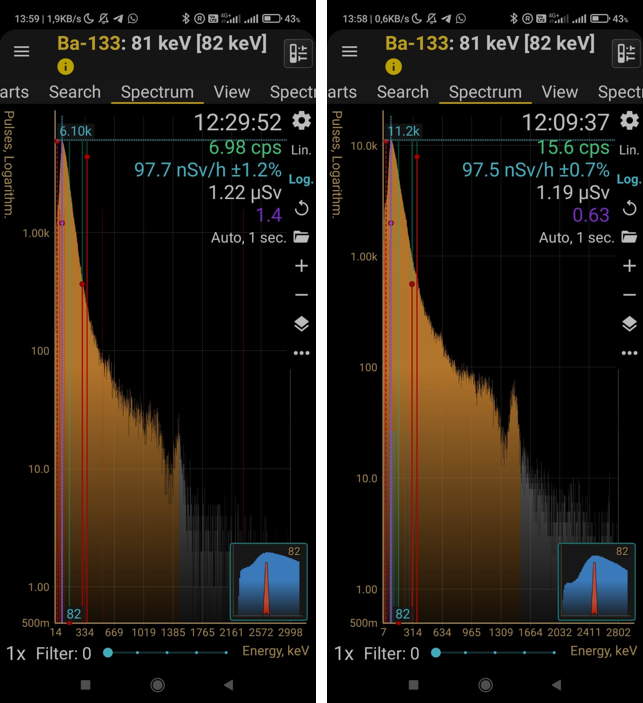
[Above, the full spectrum acquired by the two instruments in 12 hours of integration. The different shape of the curves is noticeable - it indicates the different response of smaller and larger crystals to low vs high energy radiation.]
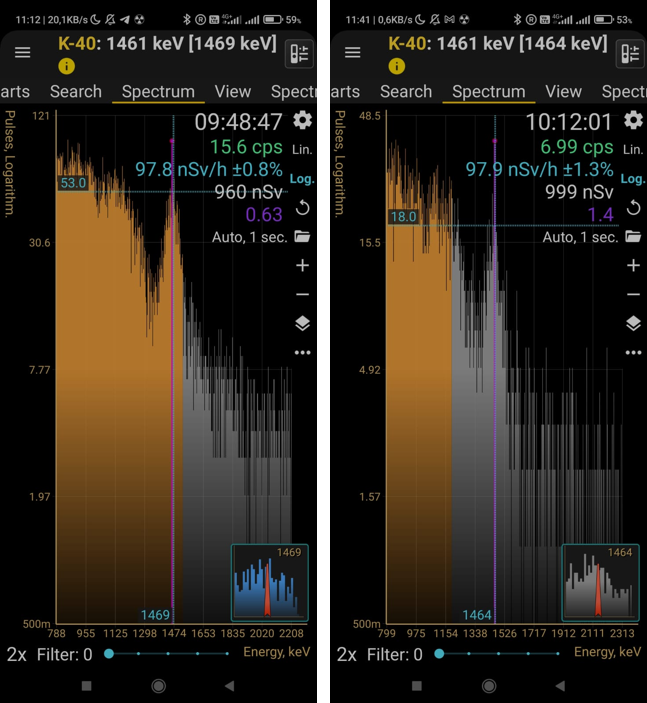
[Above, the potassium-40 line as seen from 10-hour runs in the Radiacode 110 and Radiacode 103. Note how the R103 has the peak in grey, indicating that 10 hours are not sufficient to give it confidence on the distribution yet.]
If the above triggers your curiosity on the real reasons why the detection probability of low-energy and high-energy photons may change in going from 100 keV to above 1 MeV, this makes me happy - but this post is not the place for a tutorial on interaction of radiation with matter; I suggest you open ChatGPT and ask it to tell you about Compton scattering and the related effects you need to understand if you want to get on top of the matter. Compton scattering, incidentally, is a fascinating effect, which was demonstrated in a spectacular experiment in the 1920ies.
For a first test of the new instrument, this satisfies me for today. I will soon have more to say about it in this column.