Around the pink- and red-hued madness of overpriced flowers and heart-shaped everything that is Valentine's Day, even a rocket man1 needs a little love.2 Unfortunately for NASA, the Stardust spacecraft beamed down an unexpected photo of its intended Valentine, the potato-shaped comet Tempel 1. (And no wonder - what girl wants to be photographed if she's told she has the figure of a potato?)Instead of a space age love song3, scientists received the a photo of a tiny speck:
A scientist and journalist by training, I enjoy all things science, especially science-related humor. My column title is a throwback to Jane Austen's famous first line in Pride and Prejudice - I like to explore whether truths really are, or if they …
In medicine, physicians often present case histories or case reports of an interesting situation/patient, along with the outcome (typically a diagnosis) and discussion.1 On controversial cases, medical ethics can be invoked (although not quite to the expertise or depth of Dr. Pigliucci). Here's one I recently came across - whether to perform a kidney transplant for a middle-aged male with multiple co-morbidities - and I thought the implications were really interesting. I'll give you basic relevant facts and context and would like to know what you'd do.Patient: A 50-year-old Caucasian male with Cystic Fibrosis (CF) and Type 1 Diabetes.
"The common curse of mankind - folly and ignorance." - Shakespeare, Troilus and Cressida"And of all plagues with which mankind are cursed, ecclesiastical tyranny's the worst." - Daniel Defoe, Jure divino: a satyr
As if Mondays aren't bad enough, I found out today courtesy of my Wall Street Journal RSS feed that perhaps researchers have been mistaken in their calculations of calorie consumption and weight loss. So all of the little steps I was taking really don't add up to the ultimate diet equation?Well, sort of. The problem is that the formula used for "diet math" - 3,500 calories equals one pound - isn't really all that simple.1 This rule of thumb works well in the short term, WSJ says, and with small shifts in weight, but the rule breaks down over long periods, because as a person's weight changes, so does the body's energy needs.
What does it mean to be human? In the six million years or so since our ancestors first stood upright, we still don't have the perfect answer. In an effort to help the public appreciate our own unique development as human beings and explore the question for themselves, the Smithsonian's National Museum of Natural History opened the David H. Koch Hall of Human Origins.The exhibit hall "offers visitors an immersive, interactive journey through 6 million years of scientific evidence for human origins and the stories of survival and extinction in our family tree during times of dramatic climate instability," the Smithsonian says. I had the fortune to visit the exhibit this weekend; if you're in D.C.1 in the future, I strongly recommend you check it out.
Rocket science, it isn't: eating at restaurants is typically a more caloric experience than if you prepare foods at home.1However, the new health care law has a provision that may help customers make more informed choices about the calorie content of their food. The law requires that any restaurant chain with at least 20 outlets post calorie counts for all the food items they sell. This affects about 200,000 restaurants nationwide, WSJ reports. The general idea is that it could help consumers make decisions that will change their behavior and lead to more healthy eating habits.
The jokes just write themselves, really. But poor sanitation is no laughing matter, especially if you're one of the 2.6 billion people on Earth without access to a toilet. And for pennies on the dollar, a Swedish entrepreneur is hoping to help that 40% of the world's population in more ways than one.
Imagine a child, standing in a school cafeteria. We'll assume that this child has reached or surpassed the age of reason (7 years old, for non-Catholics out there), meaning they can understand their choices and therefore can make the wrong choice along with the right one.In front of this lovely child is a vending machine filled with tempting soda1 and sports drinks and other such calorie-laden, battery-acid-by-another-name, neatly packaged consumables.
Much like the Chicago Bears' defensive lineman William "The Fridge" Perry cleaned out the New England Patriots in Superbowl XX, you really should clean your fridge out more often.In fact, most Americans clean their fridges only once or twice a year, according to the Wall Street Journal. That's registering really high on the vomit-encrusted nastiness scale.1 People don't generally clean fridges until something triggers them to act, such as a spill or a pungent odor. Or, if you're a conscientious renter, when you move into and out of apartments.2
Can a differential equation cure cancer?A fascinating article in Forbes suggests that using mathematics may be able to create drug combinations that are far more effective than the ones now in use.1 "I have a suspicion that we are using almost all the cancer drugs in the wrong way," Larry Norton, Memorial Sloan-Kettering Cancer Center deputy physician-in-chief for breast cancer, says. "For all I know, we may be able to cure cancer with existing agents."2
If the folks behind the Diagnostic and Statistical Manual of Mental Disorders (DSM) were crafty, they would have latched on to the upcoming movie, "The Crazies," for some free publicity.1 Although that's probably not quite the image they want to convey, so maybe it was a shrewd non-move after all. Well played, American Psychiatric Association.
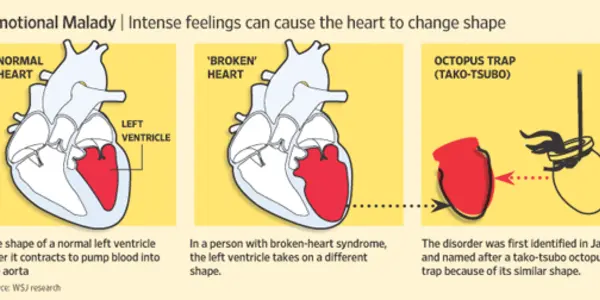
If you feel like you have an achy breaky heart, you may not be imagining things. "Broken hearts" are indeed real, although in the medical community they go by the much less lyrical name of stress (tako-tsubo) cardiomyopathy.A recent article in the Journal of the American College of Cardiology described stress (tako-tsubo) cardiomyopathy as "a rapidly reversible form of acute heart failure reported to be triggered by stressful events and associated with a distinctive left ventricular (LV) contraction pattern." Oooh, romantic. Shakespeare couldn't have written it better.
To get it on or not get it on, that is the question for adolescents and teens. The Bush administration pushed abstinence-only education as the way to go, and anyone daring to discuss safe sex and contraceptives was excoriated. As Bristol Palin can attest, abstinence-only education isn't the slam dunk its proponents claim.Many AOE programs were preachy, moralistic, criticized condom use, and advocated for abstinence until marriage. Unfortunately for children everywhere, these were the programs that were funded. Anyway, word got around more than Paris Hilton and the idea of AOE fell upon hard times.