Around the pink- and red-hued madness of overpriced flowers and heart-shaped everything that is Valentine's Day, even a rocket man1 needs a little love.2 Unfortunately for NASA, the Stardust spacecraft beamed down an unexpected photo of its intended Valentine, the potato-shaped comet Tempel 1. (And no wonder - what girl wants to be photographed if she's told she has the figure of a potato?)Instead of a space age love song3, scientists received the a photo of a tiny speck:
A scientist and journalist by training, I enjoy all things science, especially science-related humor. My column title is a throwback to Jane Austen's famous first line in Pride and Prejudice - I like to explore whether truths really are, or if they …
If the coming Olympic games handed out gold medals for news coverage of medical topics, the coveted podium in a winner-takes-all contest would likely be a lonely place. Not that there aren't worthy contestants, but like figure skating's Michelle Kwan in 1998 and 2002, the hopefuls need a few tweaks before they can triple-axel their way to success.The latest and greatest miracles, break-throughs, and fads are trumpeted in the news, and the newsroom's dwindling coffers combined with a "have to beat the other guys to it" 24-hour news cycle means consumers are often shortchanged.
After Top Gun, the number of fighter pilot recruits exploded. After CSI took over the country, more people went into forensic science. The lesson? Media definitely makes a difference in the level of interest of a topic - An Inconvenient Truth, anyone? - so perhaps getting authentic, real-life science out in front of viewers could inspire a whole new flock of scientists and engineers to fill the growing deficit in our workforce.
The days are getting shorter, and it's dark out when you leave work. If you look out your window at 5 pm and it's dark - I'm not sure how it is on the West Coast, but here on the East Coast this is the case - it can be rather disheartening. Most people sigh and go about their business, but for about 6% of Americans (18 million people), the darkness of the fall and winter months mean depressed mood, increased anxiety, fatigue, increased need for sleep, decreased energy, weight gain, difficulty concentrating, loss of interest and desire to be alone, increased craving for sweets, thoughts of death or suicide - symptoms of Seasonal Affective Disorder.
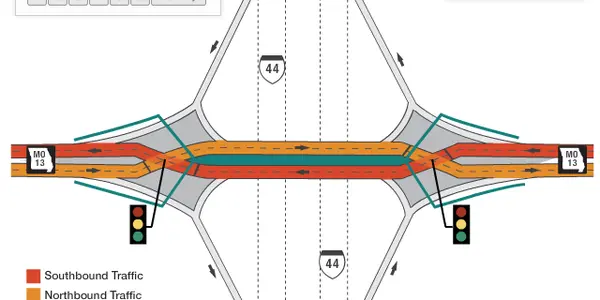
Missouri can proudly claim it is first in the nation - first to test a new "diverging diamond" interchange that improves traffic flow by eliminating problematic left turns. Sound boring? I admit, the story didn't jump out at me at first. But the myriad diagrams with tiny cars moving across the screen got me hooked, and now I hope that the experiment, if successful, spreads across the country. Even Popular Science reported on the action.
The Wall Street Journal published a list of 20 medical advances for which we should be thankful. WSJ says that amid all the bad news about medicine in the media - H1N1, failed miracle drugs, etc, contentious health-care reform issues - it's easy to overlook how much progress has been made in recent years.Without further ado:
During the past few days, news media has inundated the U.S. public with word that for the first time in 20 years, a government task force has changed course in its recommendations for breast cancer screening.On the surface, that doesn't seem like an earth-shattering story. Guidelines are routinely revised and updated based on available evidence. But the new recommendations go against entrenched medical practice and advice, and the firestorm the change caused shows no signs of flickering out, and is pitting two government groups against each other.
Cancer research took a fascinating step forward thanks to recent research by a collaborative group from Boston; a step that, if it pans out, could impact a wide swath of cancer drug development. The research is still in its early stages - mouse models - but the potential implications led to a great deal of media coverage. Just a few examples:
"Scientists have found a way to disarm a protein thought to play a key role in leukaemia and other cancers," from NHS (UK)
The word on the street is that Jesus is pretty t'd off at NASA.1 What mortal sin2 did the space agency allegedly commit? The non-biological reproduction of an RNA component in a laboratory, of course.NASA scientists reproduced uracil in a lab under conditions found in space, according to Astrobiology. Uracil is one of the components of the genetic code that makes up ribonucleic acid (RNA); RNA is mainly known for its role in protein synthesis. In other words, NASA was able to create a building block of life in the lab.
*Laws that should be formally on the books but sadly are only known in the collective Geek conscious.Matt Blum of Wired writes, "There are many, many laws having nothing to do with government, that are useful to know because they tell you something about how the universe works. There are Newton’s laws of motion, the laws of thermodynamics, Boyle’s law, Heisenberg’s uncertainty principle, among dozens more."
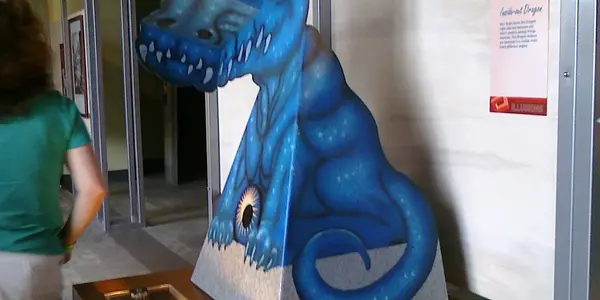
Art is many things, but not often enough is it scientific. Fear not, art/science lovers, for Sir Isaac's Loft in the Franklin Institute is here to save the day!I began describing the Loft in my previous article, including impossible human tricks to try at work or at the bar and amaze your friends! But there's so much more...read on.IllusionsThe eyes of the "inside out dragon" followed me no matter where I walked, which would have been creepy, but he was a cute little blue dragon. Since we aren't used to seeing things inverted, our brains turn the dragon right side out, and it looks "normal."
Science and art aren't mutually exclusive. You can demonstrate scientific concepts artistically, and sometimes even physics can be phun. Take, for example, Sir Isaac's Loft, a feature in the Franklin Institute that "blends art and science into a 3,600 square feet display of aesthetic innovation." And with awesome exhibit names like the "Bowling Ball of Doom," how can you go wrong?
Mind over matter. Think happy thoughts. Don't worry be happy. Accentuate the positive.Is happiness really that simple?Sure, it's easy to say, "Think positively." But to actually do it? Not so much.1 We spend bazillions of dollars trying to buy happiness and yet somehow we're not satisfied.2 I don't have any money left to spend, so my options are (a) a life of misery and despair, or (b) find a cheaper alternative.The Coldplay Proof, and searching the InterGoogle