Around the pink- and red-hued madness of overpriced flowers and heart-shaped everything that is Valentine's Day, even a rocket man1 needs a little love.2 Unfortunately for NASA, the Stardust spacecraft beamed down an unexpected photo of its intended Valentine, the potato-shaped comet Tempel 1. (And no wonder - what girl wants to be photographed if she's told she has the figure of a potato?)Instead of a space age love song3, scientists received the a photo of a tiny speck:
A scientist and journalist by training, I enjoy all things science, especially science-related humor. My column title is a throwback to Jane Austen's famous first line in Pride and Prejudice - I like to explore whether truths really are, or if they …
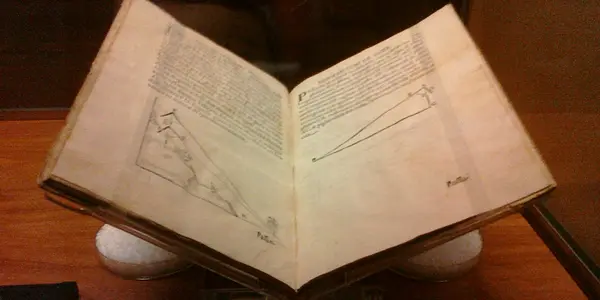
Galileo merged the fields of cosmology and astronomy, thanks to his telescope, which gave scientists a more accurate way to observe and define the heavens. His telescope helped shift authority in the observation of nature from men to instruments. From backyard astronomers to the Hubble Telescope to the Vatican Observatory, Galileo’s impact on astronomy is both formative and lasting.
Galileo's contributions to science in general, and optics and astronomy in particular, were so monumental that over 350 years later we still discuss them in introductory physics courses.
Galileo Galilei wasn't just an Italian physicist, mathematician, astronomer, philosopher and heresy suspect (not to mention father of modern observational astronomy, modern physics, science, and modern science, that last one he was named by both Hawking and Einstein). He was also a friend of the Medici, the political Italian dynasty whose patronage of scientists and artists led to the Renaissance.1
Where does evolution leave God? This question has been debated for over a century, and it likely isn't going anywhere any time soon. Some may feel, myself included, that the glut of fighting among the camps should just be put to rest, like the new song on the radio that is played every five minutes. One is about science, one is about religion. Over and done.Occasionally I'll come across an article that still sparks my interest (like the many on Scientific Blogging, of course). One such article was an essay featured in the Wall Street Journal, in the vein of point/counter-point, but neither writer knew what the other was going to say.1
A number of stories caught my eye today and I wanted to write about each of them, but did not want to overwhelm the blog list like someone else who shall remain nameless (but happens to play rugby) does on occasion. The first unifying thread I noticed was that all deal with the letter D. So, like Kathy Griffin, the D-list it is.Drug dispensers: Vending machines in prison - Pepsi, Coke ... Viagra?Really, what could go wrong in this scenario? Images of the Fonz whacking the jukebox played in my mind, but replace the Fonz with a convict and the jukebox with a vending machine dispensing prescription drugs...
Sometimes people are attracted to strange things. I still have trouble figuring out how people procreated in the 1970s and 80s - the hair, the moustaches, boys wearing those teeny short shorts - yuck. Apparently, butterflies are no different. Or so says a retired zoologist in a surprising PNAS article.
What do you do if you're stuck between a banana and a hard place?The slippery slope of paying extortionists tripped up Chiquita in the late 1990s and early 2000s, much like Donald below...But two years after the company agreed to pay a $25 million fine for paying violent paramilitaries in Colombia to protect its employees there, Chiquita is still dealing with the fallout. If you were the CEO of Chiquita, what would you have done?A Boatload of Baddies
There are no words to explain this. Perhaps British folk like Patrick can explain.Cheese rolling is a sport, according to ESPN's E:60. It's just like the running of the bulls in Pamplona, except it's in England, and you're chasing cheese instead of bulls chasing you...ok, so it's not really like running of the bulls, but makes about the same amount of sense.
As a science nerd, and as a science nerd with friends who are science teachers, I am always on the lookout for new and interesting ways to expose others to the beauty and wonder that is science and broaden their horizons in a concise, meaningful way. I was bested today by aforementioned science teacher extraordinaire (and best friend) Maggie Nufer, who sent me a site that fulfills all criteria, and as a bonus is aesthetically pleasing (the site, I mean, but Maggie is too).
Q: Which phrase, more than any other, surged in utilzation in the news during the final months of the U.S. presidential campaign?A: Obama's "lipstick on a pig" quipFor the first time, the Web has been used to track and attempt to measure the news cycle, the process by which information becomes news, competes for attention and fades, says the NY Times.
The first two articles of this series have covered a brief overview of evolutionary psychology and the difficulty in defining and measuring intelligence. In the first article, I covered that we can measure what people prefer and value, but we don’t know the "why" behind those preferences and values. An evolutionary psychologist from the London School of Economics, Satoshi Kanazawa, wrote a paper on the origin of individual values and preferences that suggests values are tied to IQ, and you can theoretically predict the values of a nation based on its average intelligence.
Q. Who said this? "I have only two passions - space exploration and hip-hop."A. Buzz Aldrin, space exploration pioneer, on Apollo 11, second person to walk on the moon, 79-year-old white dude.I thought this was a joke when I first saw the posting on Wired, but it's real - Buzz recorded a rap song, "The Rocket Experience," with help from Snoop Dogg, Quincy Jones, Soulja Boy and Talib Kweli (who I didn't know but according to Wikipedia is "one of the best-known and critically, if not commercially, successful rappers in alternative hip-hop).