Genomicron

T Ryan Gregory

T Ryan Gregory

I am an evolutionary biologist specializing in genome size evolution at the University of Guelph in Guelph, Ontario, Canada. Be sure to visit Evolver Zone. Subscribe to this column: Genomicron
RSS Feed
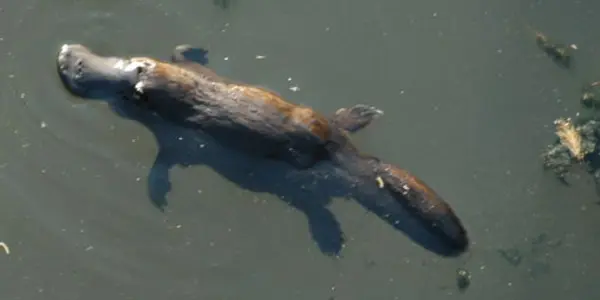
Platypus And The Problem With Primitive

Platypus And The Problem With Primitive

The concept of "primitive" is one that is very often misunderstood.Properly defined, "primitive" means "more like a particular ancestor", refers only to individual characteristics (not whole species or lineages), and is contrasted with "derived" (not "advanced" or "more evolved").I have covered this and other misunderstandings of evolutionary concepts in various articles and I try to clarify these in my courses. But the intuitive interpretation in which one species is deemed more primitive than another is very hard to shake, including in the scientific literature.An example:

Primitive frogs and phylogenetic fallacies

Primitive frogs and phylogenetic fallacies

As I have explained in various blog posts and in this paper, it is a fallacy to assume that any one character found in a so-called "primitive" species alive today was also found in the ancestral species. All living species are modern species, and "primitive" vs. "derived" refers to characters, not whole species.Anyway, New Scientist seems to have fallen for this in their interpretation of a recent paper.Bellyflopping frogs shed light on evolution

Mattick On Transposable Element Function

Mattick On Transposable Element Function

John Mattick, University of Queensland, is one of the leading proponents of the idea that much -- perhaps most -- of the human genome is functional. He has been making claims along these lines for at least 15 years, but seems to always present it as a new idea. Readers of this blog may also remember the Dog's Ass Plot included in one of his publications. 

Does Junk DNA Protect Against Mutation?

Does Junk DNA Protect Against Mutation?

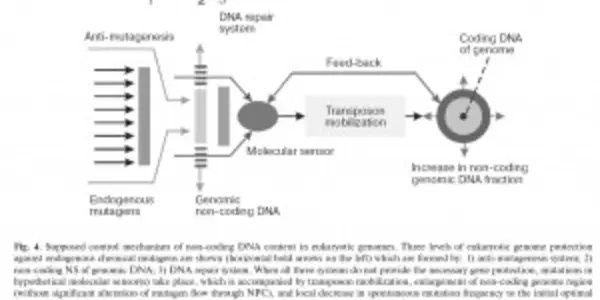
One of the most common hypotheses that I hear with regard to possible non-coding DNA function is that it serves to protect genes against mutation. Junk DNA, according to this proposal, is there to provide a defensive shield against mutagens (usually this includes UV, ionizing radiation, chemical mutagens, viruses, and/or oxygen radicals). I am very skeptical of this explanation, but I am willing to take it seriously if it is studied seriously. In fact, one of my current graduate students first came to talk with me when he was an undergraduate and asked me about this possible function.

Evolution And Art

Evolution And Art

From Oct. 9-30, the University of Guelph and Ed Video are hosting a special art exhibit entitled "This View of Life: Evolutionary Art for the Year of Darwin". It was organized by professors in four departments: Integrative Biology, Philosophy, History, and English and Theatre Studies, and was curated by Scott McGovern of Ed Video. The exhibit features art by 10 artists, all inspired by the themes of evolution, Darwin, and biodiversity.The Gregory Lab contributed some installations as well, which are shown in this brief clip from just before the opening reception on Oct. 16 (about 200 people attended the event).

Omnigenomics

Omnigenomics

Sometimes it is helpful to have a catchy word to describe one's type of research. I think that's why "omics" words are so popular -- they encapsulate a complex combination of approaches (usually something + genomics, or something-more-than-genomics) in a memorable way that immediately conveys the gist of the field."Metagenomics" is a good example -- it's the study of a larger assemblage of genomes than just one, usually from an environmental sample of microbes. "Proteiomics" is another, or "transcriptomics". Of course, this can get out of hand (see here).

Does Evolutionary Biology Make Predictions?

Does Evolutionary Biology Make Predictions?

A commenter on a previous post seems to have objected to the claim that evolutionary science makes predictions.gimme 5 examples of predictions, i mean real predictions: not fit the model hogwash MarilynHere's a list that I put together in around 10 minutes.1) That a transitional fossil linking fishes and tetrapods would be found in rocks of a specific age (from the Devonian) and formed in freshwater environments. CONFIRMED.

Are We Descended From Monkeys?

Are We Descended From Monkeys?

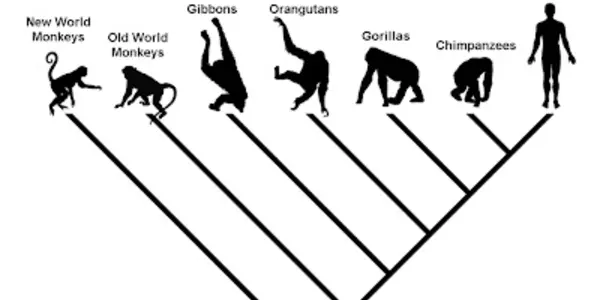
Today I gave my lecture on mammal diversity and evolution in the 4th year vertebrate course. We have been talking a fair bit about paraphyletic groups, common vs. scientific names, and so on. Within this context, we explored the issue of whether we're "descended from monkeys", by taking a look at a phylogeny of relevant primates:

Breaking News: Evidence For Evolution Found!

Breaking News: Evidence For Evolution Found!

One of Doug Futuyma's great quotes is this one:"...no biologist today would think of publishing a paper on ‘new evidence for evolution’... it simply hasn’t been an issue in scientific circles for more than a century." - Futuyma, 1998 Evolution Biology, 3rd editionPress officers are a different story. Here's one from the University of California, Riverside:Molecular decay of enamel-specific gene in toothless mammals supports theory of evolution

Small genomes in pterosaurs too.

Small genomes in pterosaurs too.

My colleagues Chris Organ and Andrew Shedlock, who provided evidence that theropod dinosaurs already had (somewhat) reduced genome sizes prior to the evolution of birds (Organ et al. 2007) have followed up their study by estimating the genome sizes of several species of pterosaurs.Pterosaurs were the first vertebrates to evolve powered flight, having taken to the air 70 million years before birds and 150 million years prior to bats. Interestingly (though perhaps not surprisingly at this point), they seem to have possessed reduced genome sizes, and these downsizings of DNA amount began before flight arose.

Evolution: Education and Outreach special issue - eye evolution

Evolution: Education and Outreach special issue - eye evolution

I was planning to wait until the issue was actually in print, or at least until all the articles were available in preprint, but there is already some buzz starting so here it is. The upcoming issue of Evolution: Education and Outreach, of which I was editor, is a special issue dedicated to eye evolution. The table of contents:
Evolution: Education and OutreachVolume 1 Issue 4The evolution of eyesEdited by T. Ryan Gregory
Editorial