Understanding which brain circuits respond to weight loss medications and how they behave could lead to better weight loss with fewer side effects. A new study (in mice, so only EXPLORATORY) found that stimulating the protein ‘switch’ known as the glucagon-like peptide 1 receptor (GLP-1R) switch in the brainstem (at the base of the brain above the spinal cord, linked to appetite and nausea) suppresses appetite and the same effect occurs after blocking the switch in the hypothalamus.
Drugs such as such as Wegovy and Ozempic stimulate GLP-1R while others act on both it and the glucose-dependent insulinotropic polypeptide receptor (GIPR). Drugs like Mounjaro and Zepbound stimulate GIPR while those like MariTide (currently in phase 3 clinical trials) combine GIPR antagonism with GLP-1 receptor agonism blocking it.
Some work by blocking, some work by stimulating, but they all work, and that's a science puzzle.
For this study, they genetically engineered mice to remove GIPR from different parts of the brain and compare the effects. The group without GIPR in the brainstem got various combinations of a GIPR agonist (activating the receptor), a GIPR antagonist (blocking the receptor) and a GLP-1 drug. They monitored brain activity, calories, glucose control, fat mass, and weight. The second group lacked GIPR in the hypothalamus, linked to appetite suppression and weight. Acontrol group were unmodified mice.
By comparing the three groups, they found that GIPR agonists act on the brainstem to suppress appetite and reduce weight. while GIPR antagonists acted on this receptor in the hypothalamus, where they released a ‘brake’ that usually limits the brainstem’s ability to respond to signals telling us we are full.
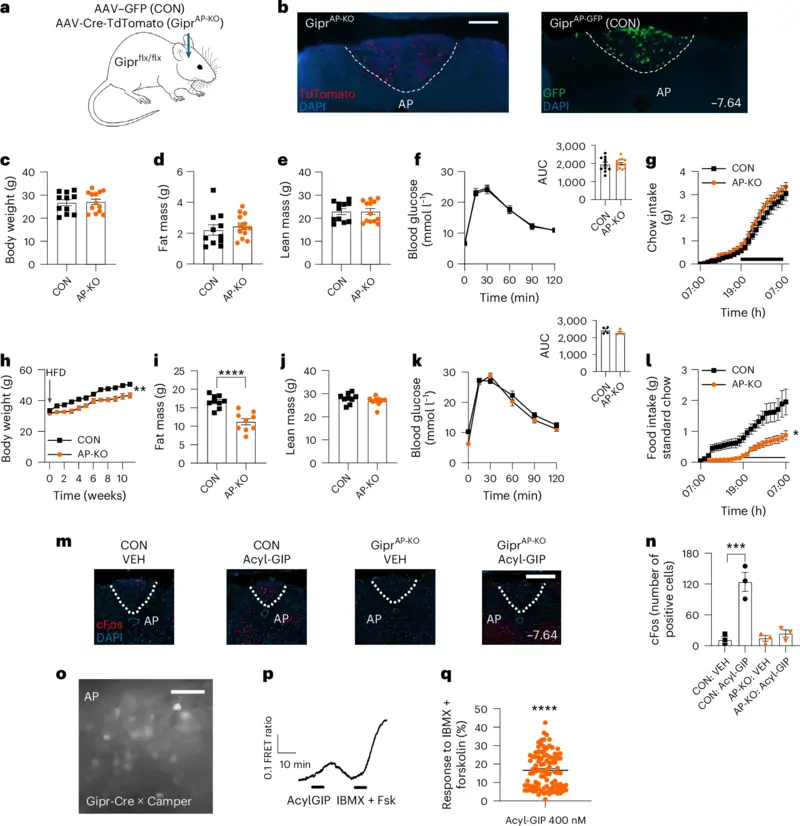
Schematic showing the targeting of AAV–GFP (CON, GiprAP-GFP) or AAV-Cre-TdTomato (GiprAP-KO) to the AP of Giprfx/fx mice. b, Immunohistochemistry confirming targeting of AAV-Cre (example of n = 10) and AAV–GFP (CON) (example of n = 10) (scale bar, 100 µm). Additional examples are shown in Supplementary Fig. 1. c–g, Metabolic parameters of lean mice on standard chow: body weight (c), fat mass (d), lean mass (e), IPGTT with AUC (f) and food intake in metabolic cages (g) (CON n = 11, GiprAP-KO n = 13 per group). h–l, Metabolic parameters of DIO mice on 45% HFD: body weight (h), fat mass (i), lean mass (j) (n = 9 per group for h–i), IPGTT with AUC (n = 4 per group) (k) and HFD intake in metabolic cages (l) (DIO male mice, CON n = 5, GiprAP-KO n = 4). m,n, Representative cFos images of the AP of CON and GiprAP-KO animals receiving VEH or acyl-GIP (100 nmol kg−1; scale bar, 100 µm) (m) and accompanying quantification (n) (n = 3 mice per group; additional examples are shown in Supplementary Fig. 2). o–q, cAMP imaging in ex vivo brain slices: representative image of fluorescence of the AP from Gipr-Cre × CAMPER mice (scale bar, 30 µm) (o), representative trace of cAMP-level changes monitored as FRET ratio YFP/CFP, on perfusion with acyl-GIP and IBMX-forskolin, as indicated by the bars (p) and percentage FRET response to acyl-GIP relative to IBMX-forskolin treatment (n = 101 cells from four animals monitored in nine slices) (q). Data were analysed by: two-tailed Student’s (unpaired) t-test (c–f and i–k), Welch’s test on final weight (h), Mann–Whitney test on final cumulative intake (i), one-way ANOVA with Tukey’s multiple comparisons test (n) and two-tailed one-sample t-test (q). Data are mean ± s.e.m.; *P < 0.05, **P < 0.01, ***P < 0.001, ****P < 0.0001. CON, control; DAPI, 4,6-diamidino-2-phenylindole.
Blocking GIPR also boosted the effect of emerging new drugs targeting the amylin receptor, suggesting that GIPR antagonists could potentially be used to strengthen several types of anti-obesity medicines, which explains why MariTide is effective.
If the results ever apply to humans, it could lead to better medicines with fewer side effects.
Citation: Jo Edward Lewis, Mireia Montaner, Danae Nuzzaci, Paula-Peace James-Okoro, Norio Harada, Nobuya Inagaki, W. Scott Dodson, Patrick J. Knerr, Jonathan D. Douros, Fiona Mary Gribble & Frank Reimann, 'Distinct brain regions mediate regulation of food intake in response to GIPR agonism or antagonism'. Nat Metab (2026). DOI:10.1038/s42255-026-01575-z