There is ongoing concern about species extinction in modern times but we have no real idea how many species there are right now, and 99.999997 percent of species that have gone extinct we can't identify.
Even in one species, humans, there are ghosts we know nothing about. They only haunt our DNA.
A new study of archaic DNA identified regions we inherited as a result of long-ago interbreeding among modern humans and at least four other archaic human relatives. Including two unknown biological ancestors.
It's assumed that Modern Humans bred Neanderthals and Denisovans and any other ancient hominins available so they created a new technique, TRACE (TRacking Archaic Contributions via ARG Estimation), which utilized hundreds of genomes of modern-day humans to look for ancient genealogical relationships.
One is a ghost ancestor that interbred with modern humans in Africa over 50,000 years ago, and their genes comprise around 1% of the genomes of modern humans, comparable to the amount of Neanderthal DNA we have. The ghost ancestor split off from the modern human lineage around the same time that Neanderthals and Denisovans did - around 800,000 years ago. The other is a super-archaic ancestor, a 1.8 million-year-old hominin lineage that interbred with Denisovans in Eurasia, and those then interbred with Homo sapiens.
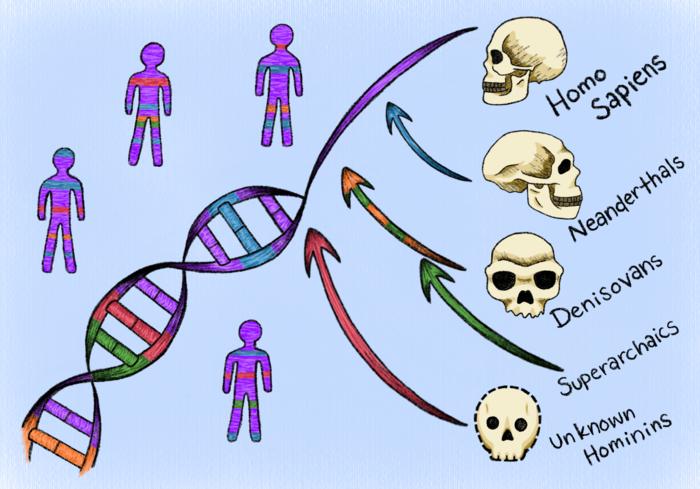
The ghost in our DNA machine. Credit: Meaghan Marohn
First author and U.C. Berkeley graduate student Yulin Zhang says, “We were actually able to find and map genomic locations in modern humans that are from this ghost lineage and show that this ghost ancestry is in all modern humans, not only in Africans.”
The new findings affirm that early modern humans lived with various related hominin groups in Africa and Eurasia and were still close enough genetically to interbreed with them.
It's unknown who the ghost and super-archaic ancestors were but the divergence time overlaps with the existence of Middle Pleistocene Homo groups in Africa 800,000 years ago and Homo erectus in Eurasia 1.8 million years ago, respectively.
The team hopes to detect more faint signals of additional lineages in human DNA as the genome databases become more diverse and include a broader variety. Protein sequences from Homo erectus fossils could also help identify who the super-archaic ancestor was.
Citation: Yulin Zhang, Arjun Biddanda, Sarah A. Johnson, Colm O’Dushlaine, and Priya Moorjani, Recovering signatures of archaic hominin introgression using ancestral recombination graphs, Science, eaef8874 DOI:10.1126/science.aef8874