Asteroid (44) Nysa, discovered in 1857 by astronomer Hermann Goldschmidt, has gotten a lot of study in the last 170 years but a recent analysis of data reveals it has its own moon.
The new data came via the SHARK-VIS instrument on the Large Binocular Telescope, the last large telescope built in the United States after a crush of lawsuits by environmental groups, and the SPHERE/ZIMPOL instrument on the Very Large Telescope in Chile, where clean, white-collar astronomy jobs are now created. They combined the adaptive optics images with extensive photometric observations from observatories around the world plus photometric observations from observatories around the world to create a detailed three-dimensional model of Nysa.
It's not spacecraft-quality but it revealed multiple large surface features, including two prominent valleys that wrap around the asteroid's circumference, evoking neck-like connections between separate lobes.
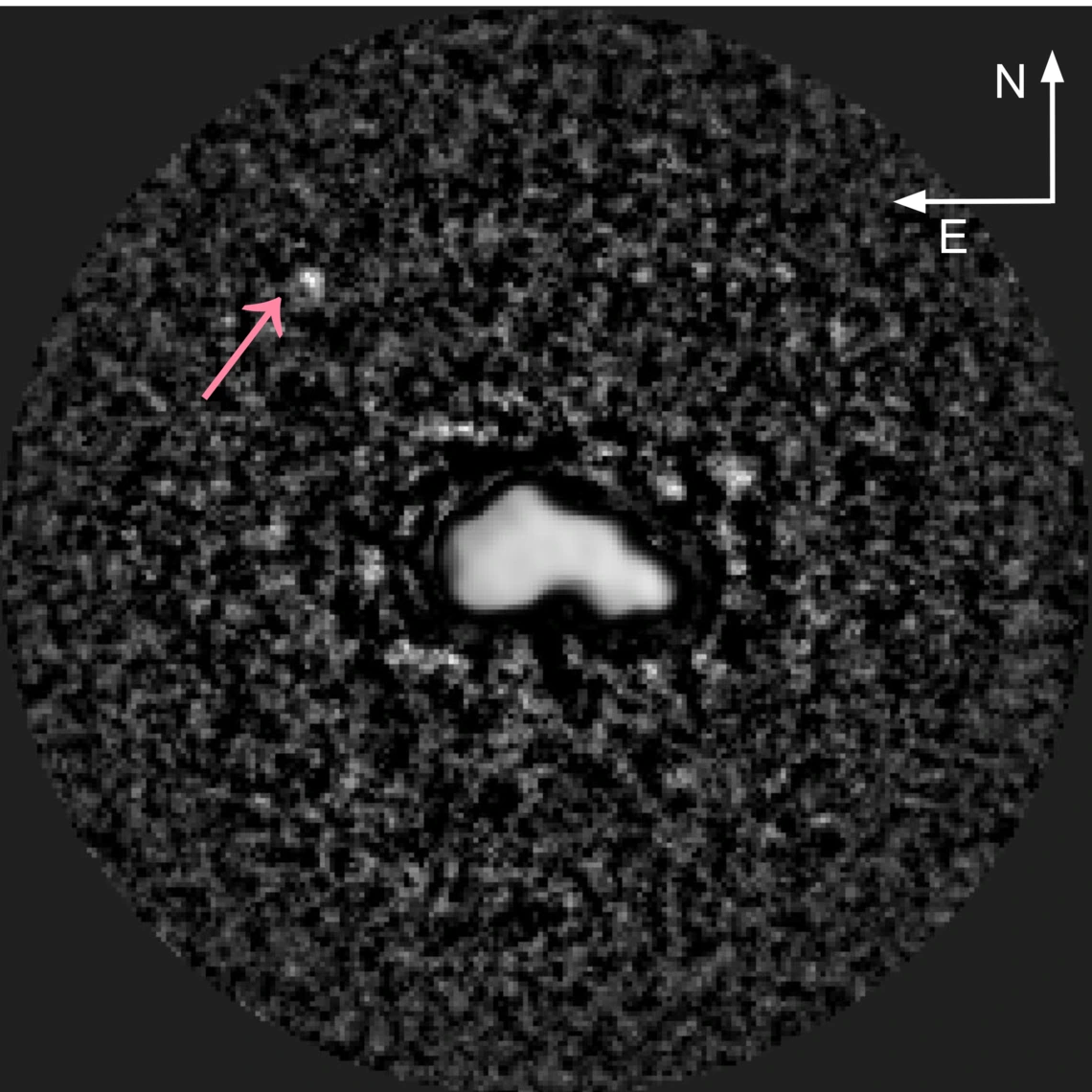
The tiny moon S/2026 (44) 1, marked with a pink arrow, around asteroid (44) Nysa. Also visible are the what the authors mean by three connected lobes.
“The images reveal a remarkably unusual object," stated lead author Kate Minker of Lowell Observatory. "The most likely explanation is that Nysa is either a contact trinary, consisting of three connected components, or an extremely irregular coherent body unlike anything we've previously observed."
The previously unknown moon, designated S/2026 (44) 1, has been independently identified during two separate campaigns using high-contrast imaging to distinguish it from the brightness of the primary asteroid. It is about a half-mile in diameter and orbits at least 100 miles from the 47-mile-diameter asteroid.
Speculation is that the asteroid (44) Nysamay have formed through low-velocity reaccumulation of remnants torn away during a collision before it reached its current location in the asteroid belt. Or Nysa could itself have been torn off from a larger parent body.
E-type asteroids like this could also reveal details about the enstatite-rich inner solar system, when planetesimals and protoplanets competed for dominance.
Citation: Kate Minker, Anthony Berdeu, Gianluca Li Causi, Josef Hanuš, Michaël Marsset, Al Conrad, Fernando Pedichini, Simone Antoniucci, Piero Vaccari, Nick Moskovitz, Benoit Carry, Tom Polakis, Marin Ferrais, Emmanuël Jehin, Roberto Bonamico, Rhiannon Hicks, Daejhanae Smith, M. Amine Miftah, Ester Marini, Unmasking (44) Nysa: Evidence for a trilobate structure, arXiv:2607.25786 [astro-ph.EP]