A longitudinal study of Black, Mixed, Asian, and Indigenous women determined that lower levels of education and other social inequality keeps them from exercising as much as white people.
The World Health Organization recommends that adults engage in 150 to 300 minutes of moderate-intensity exercise but the latest Surveillance System for Risk and Protective Factors for Chronic Diseases by Telephone Survey (VIGITEL) by the Brazilian government found that only 42.3 percent of adults engaged in at least 150 minutes of moderate physical activity per week in 2024.
Obesity is linked to 5,000,000 deaths annually so the authors set out to see what limits exercise/sports participation. The authors tracked 978 participants from 2014 to 2024, collecting data in 2014/15, 2020/21, and 2023/24.
They created a metric of intersectional social identities - social characteristics that contribute to or limit opportunities and experiences - and found that exercise isn't determined by individual choice. Environmental, structural, and social factors are key factors and that exercise is a privilege of the most socially advantaged groups - white men.
The team used the long version of the International Physical Activity Questionnaire (IPAQ) and a Multiple Jeopardy Index to gather sex, race/skin color, and educational attainment. Scores ranged from 0 (least vulnerable) to 4 (most vulnerable).
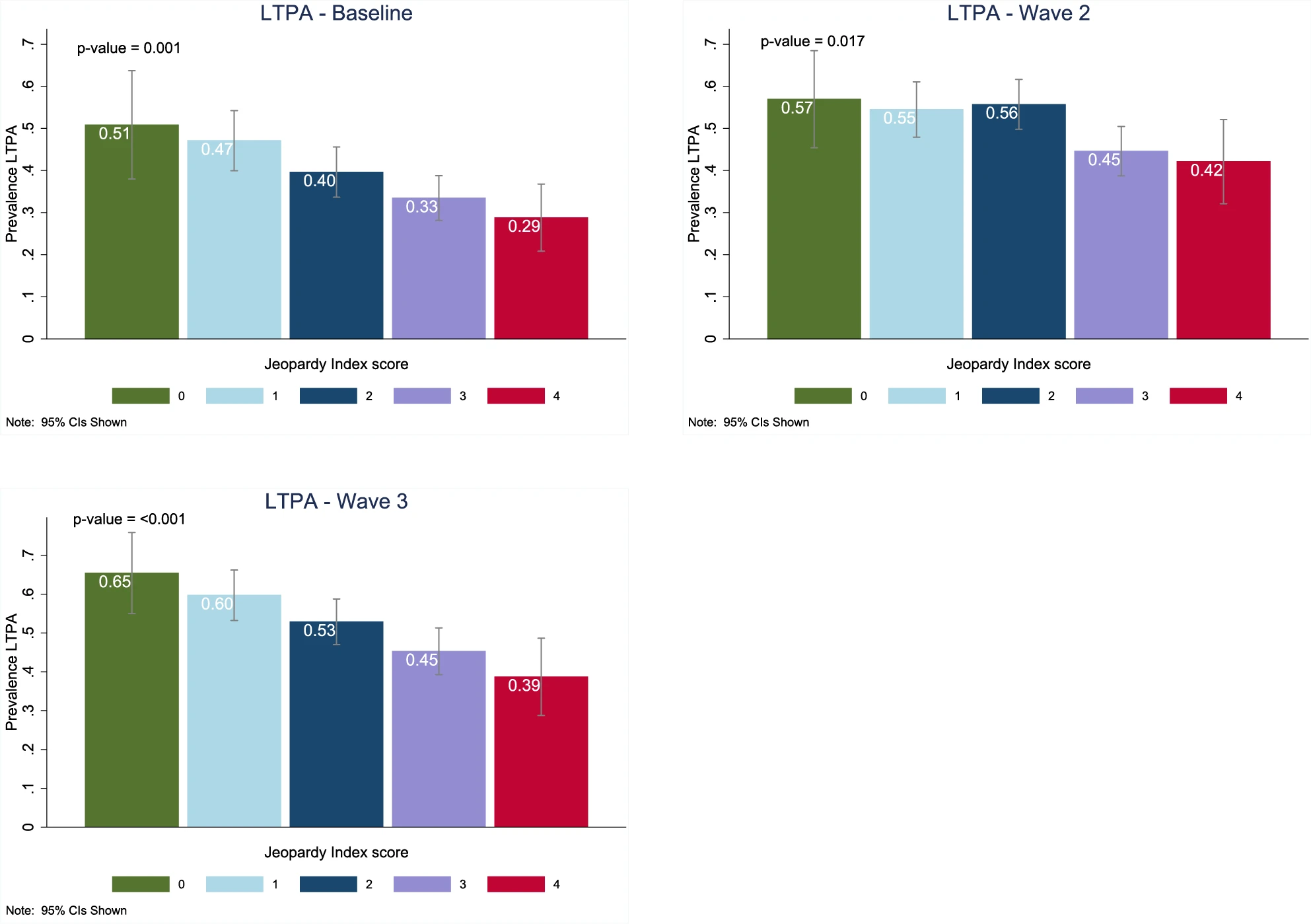
Leisure-time physical activity according to the according to Jeopardy Index across the three waves of the Physical Activity and Environment (ISA study), a longitudinal study designed to examine how characteristics of the built environment influence health-related behaviors and outcomes.
It seems that white men are more supportive of each other while their ecological model of physical activity finds that Black, Mixed, Asian, and Indigenous women receive less support from partners or family members. That coupled with ready access to nature creates a significant gap between those who are able to engage in physical activity during their leisure time and those who don't. They find that recreational exercise was 51 percent among white men with higher levels of education but only 29 percent among non-white women in the first survey. In the third assessment phase, these figures rose to 65 percent and 39 percent inequality between the groups rose.
It may be due to lack of time and that countries like Brazil are well below the U.S. in gender equality. Domestic work being done by females is a cultural expectation. Culture may also mean they feel less safe in public spaces than U.S. women do. Or the much larger pay gap between men and women, that the U.S. does not have.
The authors recommend walking for commuting as an exercise practice that could easily be incorporated into daily life.
Citation: Andreia Alexandra Machado Miranda, Danilo Dias Santana, Andiara Schwingel, Grace M. Turner, Kiya L. Hurley, Katie L. Edwards, Shelby Keye, Pedro Curi Hallal & Alex Antonio Florindo, 'Social inequalities in leisure-time and transport-related physical activity through the lens of intersectionality: 10-year longitudinal study in Brazil', Int J Behav Nutr Phys Act 23, 64 (2026). DOI: 10.1186/s12966-026-01900-5