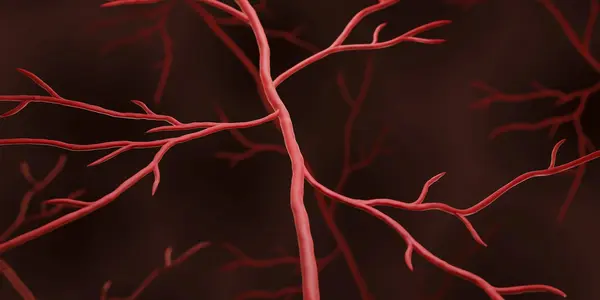
You Feel Colder As You Age: The Science Reason Why
Older people report feeling colder, enough that it is clearly happening, but why has been a mystery. Until now.
Older people report feeling colder, enough that it is clearly happening, but why has been a mystery. Until now.


Previous research into genetic variants has shown that dancers really are different than most people and a new neuroscience study sheds some light on ballet brains as well.
Differences in the brain structure of ballet dancers may help them avoid feeling dizzy when they perform pirouettes - and that ability to suppress signals from the balance organs in the inner ear can happen as a result of training, which could help to improve treatment for patients with chronic dizziness.

Native small mammals on forest islands created by a large hydroelectric reservoir in Thailand faced extinction and a new paper says species living in rainforest fragments could be far more likely to disappear than was previously thought.
The authors draw parallels between logging and the islands created by hydroelectric power and say they were motivated by a desire to understand how long species can live in forest fragments. If they persist for many decades, this gives conservationists a window of time to create wildlife corridors or restore surrounding forests to reduce the harmful effects of forest isolation.
The first rock that scientists analyzed on Mars with a pair of chemical instruments aboard the Curiosity rover turned out to be a doozy – a pyramid-shaped volcanic rock called a "mugearite" that is unlike any other Martian igneous rock ever found.
Dubbed "Jake_M" – after Jet Propulsion Laboratory engineer Jake Matijevic – the rock is similar to mugearites found on Earth, typically on ocean islands and in continental rifts. The process through which these rocks form often suggests the presence of water deep below the surface, according to Martin Fisk, an Oregon State University marine geologist and member of the Mars Science Laboratory team.
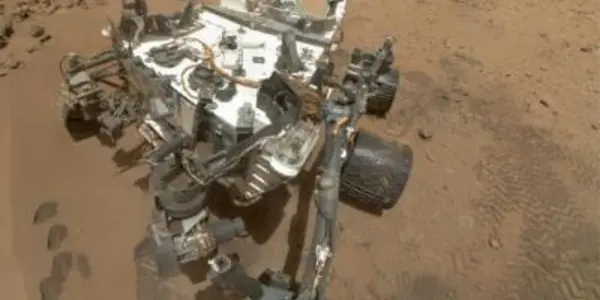
The first scoop of soil analyzed by the analytical suite in the belly of NASA's Curiosity rover reveals that fine materials on the surface of the planet contain several percent water by weight.
The quest for evidence of life on Mars could be more complicated than previously thought due to perchlorate,, a salt comprised of chlorine and oxygen, that interferes with the techniques used by the Curiosity rover to test for traces of life. The chemical causes the evidence to burn away during the tests.
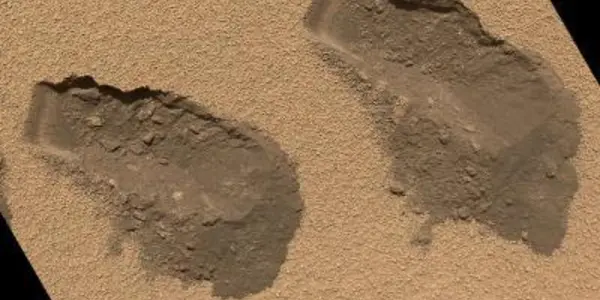
NASA's Curiosity Rover has sampled a surprising diversity of soils and sediments along a half-kilometer route during its first few months on Mars. And what it has found tells a complex story about the gradual desiccation of the Red Planet.
Perhaps most notable among findings from the ChemCam team is that all of the dust and fine soil contains small amounts of water.
In a series of papers covering the rover's top discoveries during its first three months on Mars, the rover's ChemCam instrument team up with an international cadre of scientists affiliated with the CheMin, APXS, and SAM instruments to describe the planet's seemingly once-volcanic and aquatic history.

Reports of a new hepatitis virus earlier this year were a false alarm, according to U.C. San Francisco researchers who correctly identified the virus as a contaminant present in a type of glassware used in many research labs.
The finding highlights both the promise and peril of today’s powerful “next-generation” lab techniques that are used to track down new agents of disease.

IGR J18245-2452, located about 18,000 light-years from Earth in the constellation Sagittarius in a cluster of stars known as M28, is a neutron star with the peculiar ability to transform from a radio pulsar into an X-ray pulsar and back again.
The star's capricious behavior appears to be fueled by a nearby companion star and may give new insights into the birth of millisecond pulsars.
New methods are needed to fight the infection Clostridium difficile and better use of antibiotics could be key, according to a new paper.
Clostridium difficile (C.diff) causes severe diarrhoea, cramps and sometimes life-threatening complications, and has traditionally been thought to be transmitted within hospitals from other sick C.diff patients.
In a United Kingdom study, the team mapped all cases of Clostridium difficile (C.diff) in Oxfordshire over a three-year period (2008 to 2011) and found that less than one in five cases of the "hospital superbug" were likely to have been caught from other hospital cases of C.diff, where the focus of infection control measures has been.
Earlier studies have suggested that omega-3 fatty acids, found in fatty fish such as salmon and in nuts, benefit thinking skills. A new paper in Neurology, based on a study that involved 2,157 women age 65 to 80 who were enrolled in the Women's Health Initiative clinical trials of hormone therapy, disputes that.
The women were given annual tests of thinking and memory skills for an average of six years. Blood tests were taken to measure the amount of omega-3s in the participants' blood before the start of the study.
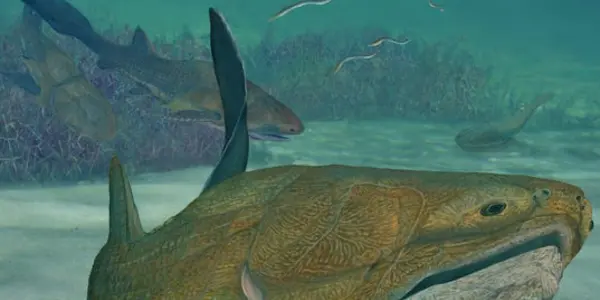
The discovery of what may be the earliest known creature with what can be discerned as a face has been reported in Nature. Entelognathus primordialis is an exceptionally well-preserved 419-million-year-old fish from China that is the most primitive vertebrate to have a modern type of jaw. This fish is a placoderm, one of a member of an extinct group of gnathostomes (jawed vertebrates), but its jaw is much more like that of a modern bony fish: its discovery may offer a new perspective on the early evolution of these creatures.

If history always felt a little made up and you wished there were more sharply-defined quantitative predictions that could be tested empirically, you are in luck. A new mathematical method has done just that.
An trans-disciplinary team tackled a way to mathematically determine how human societies evolve from small groups to the huge, anonymous and complex societies of today. Their cultural evolutionary model predicts where and when the largest-scale complex societies arose in human history.