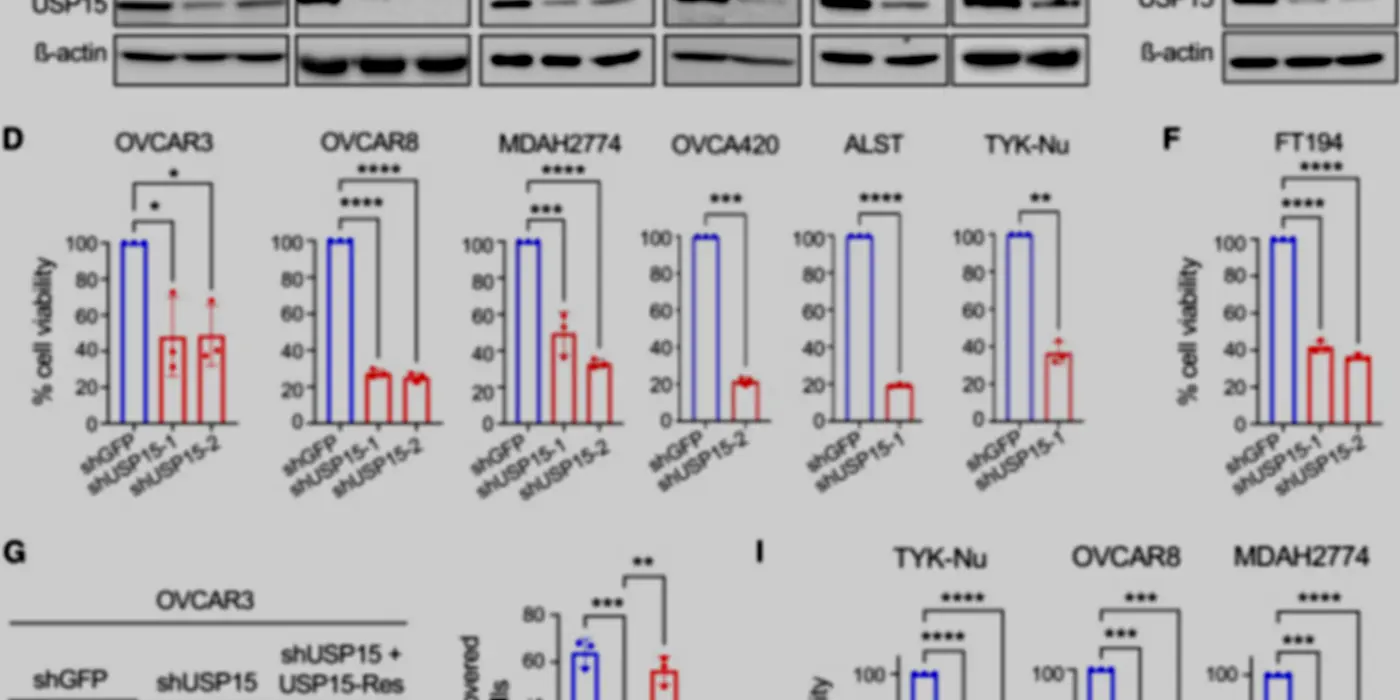
Enzyme USP15 Limits Ovarian Cancer Cells And Boosts Chemotherapy
Ovarian cancer is devastating, five-year survival rate under 30%, when detected after it has spread. New basic research may improve that.
Ovarian cancer is devastating, five-year survival rate under 30%, when detected after it has spread. New basic research may improve that.


Along with drastic reductions in carbon dioxide emissions, a team of climate scientists says internationally coordinated research and field-testing on geoengineering the planet's atmosphere need to begin immediately in order to limit risk of climate change. In a new Nature editorial, the team argues that collaborative and government-supported studies on solar-radiation management, a form of geoengineering, would reduce the risk of nations' unilateral experiments and help identify technologies with the least risk.
Whether prayer is supernatural or not, the common religious practice may generally benefit the Nine out of 10 Americans who say they pray. In a recent study appearing in Psychological Science, researchers found that when people's prayers are directed at those who have wronged them they're more likely to forgive and move on. The conclusion is based on two experiments. In the first, researchers had a group of men and women pray one single prayer for their romantic partner's well being. Others—the experimental controls—simply described their partner, speaking into a tape recorder.
The January 12th earthquake in Haiti killed an estimated 200,000 people and left 1.5 million homeless. Now, researchers are returning to the island this week to determine whether the quake could trigger another major event to the east or west of Haiti's capital Port-au-Prince. Most aftershocks occur within weeks of the initial quake and the team urgently needs to get to the site to make a detailed assessment before crucial geological information disappears.
Northwestern University researchers have developed a new material that could help with the remediation of nuclear waste that behaves much like a Venus Flytrap, permanently trapping only its desired 'prey,' the radioactive ion cesium. The results were published online this week in Nature Chemistry.The synthetic material, made from layers of a gallium, sulfur and antimony compound, is very selective. The researchers found it to be extremely successful in removing cesium -- found in nuclear waste but very difficult to clean up -- from a sodium-heavy solution. (The solution had concentrations similar to those in real liquid nuclear waste.)
Malaria and cholera take devastating tolls in the developing world. Mosquito-borne Malaria kills more than 1 million people annually and no vaccine currently exists. Cholera, a diarrheal illnessthat is common in developing countries, can be fatal and the lone vaccine is too expensive to prevent outbreaks after floods. Despite the challenges posed by the malaria and cholera, University of Central Florida biomedical researchers say they have developed what may be the first low-cost dual vaccine for both

Historians at University College London say they have discovered part of an ancient Roman law code called the Codex Gregorianus, or Gregorian Code. The discovery was made after researchers pieced together 17 fragments of previously incomprehensible parchment. The fragments were being studied at UCL as part of 'Projet Volterra' – a ten year study of Roman law in its full social, legal and political context.Corcoran and Salway found that the text belonged to the Codex Gregorianus, a collection of laws by emperors from Hadrian (AD 117-138) to Diocletian (AD 284-305), which was published circa AD 300. Little was known about the codex's original form and there were, until now, no known copies in existence.
A series of articles in the January 26 issue of PNAS illustrates recent progress in applying evolutionary theory to a range of questions in medicine and public health, and may lead to medical students soon being tested on evolution in medical entrance and licensing exams.So what does evolution – a theory that deals with changes over many generations – have to do with preventing and treating disease in our lifetime? A lot, some scientists say. "There are many ways you can use evolution to improve medical care and medical research," said psychiatrist Randolph Nesse of the University of Michigan.
The Antarctic ozone hole was once regarded as one of the biggest environmental threats facing. But the discovery of a previously unknown feedback shows that it has instead helped shield this region from carbon-induced warming over the past two decades.Now, the hole in the ozone layer is steadily closing, and its repair could actually increase warming in the southern hemisphere, according to a study appearing later this in week Geophysical Research letters.
Antioxidants have received a lot of attention in recent years for all the health benefits they supposedly provide. Some studies have suggested that they may play a role in lowering cancer and heart disease risk, slowing the aging process, and treating neurodegenerative diseases such as Alzheimer's. But recent research shows that antioxidants may also cause harm--specifically, they may impair muscle function.
It's well known that eating too much salt can be harmful. Despite that fact, many people choose to consume more of it than they need, and that to many in the health community means that something must be done population-wide to reduce salt intake. The latest effort comes from the European Society of Cardiology, who says that a new study in the New England Journal of Medicine illustrates the need for laws that restrict the salt content of processed foods.
Research has documented that most men become much more jealous about sexual infidelity than they do about emotional infidelity. Women are the opposite. The prevailing theory is that the difference has evolutionary origins: Men learned over eons to be hyper-vigilant about sex because they can never be absolutely certain they are the father of a child, while women are much more concerned about having a partner who is committed to raising a family.
Scientists from the Université de Montréal are developing a weight loss pill composed of leptin, the protein that regulates appetite in mammals. The researchers say that leptin may be a good weight loss pill because its levels decrease when we fast and rise when we eat, meaning that increasing them could reduce people's urge to continue eating. The protein has also been proven to suppress appetite when administered intravenously to pathologically obese people. "Taken orally, such a pill would provide obese people with the sensation of being full. They would eat less and in turn lose weight," says Dr. Cammisotto, one of the researchers on the project.