If not caught early, ovarian cancer can be life-threatening. The five-year survival rate for later diagnoses, after it has spread, is under 30 percent and existing therapies kill healthy cells along with cancerous ones.
New basic research hints at a new molecular target for drugs, the USP15 enzyme which seems to help ovarian cancer cells. This is cell cultures and mice so only EXPLORATORY but the team found that lowering USP15 levels slows cancer-cell growth, prevents chromosomes in cancer cells from separating cleanly during division, increasing chances of cancer DNA damage and cell death, plus reduces the cells’ ability to migrate and invade other tissues
The world evolved from studies of protein p53, which helps prevent tumor formation. When mutations occur is when you are at risk for the most common and lethal form of ovarian cancer, because instead of disrupting tumor formation it accelerates it. Researchers behind the new paper found the enzyme USP15 stabilizing a particular p53 mutant by removing small molecular “tags” attached to proteins that label them for degradation. More USP15 means fewer mutant proteins marked for destruction.
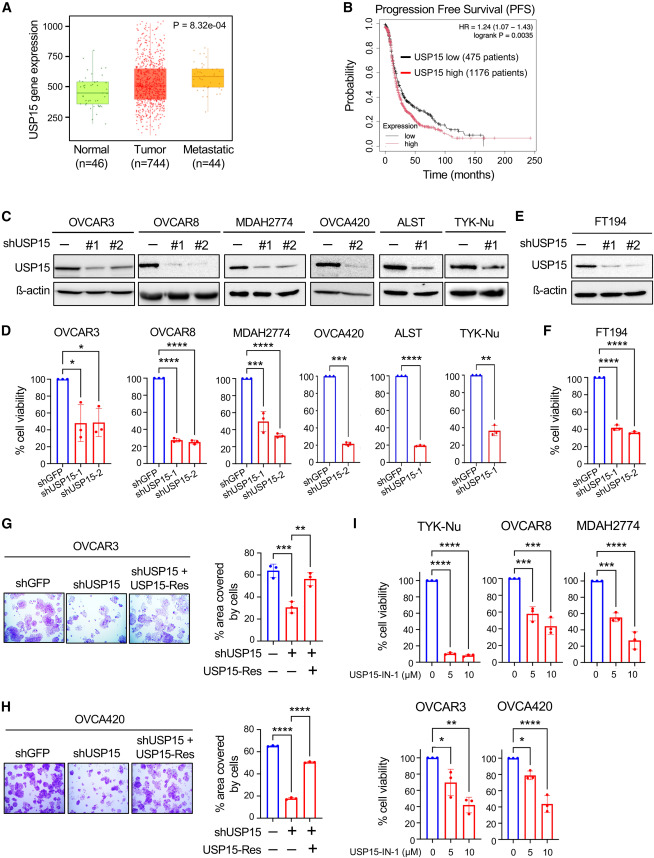
Compared to normal (non-cancerous) ovarian tissue, USP15 mRNA is elevated in ovarian tumors. Highest USP15 expression is observed in metastatic tumors. (B) Kaplan-Meier analysis showing high USP15 levels in ovarian cancer is associated with a decrease in progression free survival (n = 1,651, log rank p = 0.0035). (C) Western blot confirming successful USP15 knockdown in ovarian cancer cell lines. (D) USP15 depletion in ovarian cancer cells causes significant reduction in cell viability and proliferation. Quantified data from n = 3 is shown. (E) Western blot showing stable USP15 knockdown in the immortalized fallopian tube secretory epithelial cells, FT194. (F) USP15 depletion in FT194 cells cause significant reduction in cell viability and proliferation. Quantified data from n = 3 is shown. (G) Stable expression of shRNA-resistant USP15 rescues the decrease in cell viability observed upon USP15 knockdown in OVCAR3 cells. (H) Stable expression of shRNA-resistant USP15 rescues the decrease in cell viability observed upon USP15 knockdown in OVCA420 cells. (I) USP15 inhibition using the small molecule inhibitor USP15-IN-1 causes significant reduction in cell viability and proliferation in ovarian cancer cells. Quantified data from n = 3 is shown.
The new work found that targeting USP15 made the the most common ovarian cancer treatment drugs, carboplatin and paclitaxel, more effective, as was doxorubicin, a toxic drug used to treat a range of cancers. If their work holds up in humans, less USP15 could mean lower doses of drugs, the same benefit with less toxicity.
This is basic research so before a drug company can develop something, it will need to be understood what controls USP15 levels in cancer cells and whether inhibiting the enzyme can also reshape a tumor’s immediate surroundings. Only then can they tackle how to reduce USP15 levels safely in human patients.
Citation: Ayokunnumi Ogunsanya, Fatimah Alfaran, Omuya Noel Amadu, Achuth Padmanabhan, USP15 regulates mitotic fidelity, metastatic potential, and chemotherapeutic response in ovarian cancer cells, Molecular Therapy Oncology, Volume 34, Issue 3201329, September 17, 2026