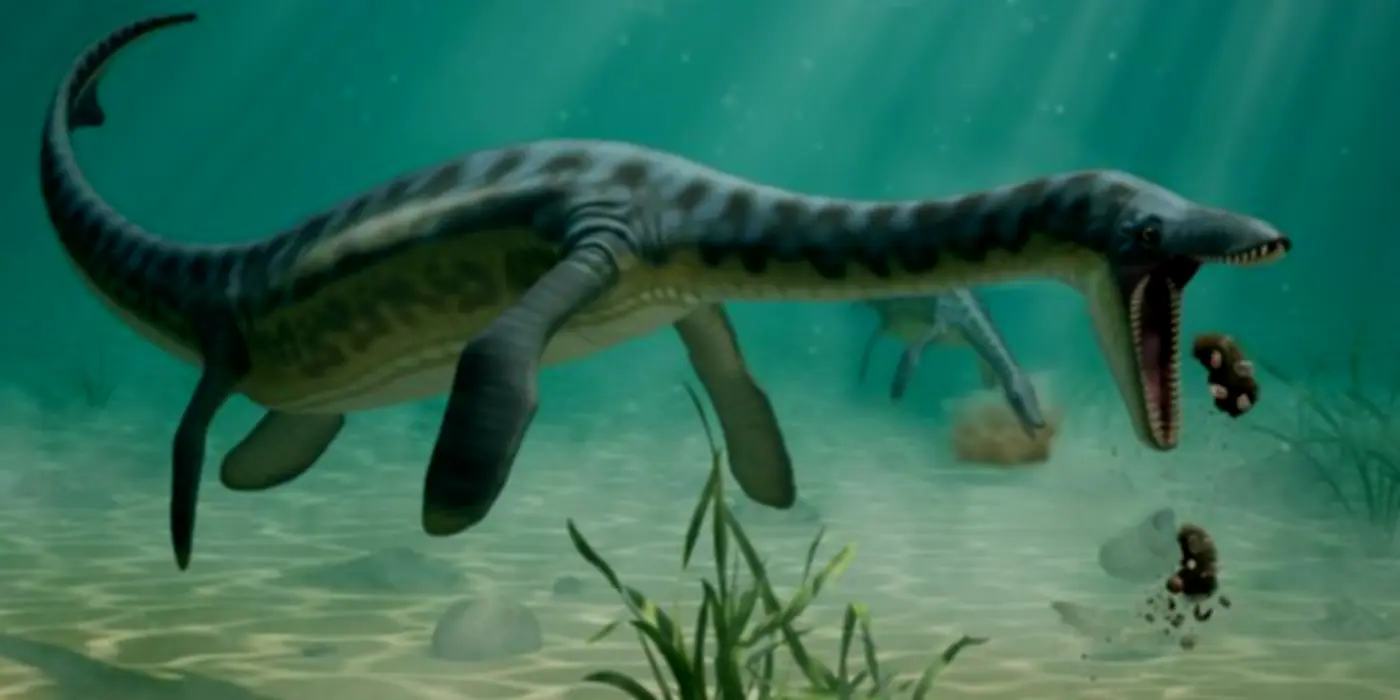
Jurassic Puke: Plesiosaurs Knew Not To Vomit Where They Eat
Jurassic monsters sometimes needed to vomit. When they did, they went to shore.
Jurassic monsters sometimes needed to vomit. When they did, they went to shore.


Nitrogen is essential to all life on Earth, and determines how much carbon dioxide ecosystems can absorb from the atmosphere, says UC Davis assistant professor Benjamin Houlton.
There are puzzling aspects of the nitrogen cycle in temperate and tropical forests. Defying laws of supply and demand, trees capable of extracting nitrogen directly from the atmosphere, nitrogen fixation, often thrive where it is readily available in the soil, but not where it is in short supply.
Houlton tackled the problem with colleagues including top international ecologist Peter Vitousek, the Clifford G. Morrison Professor in Population and Resource Studies at Stanford University.
The 2007 Intergovernmental Panel on Climate Change report was wrong, say a group of researchers, but not about whether there was global warming. Rather, the report underestimated its effects concerning ocean temperature and associated sea level increases between 1961 and 2003 - by 50 percent.
The report in the June 19 edition of Nature compared climate models with observations that show sea levels rose by 1.5 millimeters per year in the period from 1961-2003. That equates to an approximately 2 inch increase in ocean levels in a 42-year span.
Not exactly WaterWorld but not insignificant either.
Patients diagnosed with colon cancer who had abundant vitamin D in their blood were less likely to die during a follow-up period than those who were deficient in the vitamin, according to a new study by scientists at Dana-Farber Cancer Institute.
The findings of the study -- the first to examine the effect of vitamin D among colorectal cancer patients -- merit further research, but it is too early to recommend supplements as a part of treatment, say the investigators from Dana-Farber and the Harvard School of Public Health.
In a report in the June 20 issue of the Journal of Clinical Oncology, the authors note that previous research has shown that higher levels of vitamin D reduce the risk of developing colon and rectal cancer by about 50 percent, but the effect on outcomes wasn't kno
A new mass spectrometry test can help sports anti-drug doping officials to detect whether an athlete has used drugs that boost naturally occurring steroid levels. The test is more sensitive compared to previous alternatives, more capable of revealing specific suspicious chemical in the body, faster to perform, and could be run on standard drug-screening laboratory equipment.
The new test was announced in a special issue of the Journal of Mass Spectrometry that concentrates on detecting drugs in sports.
One of the roles of the masculinising hormone testosterone is to increase muscle size and strength. Taking extra testosterone, or taking a chemical that the body can use to create extra testosterone, could therefore enhance an athlete's performance. For this reason taking it is banned by the World Anti-Doping Agency (WADA).
NASA hopes to use the the new Walt Disney Studios Motion Pictures film WALL-Eto promote interest among schoolchildren in science and technology. They have signed a Space Act Agreement for a series of educational and public outreach activities related to Disney-Pixar's new movie opening in theaters nationwide on June 27, 2008.
This collaboration highlights the similarities between the movie's storyline and NASA's real-life work in robot technology, propulsion systems and astrophysics. Disney-Pixar's WALL-E is set 700 years in the future. The film's main character is the only rover-robot left on Earth. He meets a new robot named Eve, and together they take a journey through the universe.
Disney has designed a 30-second public service announcement featuring WALL-E for NASA's television channels and Web site. The video is designed to draw students to NASA's Web site to explore the agency's missions. The WALL-E character also will be featured on NASA's Kids' Club page. In addition, Disney has designed a "movie surfer vignette" about WALL-E that touches on science and technology that drives NASA's programs, which began airing on the Disney Channel in June.

The newly sequenced genome of a dainty, quill-like sea creature called a lancelet provides the best evidence yet that vertebrates evolved over the past 550 million years through a four-fold duplication of the genes of more primitive ancestors.
The late geneticist Susumu Ohno argued in 1970 that gene duplication was the most important force in the evolution of higher organisms, and Ohno's theory was the basis for original estimates that the human genome must contain up to 100,000 distinct genes.
Instead, the Human Genome Project found that humans today have only 20,000 to 25,000 genes, which means that, if our ancestors' primitive genome doubled and redoubled, most of the duplicate copies of genes must have been lost. An analysis of the lancelet, or amphioxus, genome, published in the June 19 issue of Nature, shows this to be the case.

The Nazca booby, a Galápagos Island seabird, emerges from its shell ready to kill its brother or sister. Wake Forest University biologists and their colleagues have linked the murderous behavior to high levels of testosterone and other male hormones found in the hatchlings.
The research is part of a long-term study by Anderson that has included monitoring more than 16,000 Nazca booby nests at Punta Cevallos, Isla Espanola, in the Galápagos Islands since 1984.
The elevated levels of male hormones, called androgens, increase aggression in both male and female chicks and prepare the birds to fight to the death as soon as they hatch, said David J. Anderson, professor of biology at Wake Forest and project leader.

Researchers at Carnegie Mellon University have devised the first computerized method that can analyze a single photograph and determine where in the world the image likely was taken. It's a feat made possible by searching through millions of GPS-tagged images in the Flickr online photo collection.
The IM2GPS algorithm developed by computer science graduate student James Hays and Alexei A. Efros, assistant professor of computer science and robotics, doesn't attempt to scan a photo for location clues, such as types of clothing, the language on street signs, or specific types of vegetation, as a person might do. Rather, it analyzes the composition of the photo, notes how textures and colors are distributed and records the number and orientation of lines in the photo.

Two stars, each with the same mass and in orbit around each other, are twins that one would expect to be identical. So astronomers were surprised when they discovered that twin stars in the Orion Nebula, a well-known stellar nursery 1,500 light years away, were not identical at all. In fact, these stars exhibited significant differences in brightness, surface temperature and possibly even size.
The study published in the June 19 Nature suggests that one of the stars formed significantly earlier than its twin. Because astrophysicists have assumed that binary stars form simultaneously, the discovery provides an important new challenge for today's star formation theories, forcing theorists to reexamine their models to see if the models can indeed produce binaries with stars that form at different times.
The pageantry of Oprah Winfrey’s talk show, the Coca-Cola empire, Michael Jackson’s turn from the King of Pop into an iconic global recluse: American pop culture – Hollywood cinema, television, pop music – dominates the rest of the world through its hegemonic presence. Does that make everyone a hybridized American, or do these elements find mediation within the other cultures that consume them?
Fabricating the Absolute Fake. America in Contemporary Pop Culture by Jaap Kooijman applies concepts of postmodern theory – Baudrillard’s hyperreality and Eco’s “absolute fake,” among others – to this globally mediated American pop culture in order to examine both the phenomenon itself and its appropriation in the Netherlands, as evidenced by such diverse cultural icons as the Elvis-inspired crooner Lee Towers, the Moroccan-Dutch rapper Ali B, musical tributes to an assassinated politician, and the Dutch reality soap opera scene.
Bacteria survive everywhere. Under the sea, in the air, even in some of the hottest environments on Earth.
How are microbes seemingly so smart? Bacteria don't just react to changes in their surroundings, say Princeton University researchers, they anticipate and prepare for them. The findings, reported in the June 6 issue of Science, challenge the prevailing notion that only organisms with complex nervous systems have this ability.
"What we have found is the first evidence that bacteria can use sensed cues from their environment to infer future events," says Saeed Tavazoie, an associate professor in the department of Molecular Biology, who conducted the study along with graduate student Ilias Tagkopoulos and post-doctoral researcher Yir-Chung Liu.
It's an ingredient found in dandruff shampoos and, if you're a movie buff, you also know it was used to help fight off alien invaders in the film "Evolution."
Scientists at the University of Leicester are now using selenium as a tool in investigating how the oxygen content of the oceans has changed over geologically recent time.
Selenium is an anti-oxidant and an essential trace nutrient in our diet. It belongs to a group of elements whose behavior is controlled by the concentration of oxygen in the environment. Now scientists are using selenium as part of a research project to measure the isotopic ratios of selenium in sediments.