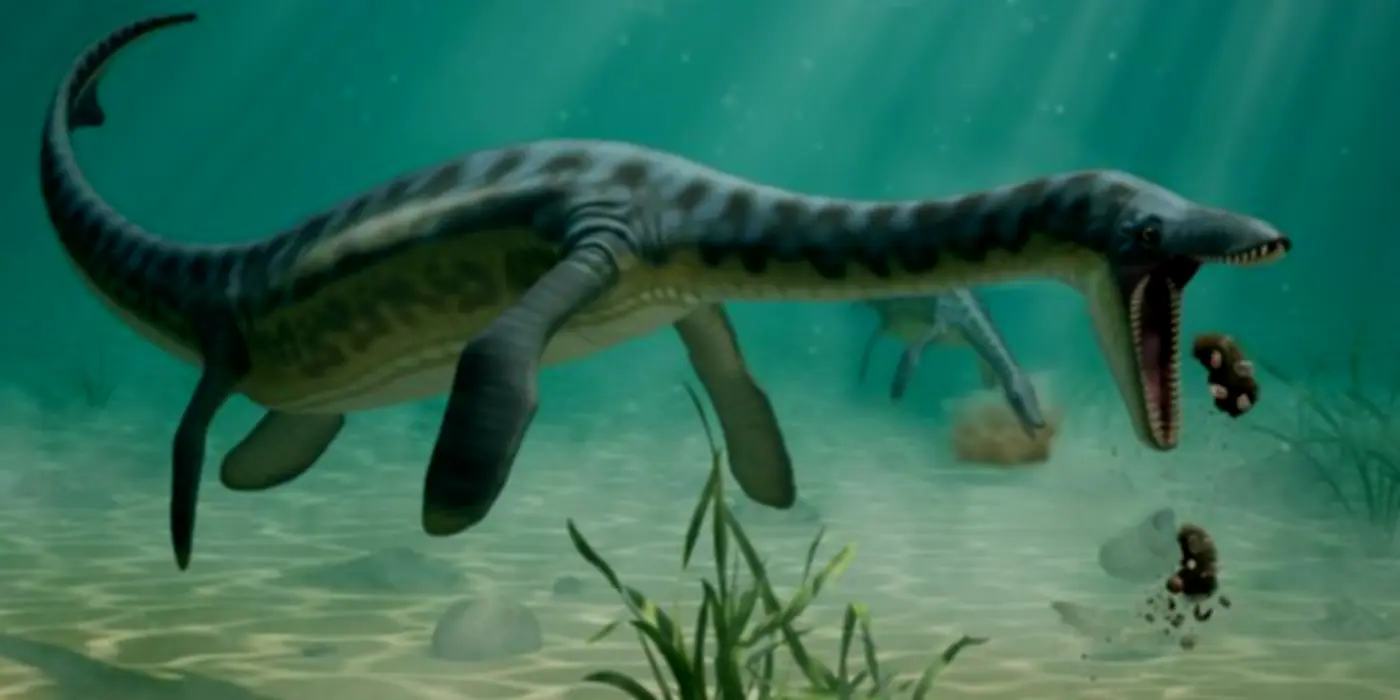
Jurassic Puke: Plesiosaurs Knew Not To Vomit Where They Eat
Jurassic monsters sometimes needed to vomit. When they did, they went to shore.
Jurassic monsters sometimes needed to vomit. When they did, they went to shore.

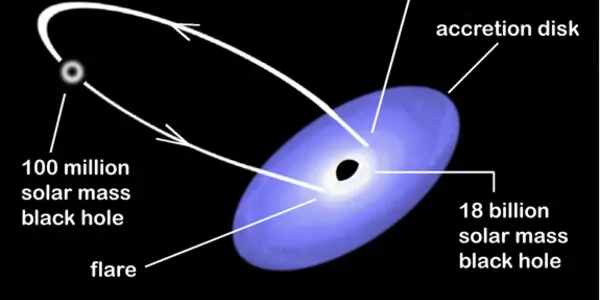
A close binary system of two candidate black holes in the quasar OJ 287 has shown Einstein some physics love. A central black hole, with a mass equal to 18 billion times that of the Sun, is orbited by a smaller one, and the interaction of the system with its surroundings produces brightness changes that allow astronomers to study the evolution of the orbit.
This evolution is dominated by one of the most intriguing predictions of Einstein's General Theory of Relativity: the emission of gravitational waves.
Astronomers believe that very massive black holes lurk at the centers of most galaxies but, as in the case of our own Galaxy, they often remain silent and are difficult to detect. In other cases where the black holes are surrounded by disks of material that fall onto them (accretion disks), the infalling material is heated and emits huge quantities of radiation: the active nucleus of a galaxy can appear, then, as a quasar.

A 240 million year-old Ichthyosauria specimen went on display at Tromsø University Museum in northern Norway. The Botneheia ichthyosaur, presumably a new species, was the largest predator of its day.
A team from the University of Tromsø, the Norwegian Polar Institute, and the University of Tübingen discovered the exceptionally large specimen at Svalbard, Norway. The preparation and exhibition of the fossil was sponsored by the Norwegian oil company StatoilHydro.
What species is it?
The fossil from the Botneheia Formation at Sauriedalen, Svalbard belongs to the Ichthyosauria (meaning ”fish-lizards”), a large group of marine reptiles that roamed the oceans for most of the Mesozoic. It is among the more “primitive” and early ichthyosaurs of the Triassic that the new find from Svalbard finds its place.
As no large ichthyosaurs have so far been described from the Middle Triassic of Svalbard, there is a high probability that one is dealing with a genus and species new to science.

Teaching robots to understand enough about the real world to allow them act independently has proved to be much more difficult than first thought.
The technologies developed on the iCub platform – such as grasping, locomotion, interaction, and even language-action association – are of great relevance to further advances in the field of industrial service robotics.
The EU-funded RobotCub project, which designed the iCub, will send one each to six European research labs. Each of the labs proposed winning projects to help train the robots to learn about their surroundings – just as a child would.

Data from the ESA/NASA spacecraft SOHO shows clearly that powerful starquakes ripple around the Sun in the wake of mighty solar flares that explode above its surface. The observations give solar physicists new insight into a long-running solar mystery and may even provide a way of studying other stars.
The outermost quarter of the Sun’s interior is a constantly churning maelstrom of hot gas. Turbulence in this region causes ripples that criss-cross the solar surface, making it heave up and down in a patchwork pattern of peaks and troughs.

Researchers at the Department of Energy's Pacific Northwest National Laboratory found that the restless movement of oxygen atoms heals radiation-induced damage in the engineered ceramic yttria-stabilized zirconia.
This may lead to development of radiation-resistant materials for nuclear power plants and waste storage.
Scientists Ram Devanathan and Bill Weber modeled how well that ceramic and other materials stand up to radiation. "If you want a material to withstand radiation over millennia, you can't expect it to just sit there and take it. There must be a mechanism for self-healing," said Devanathan.

Your contact lenses of the future could be completely biodegradable. A soft contact lens is a hydrogel - a solid, gelatinous mass consisting of water incorporated in a polymer network.
Now Berkeley researchers have developed a technique for the formation of hybrid materials from synthetic polymers and proteins, fusing the biological functions of proteins with the processing properties of plastics.
Aaron P. Esser-Kahn and Matthew B. Francis say they have successfully synthesized a green-fluorescing biodegradable gel that responds to changes in pH value and temperature. These polymer-protein hybrid materials can also be used in sensors, nanomachine parts, or drug-delivery systems.
Increased carbon dioxide in the Earth's atmosphere is causing microscopic ocean plants to produce greater amounts of calcium carbonate (chalk) - with potentially wide ranging implications for predicting the cycling of carbon in the oceans and climate modelling.
That is the conclusion of an international team of scientists led by investigators based at the UK's National Oceanography Centre, Southampton and the University of Oxford, published in Science, on 18 April 2008.
Co lead-author, Dr M Debora Iglesias-Rodriguez, of the University of Southampton's School of Ocean and Earth Science at the National Oceanography Centre, Southampton said:
A connection between vitamin D level and the risk of developing breast cancer has been implicated for a long time, but its clinical relevance had not yet been proven.
Sascha Abbas and colleagues from the working group headed by Dr. Jenny Chang-Claude at the German Cancer Research Center (Deutsches Krebsforschungszentrum, DKFZ), collaborating with researchers of the University Hospitals in Hamburg-Eppendorf, have now obtained clear results: While previous studies had concentrated chiefly on nutritional vitamin D, the researchers have now investigated the complete vitamin D status. To this end, they studied 25-hydroxyvitamin D (25(OH)D) as a marker for both endogenous vitamin D and vitamin D from food intake.
When a hypothetical, quantum-scale balloon is popped in a vacuum, do the particles inside spread out as predicted by classical mechanics or do something else, since matter at the infinitesimally small quantum scale is both a wave and a particle, and its location cannot be fixed precisely because measurement alters the system?
The question is deceptively complex, since quantum particles do not look or act like air molecules in a real balloon. Theoretical physicists at the University of Southern California have an answer Heisenberg would be proud of.
Quantum-scale chaos exists … sort of.
Supporters of legalizing euthanasia and those who wish to develop better palliative care services can help rather than combat each other, according to a study published on bmj.com.
Palliative care concerns itself with the relief of the pain, symptoms and stress of serious illness while improving the quality of life for patients and their families. Euthanasia is where a third party causes the death of a patient. But the traditional view that palliative care and euthanasia are two alternative and antagonistic causes is not necessarily the case, say researchers.
Jan Berheim and colleagues from the End-of-Life Care Research Group of the Vrije Universiteit Brussel, reviewed historical, regulatory and epidemiological evidence from Belgium, which was the second country to legalise euthanasia in 2002, and has some of the best developed provisions for palliative care, third only to Iceland and the UK.
In recent decades, manufacturers have added more and more components onto integrated circuits. As a result, the number of transistors and the power of these circuits have roughly doubled every two years. This has become known as Moore’s Law.
But the ability to easily add more components is now noticeably decreasing and further miniaturization of electronics will experience a fundamental challenge in the next 10 years.
There's hope on the horizon. Researchers at The University of Manchesterhave used the world’s thinnest material to create the world’s smallest transistor, one atom thick and ten atoms wide. How small is that? You could fit 25 million of them in an inch.
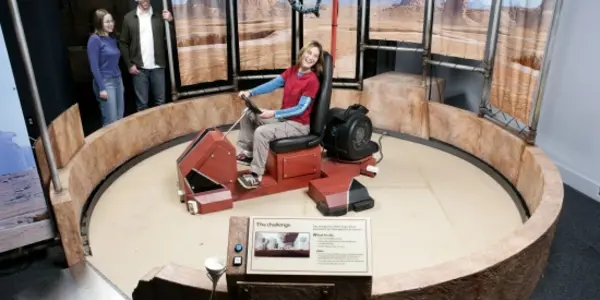
An exhibit developed by the Museum of Science, Boston, in collaboration with Lucasfilm, Ltd. explores the possibility that some of the robots, vehicles and devices of the Star Wars films are closer to reality than one might think.
The exhibition, at the Franklin Institute in Philadelphia, Pa., through May 4, discusses landspeeders and robots as engineering design challenges and highlights how researchers are currently pursuing similar technologies.
"We were surprised and delighted when we were developing the exhibit, to discover that many scientists working today were inspired by the fantasy technologies in the Star Wars movies," said Lawrence Bell, senior vice president at the Museum of Science and the lead investigator for the project. "We developed the exhibit with the goal of continuing that inspiration for the kids who will be the next set of future scientists."