Jurassic Puke: Plesiosaurs Knew Not To Vomit Where They Eat
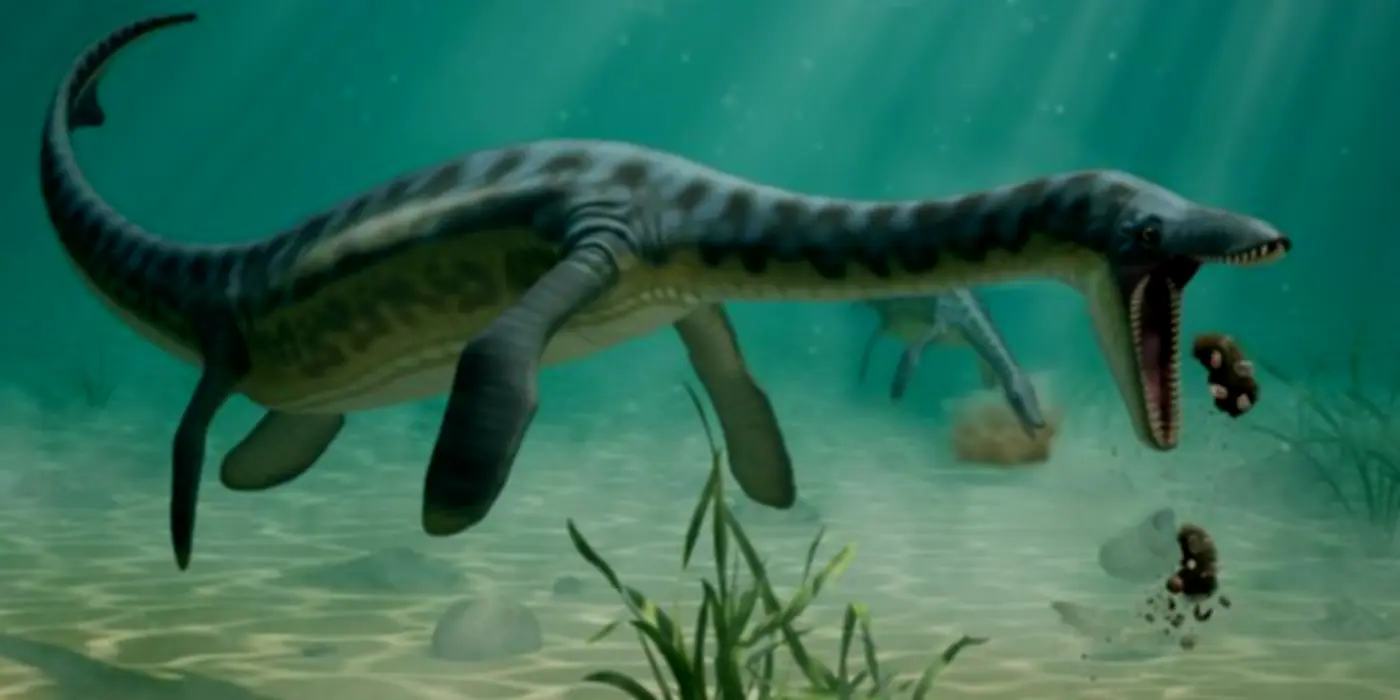
Jurassic monsters sometimes needed to vomit. When they did, they went to shore.
Jurassic monsters sometimes needed to vomit. When they did, they went to shore.


The Sun has a very dynamic atmosphere, with huge fountains of hot gas erupting in the atmosphere, or corona, every few minutes, travelling at tens of thousands of kilometers per hour and reaching great heights.
A team of scientists using the Hinode spacecraft has been searching for the origin and driver of these 'fountains', immense magnetic structures that thread through the solar atmosphere. On Wednesday 2 April at the Royal Astronomical Society National Astronomy Meeting in Belfast (NAM 2008), team leader Dr. Michelle Murray from the Mullard Space Science Laboratory (MSSL, University College London) presented the latest results from Hinode together with computer simulations that model conditions on the Sun.

Research published in the Institute of Physics' Environmental Research Letters shows how a team from Lancaster and Durham Universities sought a means to prove the correlation between the ionizing cosmic rays and the production of low cloud cover.
Previous research had shown a possible correlation, using the results of the International Satellite Cloud Climatology Project, and this had been used to propose that global warming was due to cosmic rays.
The new research shows that change in cloud cover over the Earth does not correlate to changes in cosmic ray intensity. Neither does it show increases and decreases during the sporadic bursts and decreases in the cosmic ray intensity which occur regularly.
A daily dose of caffeine blocks the disruptive effects of high cholesterol that scientists have linked to Alzheimer's disease. A study in the Journal of Neuroinflammation revealed that caffeine equivalent to just one cup of coffee a day could protect the blood-brain barrier (BBB) from damage that occurred with a high-fat diet.
The BBB protects the central nervous system from the rest of the body's circulation, providing the brain with its own regulated microenvironment. Previous studies have shown that high levels of cholesterol break down the BBB which can then no longer protect the central nervous system from the damage caused by blood borne contamination. BBB leakage occurs in a variety of neurological disorders such as Alzheimer's disease.

DNA repair capacity is an important factor in cancer, inflammation, aging, and other human conditions. Radiation is something we can never avoid and it's responsible for a lot of medical problems.
Bdelloid rotifers have been able to give up sex and escape the usual drawback of asexuality – extinction - and still survive because they have evolved an extraordinary efficient mechanism for repairing harmful mutations to their DNA, say the Marine Biological Laboratory’s David Mark Welch, Matthew Meselson, and their colleagues.
What’s more, they have done so over millions of years of evolution, resulting in at least 370 species.

Omega Centauri is visible from Earth with the naked eye and is one of the favorite celestial objects for stargazers from the southern hemisphere.
Although the cluster is 17,000 light-years away, located just above the plane of the Milky Way, it appears almost as large as the full Moon when the cluster is seen from a dark rural area.
Exactly how Omega Centauri should be classified has always been a contentious topic. It was first listed in Ptolemy’s catalogue nearly two thousand years ago as a single star. Edmond Halley reported it as a nebula in 1677. In the 1830s the English astronomer John Herschel was the first to recognise it as a globular cluster.
Now, more than a century later, this new result suggests Omega Centauri is not a globular cluster at all, but a dwarf galaxy stripped of its outer stars.

An international team of scientists, led by Prof Louise Harra, University College London, Mullard Space Science Laboratory, have found a source of the stream of particles that make up the slow solar wind using data from Hinode and SOHO.
The solar wind can have low or high speeds. The low-speed or slow solar wind moves at only 1.5 million km/h. The high-speed wind is even faster, moving at speeds as high as 3 million km/h. As it flows past Earth, the solar wind changes the shape and structure of Earth's magnetic field.
ESA’ s SOHO and Hinode Project Scientist, Bernhard Fleck says, “In the past, apart from creating beautiful auroral displays, the solar wind didn’t affect us directly. But as we’ve become increasingly dependent on technology, we are more susceptible to its effects. We’re learning that variations in its flow can dramatically change the shape of Earth's magnetic field, which can damage satellites, disrupt communications and electrical power systems.”
Scottish astronomers have found a baby planet still in the stages of forming and encased within a 'womb' of gas.
The embryonic planet, thought to be the youngest ever seen, was discovered by Dr Jane Greaves of the University of St Andrews and colleagues from across the UK and the US.
The finding provides a unique view of how planets take shape, because the supporting images also shows the womb-like parent disk material from which the new planet formed. The 'protoplanet', called HL Tau b after its parent star HL Tau, could be as young as a few hundred years old.
Dr Greaves, of the School of Physics & Astronomy at St Andrews, explained, "The planet will probably take millions of years to settle down into its final form of something like Jupiter.
Scientists have long known that emotions and other personality traits and disorders run together in families but finding which genes are most important in controlling emotions has proven difficult. Humans and mice have similar numbers of genes, but mice are valuable because their genes can be deleted or added. Many researchers have begun to study mouse behaviors to try to link genes with complex behaviors.
A new report by Wang et al., found that male mice make high-frequency vocalizations during sexual interactions with female mice. These high-frequency calls are associated with approach behaviors, and with genes that control positive emotions.
Researchers in a large, multi-institutional study have found one gene variant that is linked to an increased risk of lung cancer.
The research team collected DNA from 1,154 smokers who have lung cancer and 1,137 smokers without lung cancer. Each DNA sample was analyzed at more than 300,000 points, looking for variations—known as single nucleotide polymorphisms, or SNPs for short—between those with cancer and those without. They then analyzed the top 10 SNPs in an additional 5,075 DNA samples from smokers with and without lung cancer.
Two of the 10 SNPs were consistently associated with lung cancer risk and both of them are located in chromosome 15 inside a region that contains genes for the nicotinic acetylcholine receptor alpha subunits 3 and 5, which already are suspected to play a role in lung cancer progression.
In the first experiment of its kind conducted in nature, a University of British Columbia evolutionary biologist has come up with strong evidence for one of Charles Darwin’s cornerstone ideas – adaptation to the environment accelerates the creation of new species.
“A single adaptive trait such as color could move a population towards the process of forming a new species, but adaptation in many traits may be required to actually complete the formation of an entirely new species,” says UBC post-doctoral fellow Patrik Nosil. “The more ways a population can adapt to its unique surroundings, the more likely it will ultimately diverge into a separate species.”
Nosil studied walking-stick insects in the Santa Barbara Chaparral in southern California.
Using a new technique, two NASA scientists have identified the lightest known black hole. With a mass only about 3.8 times greater than our Sun and a diameter of only 15 miles, the black hole lies very close to the minimum size predicted for black holes that originate from dying stars.
"This black hole is really pushing the limits. For many years astronomers have wanted to know the smallest possible size of a black hole, and this little guy is a big step toward answering that question," says lead author Nikolai Shaposhnikov of NASA’s Goddard Space Flight Center in Greenbelt, Md.
Shaposhnikov and his Goddard colleague Lev Titarchuk presented their results on Monday, March 31, at the American Astronomical Society High-Energy Astrophysics Division meeting in Los Angeles, Calif. Titarchuk also works at George Mason University in Fairfax, Va., and the US Naval Research Laboratory in Washington, DC.
The tiny black hole resides in a Milky Way Galaxy binary system known as XTE J1650-500, named for its sky coordinates in the southern constellation Ara.

DNA, the stuff our genes are made of, is the building material of choice for nanoscale objects. A team led by Günter von Kiedrowski at the Ruhr University in Bochum has now made a dodecahedron (a geometric shape with twelve surfaces) from DNA building blocks. These objects are formed in a self-assembly process from 20 individual trisoligonucleotides, building blocks consisting of a “branching junction” and three short DNA strands.
A regular dodecahedron is a geometric shape made of 12 pentagons of equal size, three of which are connected at every vertex. This results in a structure with 30 edges and 20 vertices. In order to produce a hollow dodecahedral object from DNA, the researchers used 20 “three-legged” building blocks (three DNA strands connected together at one point). The centers of these building blocks represent the vertices of the dodecahedron. The three edges projecting from each vertex are formed when a single strand of DNA converts two neighboring bridging components into a double strand.