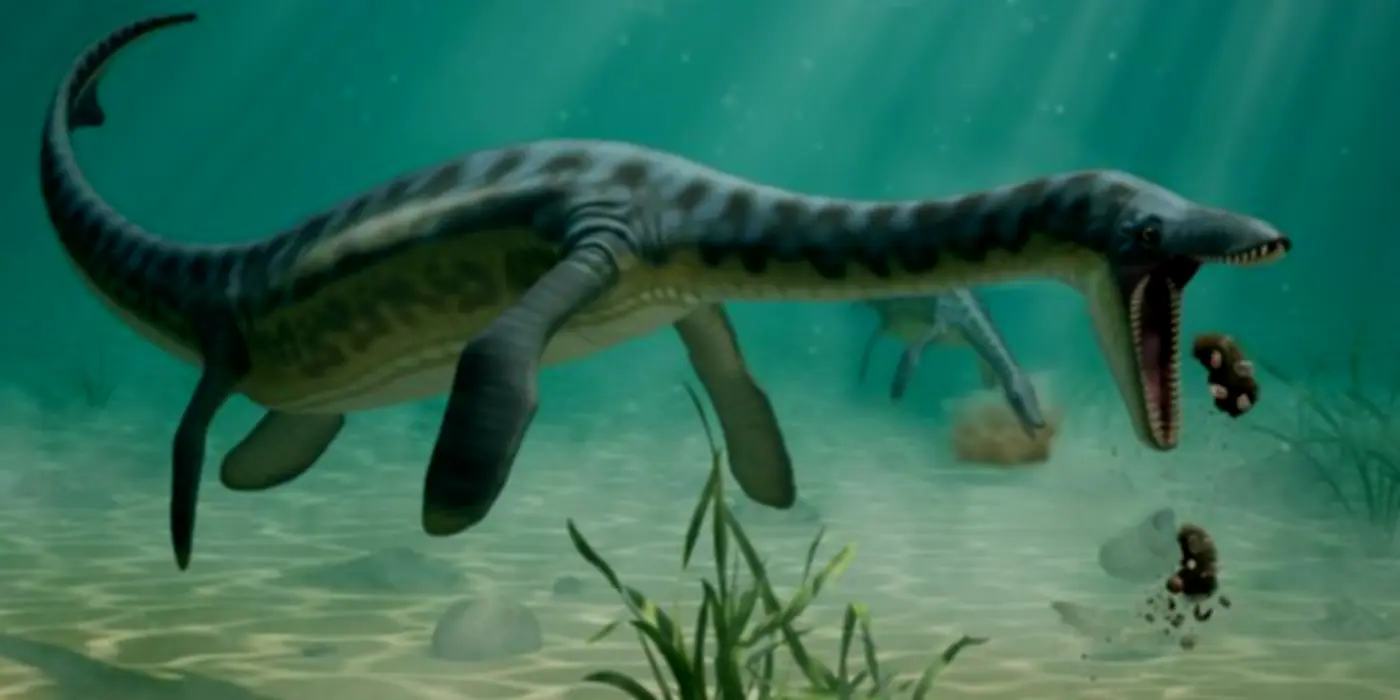
Jurassic Puke: Plesiosaurs Knew Not To Vomit Where They Eat
Jurassic monsters sometimes needed to vomit. When they did, they went to shore.
Jurassic monsters sometimes needed to vomit. When they did, they went to shore.


New research suggests that the geological staying power of continents comes partly from their losing battle with the Earth's oceans over magnesium. The research finds continents lose more than 20 percent of their initial mass via chemical reactions involving the Earth's crust, water and atmosphere. Because much of the lost mass is dominated by magnesium and calcium, continents ultimately gain because the lighter, silicon-rich rock that's left behind is buoyed up by denser rock beneath the Earth's crust.
The Earth's continents seem like fixtures, having changed little throughout recorded human history. But geologists know that continents have come and gone during the Earth's 4.5 billion years. However, there are more theories than hard data about some of the key processes that govern continents' lives.
We all know people who can seemingly eat whatever they want and not gain weight. Recent research from Tel Aviv University says a woman’s waistline may have less to do with rigorous exercise and abstaining from sweets than it does with the genes of her parents.
A new study by Prof. Gregory Livshits from the Sackler Faculty of Medicine at Tel Aviv University and colleagues from King’s College in London found a scientific link between the lean body mass of a woman and her genes. They’ve determined that thinness – like your smile or the color of your eyes – is an inheritable trait.

Scientists analysing the data from the European Venus Express spacecraft now orbiting Earth's prodigal twin planet have been piecing together an understanding of why the climate on both worlds is so different. Professor Fred Taylor of Oxford University presented the scenario in a talk at the RAS National Astronomy Meeting in Belfast on Wednesday 2nd April.
In the early stages of the Solar System, Venus seems to have evolved very rapidly compared to the Earth. Data from Venus Express supports the theory that the Earth’s twin once had significant volume of water covering the surface but it appears that these oceans were lost in a very short geological timescale. As a result of the loss of water, the geological evolution of the surface of Venus slowed right down because it was unable to develop plate tectonics like the Earth. Biological evolution was prevented altogether. Thus, in terms of Venus being another Earth in climate and habitability terms, it evolved too quickly at first, then too slowly.
Higher organisms do not have a “cost of complexity” — or slowdown in the evolution of complex traits — according to a report by researchers at Yale and Washington University in Nature.
Biologists have long puzzled over the relationship between evolution of complex traits and the randomness of mutations in genes. Some have proposed that a “cost of complexity” makes it more difficult to evolve a complicated trait by random mutations, because effects of beneficial mutations are diluted.
Democratic consultant Donna Brazile brought home America’s reluctance to talk openly about race in a New York Times article that preceded the Barack Obama speech that now has the whole nation buzzing. In essence, she said in her quote, any serious discussion about race has the effect of clearing a room.
Brazile’s remark and the presidential hopeful’s groundbreaking speech about a subject that politicians generally tiptoe around in public hint at the complexities of race relations in America today. As we approach the second decade of the 21st century, research shows that many Americans feel anxious during interracial interactions whether or not race is even mentioned.
Now a new study from Northwestern University suggests that whites who are particularly worried about appearing racist seem to suffer from anxiety that instinctively may cause them to avoid interaction with blacks in the first place.
Researchers at the University of Rochester have digitally reproduced music in a file nearly 1,000 times smaller than a regular MP3 file - a a 20-second clarinet solo encoded in less than a single kilobyte.
The achievement, announced today at the International Conference on Acoustics Speech and Signal Processing held in Las Vegas, is not yet a flawless reproduction of an original performance, but the researchers say it's getting close.
"This is essentially a human-scale system of reproducing music," says Mark Bocko, professor of electrical and computer engineering and co-creator of the technology. "Humans can manipulate their tongue, breath, and fingers only so fast, so in theory we shouldn't really have to measure the music many thousands of times a second like we do on a CD. As a result, I think we may have found the absolute least amount of data needed to reproduce a piece of music."
As gas prices continue to climb, alternative fuels get a lot of attention but how close are they?
Scientists atArgonne National Laboratory are working to chemically manipulate algae for production of the next generation of renewable fuels – hydrogen gas.
Some varieties of algae, a kind of unicellular plant, contain an enzyme called hydrogenase that can create small amounts of hydrogen gas. Tiede said many believe this is used by Nature as a way to get rid of excess reducing equivalents that are produced under high light conditions, but there is little benefit to the plant.
AIDS may partly be the consequence of an evolutionary accident, said Professor Frank Kirchhoff from the University of Ulm in Germany. at the Society for General Microbiology’s 162nd meeting being held this week at the Edinburgh International Conference Centre.
“AIDS is a deadly disease in people that is caused by human immunodeficiency virus (HIV). But similar viruses such as simian immunodeficiency virus (SIV), which infects monkeys, usually don’t cause disease in their natural monkey hosts,” says Kirchhoff.
Previous studies have established that one of the key differences between the way HIV-1 behaves in humans and closely related SIVs behave in monkeys is that when humans are infected with HIV-1 the immune system becomes highly stimulated. This means critical defence cells called helper T cells are continuously activated and die more quickly than usual.
Here's a myth many men are happy has been debunked - contrary to popular thinking about the need for hours of sexual activity, a survey of U.S. and Canadian sex therapists says satisfactory sexual intercourse for couples lasts from 3 to 13 minutes.
Penn State Erie researchers Eric Corty and Jenay Guardiani conducted a survey of 50 full members of the Society for Sex Therapy and Research, which include psychologists, physicians, social workers, marriage/family therapists and nurses who have collectively seen thousands of patients over several decades.
Thirty-four, or 68 percent, of the group responded and rated a range of time amounts for sexual intercourse, from penetration of the vagina by the penis until ejaculation, that they considered adequate, desirable, too short and too long.

Less than three months after forecasters announced the beginning of a new solar cycle (cycle 24), that has been changed. Solar Cycle 23 is still kicking.
Last week, three sunspots appeared and their magnetic polarity says they are all old cycle spots. ESA Solar and Heliospheric Observatory (SOHO) Project Scientist Bernhard Fleck says, “If cycle 24 had already begun, the magnetic polarity of the spots would be reversed.”
Two solar cycles? At the same time?
It sounds strange but it is normal. Around the time of solar minimum - which is now - old-cycle spots and new-cycle spots frequently intermingle. Eventually Cycle 23 will fade to zero, giving way in full to Solar Cycle 24, but not yet.
Plants, crops and trees naturally absorb atmospheric carbon dioxide (CO2) during photosynthesis and then pump surplus carbon through their roots into the earth around them. In most soils, this carbon can escape back to the atmosphere or enters groundwater.
Knowing this, a team from Newcastle University aims to design soils that can remove carbon from the atmosphere, permanently and cost-effectively using soils containing calcium-bearing silicates.
Calcium silicates are minerals that occur naturally in many different rocks and also in artificial materials such as concrete.

Astronomers have spied a faraway star system that is so unusual, it was one of a kind - and then its discovery helped them pinpoint a second one much closer to home.
They discovered the first star system 13 million light years away, tucked inside Holmberg IX, a small galaxy that is orbiting the larger galaxy M81. They studied it between January and October 2007 with the Large Binocular Telescope (LBT) on Mt. Graham in Arizona.
The star system is unusual, because it’s what the astronomers have called a “yellow supergiant eclipsing binary” -- it contains two very bright, massive yellow stars that are very closely orbiting each other. In fact, the stars are so close together that a large amount of stellar material is shared between them, so that the shape of the system resembles a peanut.