Carbon Nanotube Has EMI And Hides Heat
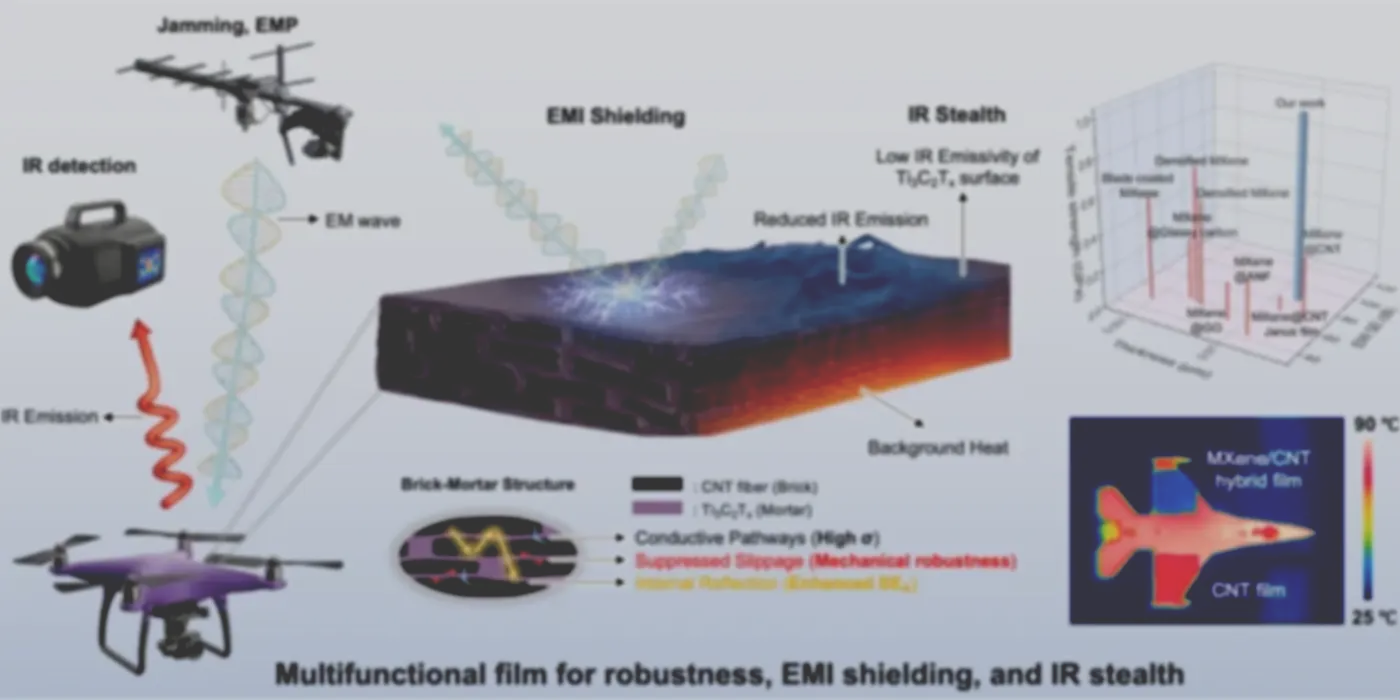
Researchers have developed a composite film that combines electromagnetic interference shielding, infrared stealth, and high mechanical strength using carbon nanotube fibers and MXene.
Researchers have developed a composite film that combines electromagnetic interference shielding, infrared stealth, and high mechanical strength using carbon nanotube fibers and MXene.


The nighttime breathing disorder known as obstructive sleep apnea increases a person’s risk of having a heart attack or dying by 30% over a period of four to five years, according to a new study.
The more severe the sleep apnea at the beginning of the study, the greater the risk of developing heart disease or dying, according to “Obstructive Sleep Apnea is Associated with an Increased Risk of Coronary Artery Disease and Death” (Session B12; Abstract # 1090)presented at the American Thoracic Society 2007 International Conference.
Women who eat apples and fish during pregnancy may reduce the risk of their children developing asthma or allergic disease, suggests a new study presented at the American Thoracic Society 2007 International Conference, on Sunday, May 20.
The SEATON study, conducted at the University of Aberdeen, UK, found that the children of mothers who ate the most apples were less likely to ever have wheezed or have doctor-confirmed asthma at the age of 5 years, compared to children of mothers who had the lowest apple consumption. Children of mothers who ate fish once or more a week were less likely to have had eczema than children of mothers who never ate fish.
A new study finds that the heat setting you choose when doing laundry makes all the difference when it comes to killing dust mites. The researchers found that washing laundry in hot water--140 degrees Fahrenheit (60 ºC) or higher--kills all house dust mites, compared with just 6.5% of dust mites in laundry washed at 104 degrees Fahrenheit (40 ºC), or warm water.
Hotter water temperatures are also more effective in removing dog dander and pollen, says lead researcher Jung-Won Park, M.D., Ph.D., of Yonsei University in Seoul, Korea.
Good news for harried housewives everywhere. Sometimes a house can be too clean. It turns out that kids may need exposure to common bacteria to develop proper immunities.
Endotoxin, a toxic substance made by certain types of bacteria, may reduce the risk of developing the allergic skin condition eczema or wheezing in children if they are exposed to it up to age 3, suggests a study presented at the American Thoracic Society 2007 International Conference, on Sunday, May 20.

Electrical engineers from the University of Delaware and Cambridge NanoTech have demonstrated for the first time how the spin properties of electrons in silicon--the world's most dominant semiconductor, used in electronics ranging from computers to cell phones--can be measured and controlled.
The discovery could dramatically advance the nascent field of spintronics, which focuses on harnessing the magnet-like "spin" property of electrons instead of solely their charge to create exponentially faster, more powerful electronics such as quantum computers.
The world's first silicon spin-transport devices, fabricated and measured in Ian Appelbaum's lab at the University of Delaware.
As societies emerge from conflict, men's dominance at all levels of decision-making ensures women never feel truly secure according to new research funded by the Economic and Social Research Council (ESRC).
In a unique study of women's security and participation in three post conflict societies—Northern Ireland, South Africa and Lebanon—researchers found that women see security differently from men. And because men dominate the institutions of peace-making and peace-building, they often fail to consider the specific security needs of women.
Astronomers have used powerful adaptive optics technology at the W. M. Keck Observatory in Hawai‘i to reveal the precise locations and environments of a pair of supermassive black holes at the center of an ongoing collision between two galaxies 300 million light-years away.
The new observations of the galaxy merger known as NGC 6240 reveal that each of the black holes resides at the center of a rotating disk of stars and is surrounded by a cloud of young star clusters formed in the merger.
An adaptive optics image of the double nucleus of the galaxy merger NGC 6240, taken in infrared light with the Keck II Telescope.
The research reactor at the Department of Energy’s Oak Ridge National Laboratory is back in action and better than ever.
After $70 million in renovations and more than a year of meticulous system checks, ORNL’s High Flux Isotope Reactor was restarted this week, taken to 10 percent power, and reached its peak power of 85 megawatts Wednesday.
ORNL's High Flux Isotope Reactor has been used for neutron-scattering studies since 196g. Credit: ORNL

Combining statistics and chemistry, researchers are challenging the evidence for the lone-gunman theory in the 1963 assassination of United States President John F. Kennedy.
Texas A&M University professor of statistics Cliff Spiegelman recently teamed with former Federal Bureau of Investigation (FBI) agent and forensic scientist William A. Tobin of Forensic Engineering International in Virginia and William D.
Physicists at the University of Pittsburgh have demonstrated a new form of matter that melds the characteristics of lasers with those of the world’s best electrical conductors. The work introduces a new method of moving energy from one point to another as well as a low-energy means of producing a light beam like that from a laser.
A lethal fish virus in the Great Lakes and neighboring waterways is approaching epidemic proportions, according to Paul Bowser, Cornell professor of aquatic animal medicine in the College of Veterinary Medicine. The viral hemorrhagic septicemia virus (VHSV), which causes anemia and hemorrhaging in fish, has now been identified in 19 species and poses a potential threat to New York’s $1.2 billion sport-fishing industry.
"It’s pretty obvious this is an epidemic even if it isn’t official," said Bowser. "There are just so many species affected and so many mortalities."
When it comes to estimating the intelligence of various animal species, it may be as simple measuring overall brain size. In fact, making corrections for a species' body size may be a mistake. The findings were reported by researchers at Grand Valley State University and the Anthropological Institute and Museum at the University of Zürich, Switzerland.
"It's long been known that species with larger body sizes generally have larger brains," said Robert Deaner, assistant professor of psychology at Grand Valley and the first author on the study. "Scientists have generally assumed that this pattern occurs because larger animals require larger nervous systems to coordinate their larger bodies. But our results suggest a simpler reason: larger species are typically smarter."