Carbon Nanotube Has EMI And Hides Heat
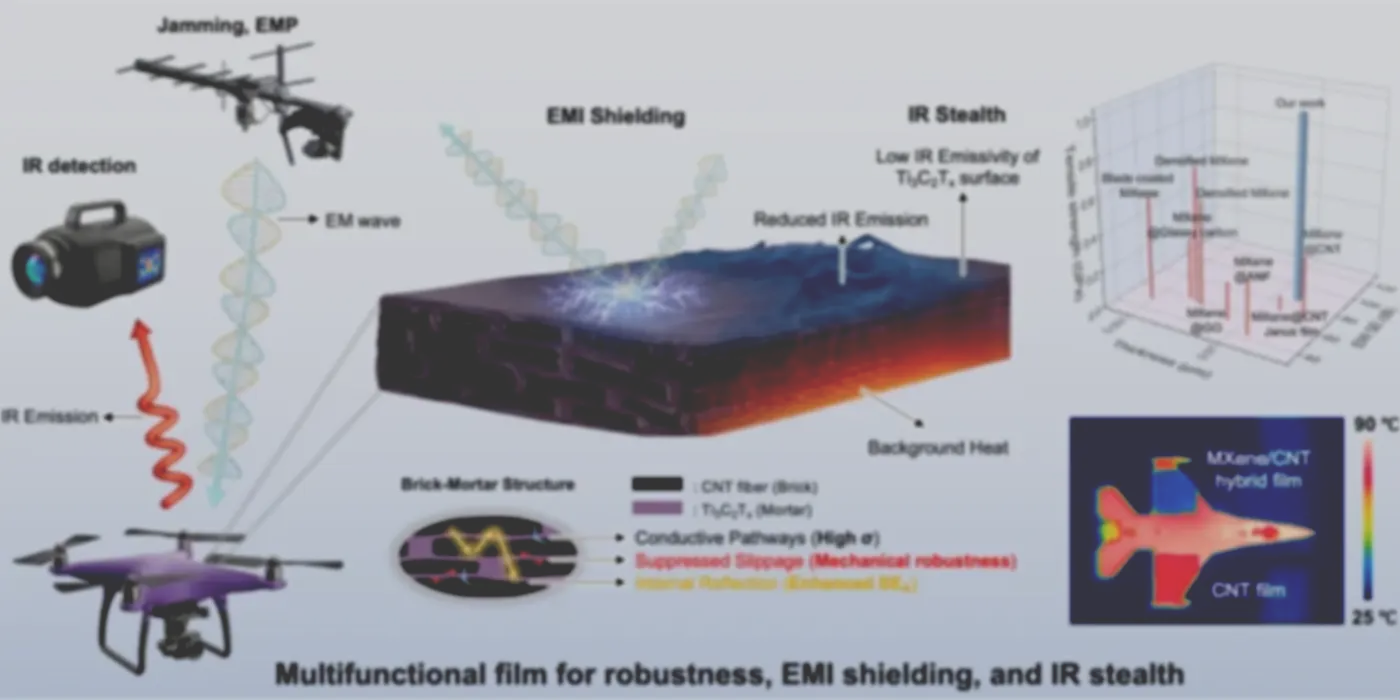
Researchers have developed a composite film that combines electromagnetic interference shielding, infrared stealth, and high mechanical strength using carbon nanotube fibers and MXene.
Researchers have developed a composite film that combines electromagnetic interference shielding, infrared stealth, and high mechanical strength using carbon nanotube fibers and MXene.


As the national repository for geological material from the Southern Ocean, the Antarctic Marine Geology Research Facility at Florida State University houses the premier collection of Antarctic sediment cores -- and a hot new acquisition will offer an international team of scientists meeting there May 1-4 its best look yet at the impact of global warming on oceans worldwide.
The remarkable new core was extracted during the recent Antarctic summer from record-setting drilling depths 4,214 feet below the sea floor beneath Antarctica's Ross Ice Shelf, the Earth's largest floating ice body. Laced with sediment dating from the present day to about 10 million years ago, the core provides a geologic record of the ice shelf's history in unprecedented detail.

University of Virginia researchers have discovered that microRNAs, a form of genetic material, can function as tumor suppressors in laboratory studies.
In the May 1 issue of Genes&Development, UVa researchers Drs. Yong Sun Lee and Anindya Dutta have shown that microRNAs can suppress the overexpression of a gene called HMGA2. This gene is related to creation of fatty tissue and certain tumors, as well as diet-induced obesity.
MicroRNA is a single-stranded RNA that is typically only 20-25 nucleotides long and is related to regulating the expression of other genes.
A Johns Hopkins team has stopped in its tracks a form of blood cancer in mice by engineering and inactivating an enzyme, telomerase, thereby shortening the ends of chromosomes, called telomeres.
Just because someone decides not to participate in a research project doesn't necessarily mean that they fundamentally object to taking part, a study published online in BMC Health Services Research suggests. Misunderstandings about the nature and process of a study often contribute to expressions of non-consent, a factor that should be incorporated in the design of future studies.
Despite the potential for conflict of interest, virtually all practicing physicians in the U.S. have some form of relationship with pharmaceutical manufacturers but the nature and extent of those relationships vary, depending on the kind of practice, medical specialty, patient mix, and professional activities, reports a study in the April 26 issue of the New England Journal of Medicine.
A Georgia Tech research team has discovered that water exhibits very different properties when it is confined to channels less than two nanometers wide – behaving much like a viscous fluid with a viscosity approaching that of molasses. Determining the properties of water on the nanoscale may prove important for biological and pharmaceutical research as well as nanotechnology. The research appears in the March 15 issue of the journal Physical Review B.
Georgia Tech physicists have discovered that water behaves differently when its compressed in nano-sized channel. In these small spaces water behaves much like a solid, exhibiting high viscosity and organizing itself into layers.
Lizards gave rise to legless snakes. Cave fishes don’t have eyeballs. In evolution, complicated structures often get lost. Dollo’s Law states that complicated structures can't be re-evolved because the genes that code for them were lost or have mutated. A group of sea snails breaks Dollo’s law, Rachel Collin, Staff Scientist at the Smithsonian Tropical Research Institute and colleagues from two Chilean universities announce in the April, 2007, Biological Bulletin.
Smaller males on top of larger females. The eggs are brooded under the shell and so are not visible. Credit: Rachel Collin, STRI Staff Scientist
Astronomers have discovered the most Earth-like planet outside our Solar System to date, an exoplanet with a radius only 50% larger than the Earth and capable of having liquid water. Using the ESO 3.6-m telescope, a team of Swiss, French and Portuguese scientists discovered a super-Earth about 5 times the mass of the Earth that orbits a red dwarf, already known to harbour a Neptune-mass planet. The astronomers have also strong evidence for the presence of a third planet with a mass about 8 Earth masses.
Artist's impression of the system of three planets surrounding the red dwarf Gliese 581.
Parents-to-be might soon don 3-D glasses in the ultrasound lab to see their developing fetuses in the womb "in living 3-D, just like at the IMAX movies," according to researchers at Duke University's Pratt School of Engineering.
The same Duke team that first developed real-time, three-dimensional ultrasound imaging says it has now modified the commercial version of the scanner to produce an even more realistic perception of depth. Paired images seem to pop out of the screen when viewed with the special glasses.
An independent study group, convened by AAAS’s Center for Science, Technology and Security Policy, has issued a report on the proposed Reliable Replacement Warhead (RRW) and its role in the future U.S. nuclear weapons program.
The panel concluded that most of the anticipated benefits of the proposed RRW program -- more easily maintained nuclear weapons with enhanced performance margins, improved safety and security properties, and greater ease of manufacture -- would occur in the long term subsequent to modernization of the weapons production complex.
Findings described in a new study by Stanford scientists may be the first step toward a major revolution in human regenerative medicine—a future where advanced organ damage can be repaired by the body itself. In the May 2007 issue of The FASEB Journal, researchers show that a human evolutionary ancestor, the sea squirt, can correct abnormalities over a series of generations, suggesting that a similar regenerative process might be possible in people.
Obese and overweight children increase their food intake by more than 100% after watching food advertisements on television; a study by the University of Liverpool psychologists has shown.
A group of 60 children of varying weights, aged between nine and eleven years was shown a series of both food television adverts and toy adverts, followed by a cartoon. Food intake following the food adverts was significantly higher compared with the toy adverts in all weight groups, with the obese children increasing their consumption by 134%; overweight children by 101% and normal weight children by 84%.