Brain Circuit Linked To Pregnancy Food Cravings Identified
Pregnant women have experienced exotic food cravings since recorded history began. This may be why.
Pregnant women have experienced exotic food cravings since recorded history began. This may be why.


In his Jan. 23 State of the Union address, President George Bush outlined his plan to reduce the nation's dependency on foreign oil by requiring the production of 35 billion gallons a year of renewable and alternative fuels by 2017, roughly five times the current target set by Congress of 7.5 billion gallons by 2012.
Among the most promising alternatives are fuels derived from biological material. Currently, the main biofuel used in the United States is ethanol distilled from kernels of corn. There are about 140 corn ethanol refineries nationwide, which produce more than 5 billion gallons a year.
Modern human mothers are probably happy that they typically have one, maybe two babies at a time, but for early hominids, low birth numbers combined with competition often spelled extinction.
"The lineages of primates have some traits that make it hard for them to respond to rapid perturbations in the environment," says Dr. Nina G. Jablonski, professor of anthropology and department head at Penn State. "Through time we see a lot of lineages become extinct when environments where the species are found become highly seasonal or unpredictable."
Primates evolved in the Paleocene and Eocene when worldwide climate was less seasonal. The beneficial environment allowed primates to evolve as relatively brainy animals that reproduce slowly.
A scientific panel revealed today that rising global demand for healthy seafood has exceeded wild capture fisheries' ability to provide all fish meals demanded by consumers. Aquaculture -- or the farming of seafood -- is helping to fill the gap between sustainable wild supplies and the public demand for seafood. Research unveiled at the AAAS Annual Meeting demonstrated the enormous potential for sustainable growth of healthy farmed seafood production, notably through advancements in feed efficiency and the ability to expand production in marine environments.
The notion that more information about the science of human-caused climate change will spur effective problem solving by American society is just flat wrong, according to a University of Colorado at Boulder climate policy analyst.
Even the 2007 Intergovernmental Panel on Climate Change report released Feb. 2, which painted a bleak global portrait of rising seas and temperatures due to human activity, is unlikely by itself to lead to meaningful mitigation or adaptation anytime soon, said Lisa Dilling of CU-Boulder’s Cooperative Institute for Research in Environmental Sciences. “Most people still don’t feel the immediacy of the problem,” she said.
A University of Queensland microbiologist is part of an international team that has identified a bacterial gene that may affect climate and weather.
Dr Phil Bond, from UQ's Advanced Wastewater Management Centre, and his former colleagues at the University of East Anglia in England, have found how a particular type of marine bacteria – Marinomonas – generates a compound that is a key component in global sulfur and carbon cycles.
“Marine algae can produce large amounts of a compound (dimethylsulfoniopropionate or DMSP) that when broken down by bacteria produces dimethyl sulfide (DMS),” Dr Bond said.
An international team of researchers from 19 countries has identified one gene and a previously unidentified region of another chromosome as the location of another gene that may contribute to a child's chances of having autism.
The findings, based on genetic samples from nearly 1,200 families with two or more children who have autism, were published today in Nature Genetics by more than 120 scientists from Europe and North America who make up the Autism Genome Project.
The project was launched in 2002 by scientists at 50 institutions to share data, samples and expertise in an effort to speed up the process of identifying susceptibility genes, those that heighten a child's risk of having the developmental disorder.
Though the cell membrane is a protective barrier, it also plays a role in letting some foreign material in — via ion channels that dot the cell’s surface. Now new research from the Nobel Prize-winning laboratory that first solved the atomic structure of several such channels shows that their function is controlled in part by a complex interaction between a channel’s voltage sensor and the cell membrane immediately adjacent to it.
The cell membrane is a specialized environment, home to a variety of proteins that enable the cell to interact with its environment. One specific family of proteins, voltage-gated channels, are especially important in conducting signals along and between nerve cells.
Hunting for traces of life on Mars calls for two radically different strategies, says Arizona State University professor Jack Farmer. Of the two, he says, with today’s exploration technology we can most easily look for evidence for past life, preserved as fossil "biosignatures" in old rocks.
Farmer is a professor of geological sciences in ASU’s School of Earth and Space Exploration, where he heads the astrobiology program. He is reporting on his work today (Feb. 16) at the annual meeting of the American Association for the Advancement of Science in San Francisco.
"Searching for extraterrestrial life must follow two alternative pathways, each requiring a different approach and tools," Farmer says. "If we're looking for living organisms, we are doing exobiology.
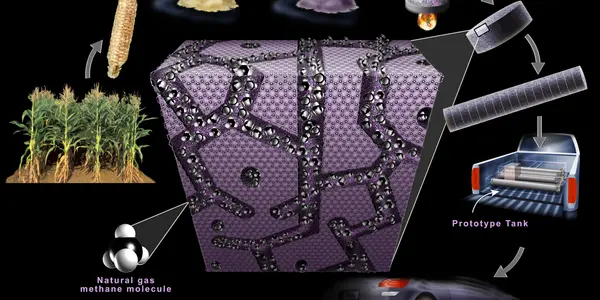
Using corncob waste as a starting material, researchers have created carbon briquettes with complex nanopores capable of storing natural gas at an unprecedented density of 180 times their own volume and at one seventh the pressure of conventional natural gas tanks.
The breakthrough, announced today in Kansas City, Mo., is a significant step forward in the nationwide effort to fit more automobiles to run on methane, an abundant fuel that is domestically produced and cleaner burning than gasoline.
Researchers at the University of Missouri-Columbia and the Midwest Research Institute in Kansas City have developed a method to convert corncob waste into a carbon "sponge" with nanoscale pores.
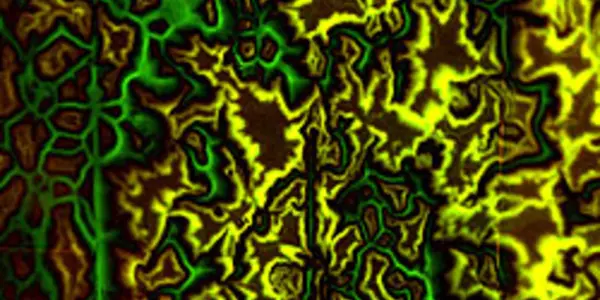
Just a little mechanical strain can cause a large drop in the maximum current carried by high-temperature superconductors, according to novel measurements carried out by the National Institute of Standards and Technology (NIST). The effect, which is reversible, adds a new dimension to designing superconducting systems—particularly for electric power applications—and it also provides a new tool that will help scientists probe the fundamental mechanism behind why these materials carry current with no resistance.
Magneto-optical image of magnetic fields within a YBCO superconductor showing electrically connected grains (yellow) and grain boundaries (green) that form barriers to superconducting currents.

Liquid or gas flowed through cracks penetrating underground rock on ancient Mars, according to a report based on some of the first observations by NASA's Mars Reconnaissance Orbiter. These fluids may have produced conditions to support possible habitats for microbial life.
These ancient patterns were revealed when the most powerful telescopic camera ever sent to Mars began examining the planet last year. The camera showed features as small as approximately 3 feet (one meter) across. Mineralization took place deep underground, along faults and fractures.
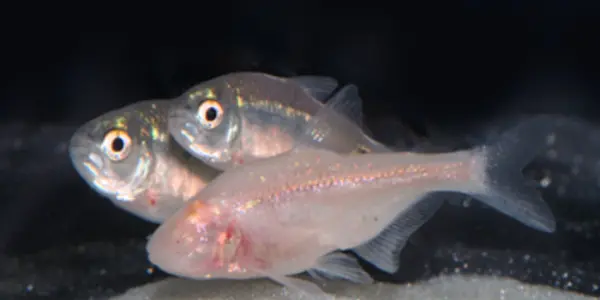
“Regressive evolution,” or the reduction of traits over time, is the result of either natural selection or genetic drift, according to a study on cavefish by researchers at New York University’s Department of Biology, the University of California at Berkeley’s Department of Integrative Biology, and the Harvard Medical School. Previously, scientists could not determine which forces contributed to regressive evolution in cave-adapted species, and many doubt the role of natural selection in this process.