Brain Circuit Linked To Pregnancy Food Cravings Identified
Pregnant women have experienced exotic food cravings since recorded history began. This may be why.
Pregnant women have experienced exotic food cravings since recorded history began. This may be why.


Ghostly galaxies composed almost entirely of dark matter speckle the universe. Unlike normal galaxies, these extreme systems contain very few stars and are almost devoid of gas. Most of the luminous matter, so common in most galaxies, has been stripped away, leaving behind a dark matter shadow. These intriguing galaxies-known as dwarf spheroidals-are so faint that, although researchers believe they exist throughout the universe, only those relatively close to Earth have ever been observed.
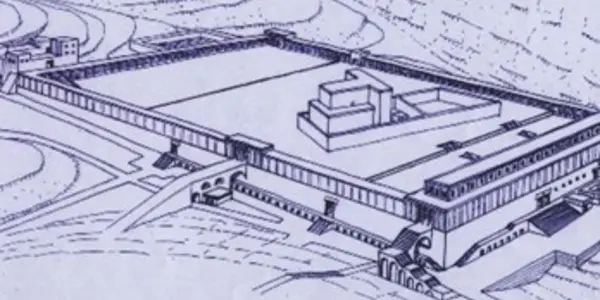
While scholars have put forth various assessments for the location of the Second Temple in Jerusalem, a Hebrew University of Jerusalem professor says that archaeological remains that have so far been ignored by scholars point to the exact location, which is in a spot that differs from prevailing opinion.
The location identified by Prof. Joseph Patrich of the Hebrew University Institute of Archaeology places the Temple and its corresponding courtyards, chambers and gates in a more southeasterly and diagonal frame of reference than have earlier scholars.
Drawing (Temple1) shows Prof. Patrich’s description of the location of the Temple compound (the rectangle defined by a solid line in the center of the drawing).

A robotic therapy device may help people regain strength and normal use of affected hands long after a stroke, according to a University of California, Irvine study.
Stroke patients with impaired hand use reported improved ability to grasp and release objects after therapy sessions using the Hand-Wrist Assisting Robotic Device (HOWARD). Each patient had at least moderate residual weakness and reduced function of the right hand, although the affected hands were neither totally paralyzed nor unable to feel.

This NASA Hubble Space Telescope image shows the colorful "last hurrah" of a star like our Sun. The star is ending its life by casting off its outer layers of gas, which formed a cocoon around the star's remaining core. Ultraviolet light from the dying star then makes the material glow. The burned-out star, called a white dwarf, appears as a white dot in the center. Our Milky Way Galaxy is littered with these stellar relics, called planetary nebulae. Hubble's Wide Field Planetary Camera 2 captured this image of planetary nebula NGC 2440 on Feb. 6, 2007.

A University of Calgary archaeologist has found the first prehistoric evidence of chimpanzee technology, adding credence to the theory that some of humanity's behavioral hallmarks were actually inherited by both humans and great apes from a common ancestor.
Dr. Julio Mercader, one of the few archaeologists in the world who studies the material culture of great apes, especially chimpanzees, uncovered stone 'hammers' last year in the Taï rainforest of Africa's Côte D'Ivoire (Ivory Coast) that date back 4,300 years.
Examples of some of the stones that were excavated. Analysis shows they were used by chimpanzees some 4,300 years ago to crack nuts.
Human nerve stem cells transplanted into rats' damaged spinal cords have survived, grown and in some cases connected with the rats' own spinal cord cells in a Johns Hopkins laboratory, overturning the long-held notion that spinal cords won't allow nerve repair.
A report on the experiments will be published online this week at PLoS Medicine and "establishes a new doctrine for regenerative neuroscience," says Vassilis Koliatsos, M.D., associate professor of neuropathology at Johns Hopkins.
Just as homes have smoke detectors, cells have an enzyme that responds to a buildup of fatty acids by triggering the production of a key molecule in the biochemical pathway that breaks down these fatty acids, according to investigators at St. Jude Children's Research Hospital. This breakdown of fatty acids, in turn, provides the cell energy while reducing the chance that excess fatty acids will accumulate.
The St. Jude discovery explains how the fatty acid-sensing enzyme PanK2 tailors production of this key molecule, coenzyme A (CoA), to the cell's energy demands. Understanding PanK2 function is also important because mutations in this enzyme cause an inherited neurodegenerative disease.

How do you get information from a preparation that is transparent? How can you still see a three-dimensional image through a microscope? Dutch researcher Rajesh S. Pillai investigated a new way of illuminating preparations under the microscope. For example, he could investigate the microstructure of food, which is important for the taste and shelf-life. Furthermore, this technique is highly promising for research into how fat is stored in the human body.
A blow with the hammer
Images can only be made under the microscope if the preparation is illuminated. Sometimes using a single lamp is not enough, for example when a three-dimensional image of a transparent sample is needed. In this project Pillai used a laser that emitted extremely short pulses of infrared light.
The rise of multicellular animals about 540 million years ago was a turning point in the history of life. A group of Finnish scientists suggests a new climate-biosphere interaction mechanism for the underlying processes in a new study, which will be published on February 14, 2007 in PLoS ONE, the international, peer-reviewed, open-access, online publication from the Public Library of Science (PLoS).
The theory invokes cold, ice-containing climates as a key precursor for multicellular life. If the model turns out to be correct, one can assume that complex life might exist also around stars which are more massive and short-lived than the Sun.
New research findings now appearing online in the Journal of Experimental Social Psychology began with a professor's desire to understand why her husband often seemed to ignore her requests for help around the house.
"My husband, while very charming in many ways, has an annoying tendency of doing exactly the opposite of what I would like him to do in many situations," said Tanya L. Chartrand, an associate professor of marketing and psychology at Duke University's Fuqua School of Business.
When Chartrand envisioned a formal academic study of people's resistance to the wishes of their partners, parents or bosses, her husband, Gavan Fitzsimons, became not only her inspiration, but also her collaborator.

The far-reaching influence of Spanish and Portuguese colonisers appears not to have extended to South American agriculture, scientists studying a 1,400-year-old Andean mummy have found.
The University of Manchester researchers compared the DNA of ancient maize found in the funerary offerings of the mummy and at other sites in northwest Argentina with that grown in the same region today.
Surprisingly, they found both ancient and modern samples of the crop were genetically almost identical indicating that modern European influence has not been as great as previously thought.
Photograph of the mummy and a close-up of the maize. (Credit: Dr Verónica Lia, Universidad de Buenos Aires)

Scientists using data from the HRSC experiment onboard ESA's Mars Express spacecraft have produced the first 'hiker's maps' of Mars. Giving detailed height contours and names of geological features in the Iani Chaos region, the maps could become a standard reference for future Martian research. The maps are known as topographic maps because they use contour lines to show the heights of the landscape.
This image of Mars taken by the High Resolution Stereo Camera on board ESA's Mars Express outlines the scales (1:200 000, 1:100 000 and 1:50 000) of the series of topographic maps of the planet's surface that can be realized thanks to HRSC data.