Brain Circuit Linked To Pregnancy Food Cravings Identified
Pregnant women have experienced exotic food cravings since recorded history began. This may be why.
Pregnant women have experienced exotic food cravings since recorded history began. This may be why.


Mice engineered to have cleft palates can be rescued in utero by injecting the mothers with a small molecule to correct the defect, say scientists at the Stanford University School of Medicine and Lucile Packard Children's Hospital. In addition to shedding light on the biology of cleft palate, the research raises hopes that it may one day be possible to prevent many types of human birth defects by using a similar vaccination-type technique in pregnant women likely to have affected fetuses.
"This is a really important baby step that opens the door to the development of fetal therapies," said pediatric craniofacial surgeon Michael Longaker, MD.
Researchers at the National Institutes of Health and other institutions have found a second genetic defect that accounts for previously unexplained forms of osteogenesis imperfecta (OI), a disorder that weakens bones, sometimes results in frequent fractures and is sometimes fatal.
The affected gene contains the information for a protein designated P3H1 (prolyl 3-hydroxylase 1), also known as leprecan. P3H1 is part of a complex of proteins that is crucial for refining collagen to its final form. Collagen is an important building block for bone.
Americans are bombarded with antismoking messages, yet at least 65 million of us continue to light up. Genetic factors play an important role in this continuing addiction to cigarettes, suggest scientists at Washington University School of Medicine in St. Louis.
In two studies in the January 2007 issue of Human Molecular Genetics, the scientists show that certain genetic variations can influence smoking behaviors and contribute to a person's risk for nicotine dependence.
The smoking-related genes identified normally facilitate communication between nerve cells in the brain. One gene in particular, the alpha-5 nicotinic cholinergic receptor (CHRNA5) gene, was a very strong indicator of risk for nicotine dependence.
Newborns with respiratory distress should be evaluated for primary ciliary dyskinesia, a rare genetic disease that has features similar to cystic fibrosis, says Thomas Ferkol, M.D., from Washington University School of Medicine in St. Louis. He reports finding that about 80 percent of patients with primary ciliary dyskinesia (PCD) have a history of newborn respiratory distress.
"The diagnosis of PCD requires a high index of suspicion, but PCD must be considered in any term newborn who develops respiratory distress or persistent hypoxemia (low oxygen in the blood), especially those who have reversed internal organs or an affected sibling," says Ferkol, director of the Division of Pediatric Allergy and Pulmonary Medicine at Washington University School of Medicine and St.
Patients with Parkinson's disease who are younger when they develop the condition, have a personality trait known as novelty-seeking or whose personal or family history includes alcohol abuse may be more likely to develop pathological gambling as a side effect of medications used to treat their condition, according to a report in the February issue of Archives of Neurology, one of the JAMA/Archives journals.
Behaviors associated with impulse control—including compulsive shopping, hypersexuality, binge eating and pathological gambling—have been associated with dopamine agonists, medications used to treat Parkinson's disease.

University of Michigan Comprehensive Cancer Center researchers have discovered the small number of cells in pancreatic cancer that are capable of fueling the tumor's growth. The finding is the first identification of cancer stem cells in pancreatic tumors.
Cancer stem cells are the small number of cancer cells that replicate to drive tumor growth. Researchers believe current cancer treatments sometimes fail because they are not attacking the cancer stem cells. By identifying the stem cells, researchers can then develop drugs to target and kill these cells.
Pancreatic tumor generated from cancer stem cells. (Image courtesy of University of Michigan Health System)

Every day we plan numerous actions, such as to return a book to a friend or to make an appointment. How and where the brain stores these intentions has been revealed by John-Dylan Haynes from the Max Planck Institute for Human Cognitive and Brain Sciences, in cooperation with researchers from London and Tokyo. For the first time they were able to "read" participants' intentions out of their brain activity. This was made possible by a new combination of functional magnetic resonance imaging and sophisticated computer algorithms (Current Biology, 20th February 2007, online: 8th February).
Brain regions from which it was possible to "read out" peoples' intentions.
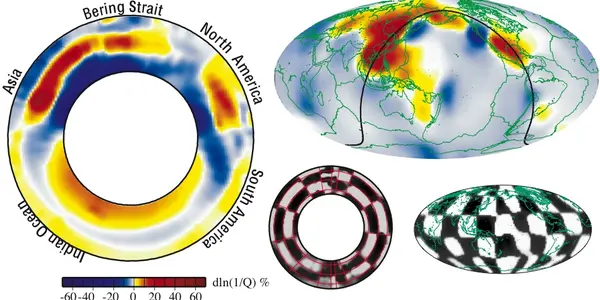
A seismologist at Washington University in St. Louis has made the first 3-D model of seismic wave damping — diminishing — deep in the Earth's mantle and has revealed the existence of an underground water reservoir at least the volume of the Arctic Ocean.
It is the first evidence for water existing in the Earth's deep mantle.
One of the most dramatic features in the Wysession et. al global mantle shear-wave attenuation model is a very high-attenuation anomaly at the top of the lower mantle beneath eastern Asia. This anomaly is believed due to water that has been pumped into the lower mantle via the long history of the subduction of oceanic lithosphere — crust and upper mantle — in this region.
They said last week they would make environmental crime a part of European law and they may have done it.
The European Commission draft still needs approval from the European Parliament and governments of the 27 member countries - since the majority of the EU countries that were signatories to the Kyoto Treaty are not in compliance the new law could have devastating effects.
Franco Frattini, the Justice Commissioner, said companies were using loopholes because various countries had different laws.
"We cannot allow safe havens of environmental crime inside the EU," he said.
The primary targets: dumping of toxic waste, illegally shipping or treating waste and trading in endangered species.

Using a unique weaving machine of their design, Duke University Medical Center researchers have created a three-dimensional fabric "scaffold" that could greatly improve the ability of physicians to repair damaged joints with the patient's own stem cells.
"If further experiments are successful, the scaffold could be used in clinical trials within three or four years," said Franklin Moutos, a graduate student in the Orthopedic Bioengineering Laboratory who designed and built the weaving machine.
It's a bad day for ghost research, though you can be sure Discovery or History Channel will fill in the gap when they run out of Shroud of Turin articles.The Princeton Engineering Anomalies Research (PEAR) program at Princeton University, which attempted to discover if there was any way the mind could influence physical reality, closing its physical facilities at the end of February. Well, they can just ESP the research, they don't need physical facilities.
A study by researchers at the University of California, San Diego (UCSD) School of Medicine shows that fluctuations in Vitamin D3 levels control the body's innate immune response, affecting a skin wound's ability to heal.
Richard L.