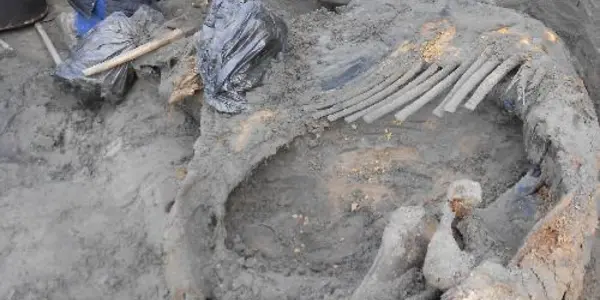
The carcass of a frozen mammoth with signs of weapon-inflicted injuries suggests humans were present in the Eurasian Arctic ten millennia earlier than previously thought. These results, which provide perhaps the oldest known story of human survival in the Arctic region, date human presence there to roughly 45,000 years ago, instead of 35,000 years ago, as previously thought. Paleolithic records of humans in the Eurasian Arctic are scarce. In 2012, a team led by Alexei Tikhonov excavated a partial carcass of a male woolly mammoth from frozen sediments in a coastal bluff on the eastern shore of Yenisei Bay, in the central Siberian Arctic. Through radiocarbon dating of the animal's tibia bone and surrounding materials, the researchers dated it at 45,000 years old.