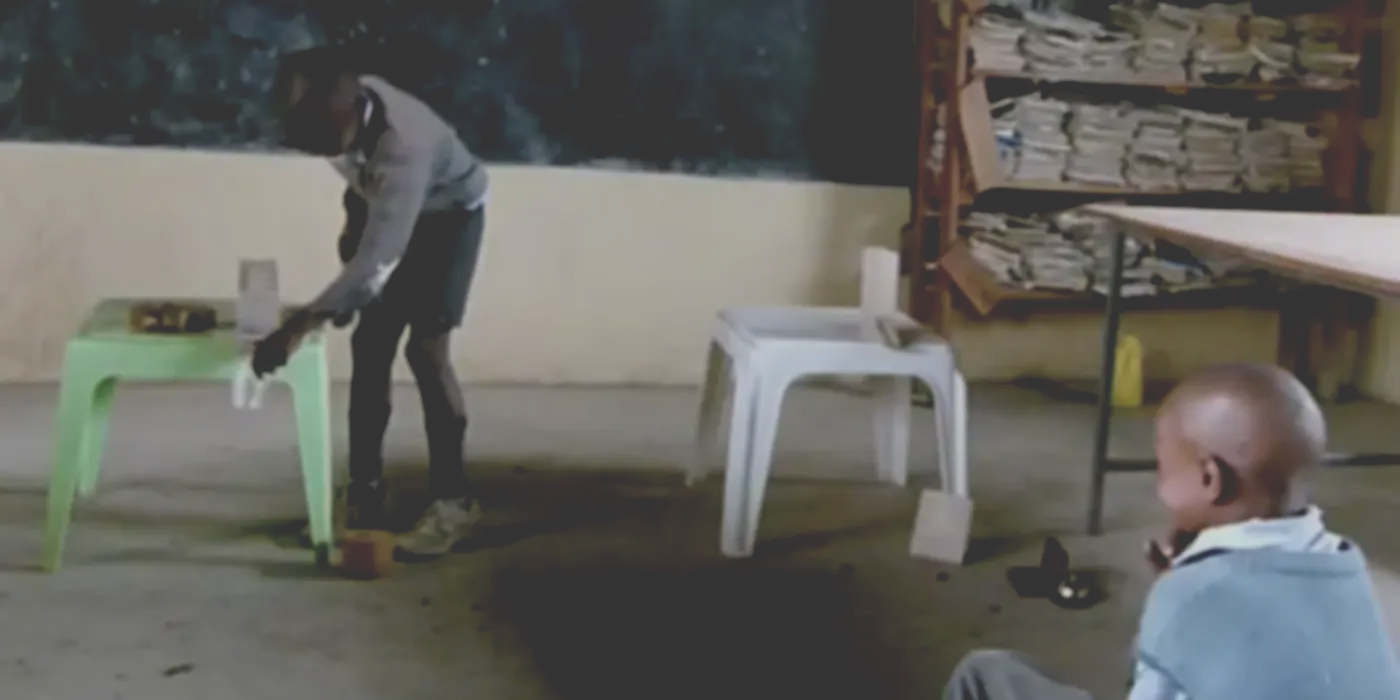
Kids Helping Kids Is Universal - But Cultures Help Differently
A simple game reveals a universal instinct in kids
A simple game reveals a universal instinct in kids


Kids with glasses were once stereotypically considered smarter - expensive prescription specs did not lend themselves to sports so it made some sense they would focus on books due to the biological hand that was dealt them
But it may be that needing glasses is an indicator of knowledge if other ways - glasses may be created by learning. A recent paper found hat attaining a higher level of education and spending more years in school were associated with a greater prevalence and severity of myopia - nearsightedness.
The authors say they are the first population-based study to demonstrate that environmental factors may outweigh genetics in the development of myopia.

You see advertisements for fitness apps on smartphones all of the time. Apple prides itself on convincing you that you will be a better dancer and healthier if you buy their phone. The problem is that the people most likely to use a fitness app for more than a week are least likely to need it.
Or maybe they do, according to recent Scare Journalism. In the health fad culture perpetuated by mainstream media, there is now a War On Sitting. Once some crazy claim appears in the New York Times, studies are going to crop up affirming exactly what popular media claims say.

A new paper based on an analysis of sleep and cognitive (brain function) data from 3,968 men and 4,821 women who took part in the English Longitudinal Study of Ageing (ELSA) indicates that sleep problems are associated with worse memory and executive function in older people.
Respondents reported on the quality and quantity of sleep over the period of a month and the results showed that there is an association between both quality and duration of sleep and brain function which changes with age.

Organic farming boosts biodiversity - at least that is the claim of organic farmers. But it depends. It's a $35 billion business and there are plenty of gigantic organic mega-farms that aren't diverse at all.
In practice, the number of habitats on the land plays an important role alongside the type and intensity of farming practices, according to a study of 10 regions in Europe and two in Africa published in Nature Communications. Organic farms still use plenty of toxic pesticides and more chemical fertilizer than conventional farms but they can support biodiversity when they consciously conservce different habitats on their holdings.

Sorry Malcolm Gladwell, and you positive thinking book buyers at Whole Foods, you are not going to be a world-class sprinter no matter how much you practice unless you were born with exceptional speed.
A new paper by Michael Lombardo, professor of biology at Grand Valley State University, and Robert Deaner, associate professor of psychology, shows that the developmental histories of elite sprinters contradict the popular deliberate practice model of expertise. According to this deliberate model, there is no such thing as innate talent. Instead, 10 years of deliberate practice (roughly 10,000 hours) are necessary and sufficient for anyone to become an expert in any field, including sports.
A new study has affirmed what most of us knew - practice makes perfect, but only if you have some ability. In the nature versus nurture debate, Usain Bolt is still going to run faster than most people no matter how much they practice.
And that goes for musicians too. An analysis of 850 sets of twins leads Zach Hambrick, a Michigan State University professor of psychology, to say both genes and environment matter, "Not only in the sense that both nature and nurture contribute, but that they interact with each other.

Want to teach a robot to tend the garden? It will go faster if you let the crowd help. University of Washington computer scientists at the 2014 Institute of Electrical and Electronics Engineers International Conference on Robotics and Automation in Hong Kong showed that crowdsourcing can be a quick and effective way to teach a robot how to complete tasks
Learning by imitating a human is a proven approach to teach a robot to perform tasks, but it can take a lot of time. Imagine having to teach a robot how to load the dishwasher – it might take many repetitious lessons for the robot to learn how to hold different types of cookware and cutlery and how to most efficiently fill the machine.

By trapping a magnetic field with a strength of 17.6 Tesla, roughly 100 times stronger than the field generated by a typical fridge magnet, in a high temperature gadolinium barium copper oxide (GdBaCuO) superconductor, researchers not only beat the previous record by 0.4 Tesla, they harnessed the equivalent of three tons of force inside a golf ball-sized sample of material that is normally as brittle as fine china.

A study of triple-negative breast cancer raises the prospect that some patients with aggressive tumors may benefit from a class of anti-inflammatory drugs used to treat rheumatoid arthritis.

Neurons are vital to the functional organization of the central nervous system. Multiple cell types are present within any brain structure, but the rules governing their positioning, and the molecular mechanisms mediating those rules, are unknown.
A new study finds that a particular neuron, the cholinergic amacrine cell, creates a "personal space" in much the same way that people distance themselves from one another in an elevator. The study also says that this feature is heritable and identifies a genetic contributor to it, pituitary tumor-transforming gene 1 (Pttg1).

Rifampicin and related drugs are important antibiotics in the "drug cocktail" that cures tuberculosis in about 6 months. But two forms of tuberculosis, referred to as "multi-drug-resistant," or MDR, and "extensively drug-resistant," or XDR, have become resistant to rifampicin.
In 1993, resurging levels of tuberculosis due to antibiotic resistance led the World Health Organization to declare it a global health emergency. Today more than 1 million people around the world are dying each year from tuberculosis.

Obviously, as the creators of the four pillars of the Science 2.0 concept, we're interested in new ways to use data to make meaningful decisions, but we recognize that key breakthroughs are more likely to happen in the private sector, where money can be made filling a demand.
A paper by Aetna and GNS Healthcare Inc. in the American Journal of Managed Care demonstrates how analysis of patient records using analytics can predict future risk of metabolic syndrome.