A few weeks ago, a religious group forecast an apocalypse with the Bible as their source. More recently, a bee religion also warned of an apocalypse. They cited Science magazine.
The differences after that are minor, less understandable than people who claim they are 'spiritual but not religious' while claiming nature has divine energy. Activists tweeting about validation in a consumer science magazine think their religion is more ethical than the hedonistic ways of others and they claim their beliefs are grounded in natural law - just like that other sect a few weeks ago.(1)
When you look at both apocalypses with the same skepticism, you see the flaws in their doomsday forecasts: both saw what they wanted to see. And both ignored common sense to do so.
The religion in the second instance is one that's cropped up around bees as sacred sees neonicotinoid pesticides as the Anti-Christ.
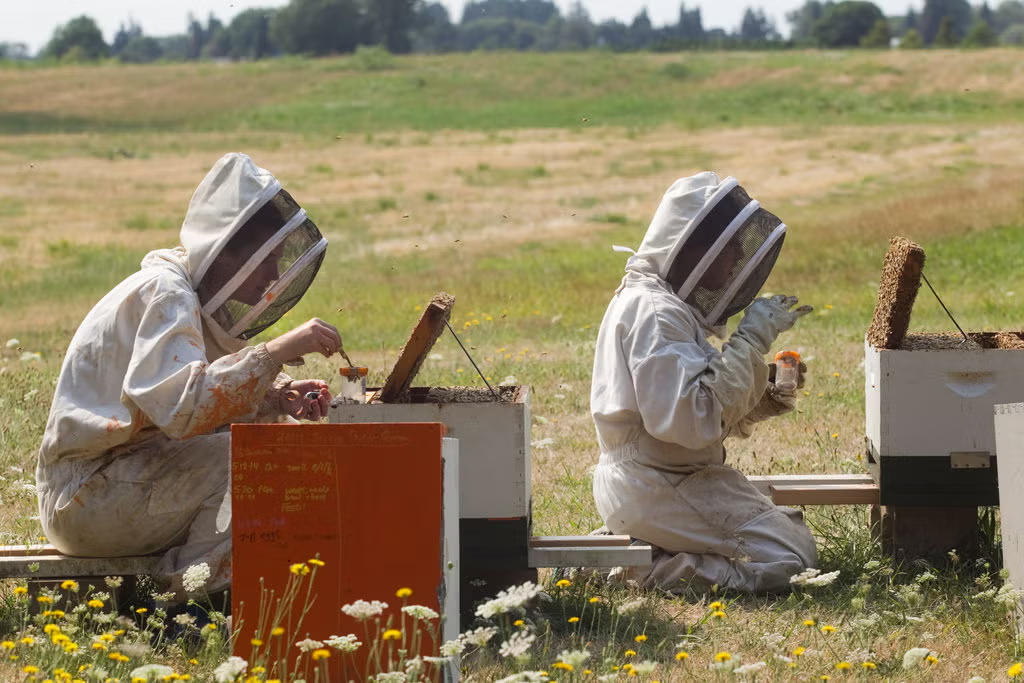
Photo: Lynn Ketchum, provided by the Oregon State University College of Agricultural Sciences
Farmers don't see what they see. Farmers love "neonics" they are a targeted seed treatment rather than older chemicals mass-sprayed on whole plants. Because they are seed treatments, they stop pests when plants are most vulnerable. Activists hate them they always need a fresh supply of science to demonize. Decades ago they were exactly the product they said they wanted, much like activists said about modern GMO seeds.
In Science, a group of anti-neonic deacons(2) discuss how they solicited honey samples from amateur volunteers. After an analysis of the samples, they searched for the presence of imidacloprid, clothianindin, thiamethoxam, acetamiprid and thiacloprid, they found that 75% tested positive for one of them; 45% tested positive for two, while 10% contained four or five.
Is that exceptional? No, it's expected given modern testing ability - zero used to mean less than one part per million but now we can test in parts per quadrillion; that is 100,000,000,000% greater precision. We can literally detect anything in anything now.
What you might be concerned about is not presence, but concentration. As Paracelsus said, the dose makes the poison. There, it showed no worry at all. A recent review found that in order to cause physiological or behavioral impairments, there needed to be 5,000% the average total concentration the Science paper reported. Instead, detectable levels were actually lower than in studies years ago, which means these levels wouldn't even have been noticed then.
I mention Paracelsus because hundreds of years ago illiterate peasants understood that "the dose makes the poison" does not mean "any molecule is a poison" - which is what $3 billion in anti-science groups argue is the case. Neonics and bees have entered the world of homeopathy, folks. Except junk science aficionados call their brand of homeopathy "bioaccumulation" or "endocrine disruption". They come up with some cosmic science-y sounding name for a new apocalypse and create a paper about it. They put a lazy disclaimer in there somewhere (Supplemental Data works well for that.) If they cut Organic Consumers Association a check, Ronnie Cummins will have one of his corporate front groups, like US Right To Know, get their apocalypse in Russia Today or Huffington Post or Project Syndicate. Twenty of their bots will retweet it on Twitter, including one they created that uses our logo and a similar-sounding name.
That is how they get paid. And they get paid a lot.
The claims are suspicious on many grounds. A few years ago, anti-neonics activists, a group which contains one of the co-authors of this study, were exposed for creating a conspiracy to manufacture doubt about this class of pesticides and get them banned. This paper follows the same playbook they outlined then: Get one paper published in a popular journal, then get it a better Impact Factor by citing it in lots of other smaller journals and in media, get activist groups to tweet about it, get a government panel called.
In this case, the authors cite as gospel a paper that matched their goal, because it claimed a kind of "neonic disorder" at 1/300th to 1/4,000th the level that results in any actual physiological or behavioral differences in real-world results. "Disorder" is all the rage in environmental circles because it has no real meaning. It can be any spectrum of conditions they want to include and link to their chemical of the month. By accepting that one paper as foundational (while ignoring others) they were able to correlate their trace levels of chemicals in honey to an effect they can't show was even happening and promote worry about effects in human, even though neonics can't impact any vertebrates. Then they can insist it should be banned, which they did in interviews.
It's Bertrand Russell's closed system with a contradiction.(3)
As long as you create a fictional ecosystem where bee numbers are dropping, where field tests show adverse effects from realistic levels and gravity doesn't work, you can introduce that "molecular effects" are happening, a kind of bee homeopathy. Except none of that is true. In the real world, bees are doing great, there are no adverse effects at normal levels and gravity will not allow clouds of pesticides to hang suspended in the air for 12 hours while bees zip back and forth through it.
If bee homeopathy is real, pesticide religions can calculate the date of the bee apocalypse, which is apparently real soon unless you send someone a check.
Which someone? Just look for the groups sending around that Science study and you'll know.
NOTES:
(1) Johannes Kepler, famous for Kepler's Laws of Planetary Motion, calculated April 27th of 4,997 BC as the date the universe was created. Young Earth Creationists can claim pretty good company. But he debunked apocalypse dates, so doomsday prophets are out on their own.
(2) Nothing else explains their fervor, as shown by this analysis on Science 2.0:
1. Senior author A. Aebi broke their own press embargo to give a special interview about the study to the activist site foodingredientsfirst.com and call for an outright ban on neonics;
2. Lead author E.A.D. Mitchell is a member of the infamous International Union for Conservation of Nature Task Force on Systemic Pesticides, which was exposed years ago plotting to fabricate studies to get neonics banned;
3. Both Mitchell and Aebi appeared with other anti-neonic activists on a so-called ‘scientists letter’ urging governments to restrict or ban uses of neonic pesticides.
(3) Bertrand Russell's assertion of the related proposition that once a contradiction is allowed into a closed system anything can be proven. Supposedly someone in the audience yelled out a challenge: "If 2 plus 2 equals 5, prove that I am the pope."
Russell replied, "If 2 plus 2 is 5, then 4 is 5; if 4 is 5, then (subtracting three from each side) 1 is 2; you and the pope are two, therefore you and the pope are one."