Actors are famous for manufacturing traumatic situations about every movie they've done but the public builds that into their psychological makeup. People just chuckle that millionaires on union-run film sets think their life was in danger because a light bulb went out. It explains why they have so much chaos in their personal lives and perhaps why so many of their children grow up rather warped. For most people, appropriating oppression, especially if the kids can't see if it is real, damages their socialization.
Like ultraprocessed foods, there is no scientific definition for “appropriated racial oppression” but one thing all seeking to define it share in common is blaming feelings of oppression on normative white ideals in society. Basically, there are no white supremacists with a psychological pathology, it's white people being the majority that creates the problem.(1)
Most immigrants don't feel appropriated oppression, they instead say 'you should see how they talk about foreigners in my country' and get on with their lives. Yet their kids may be more inclined to want to 'live in important times' and believe they have experienced oppression due to their name or skin color.(2)
A new paper says that black parents who've lived here for hundreds of years but have appropriated racial oppression - they have shaped their beliefs about themselves around their own norms of American Whiteness - are passing along less self-worth to their children. Oddly, it wasn't darker skin color that created more appropriated racial oppression, it was lighter.
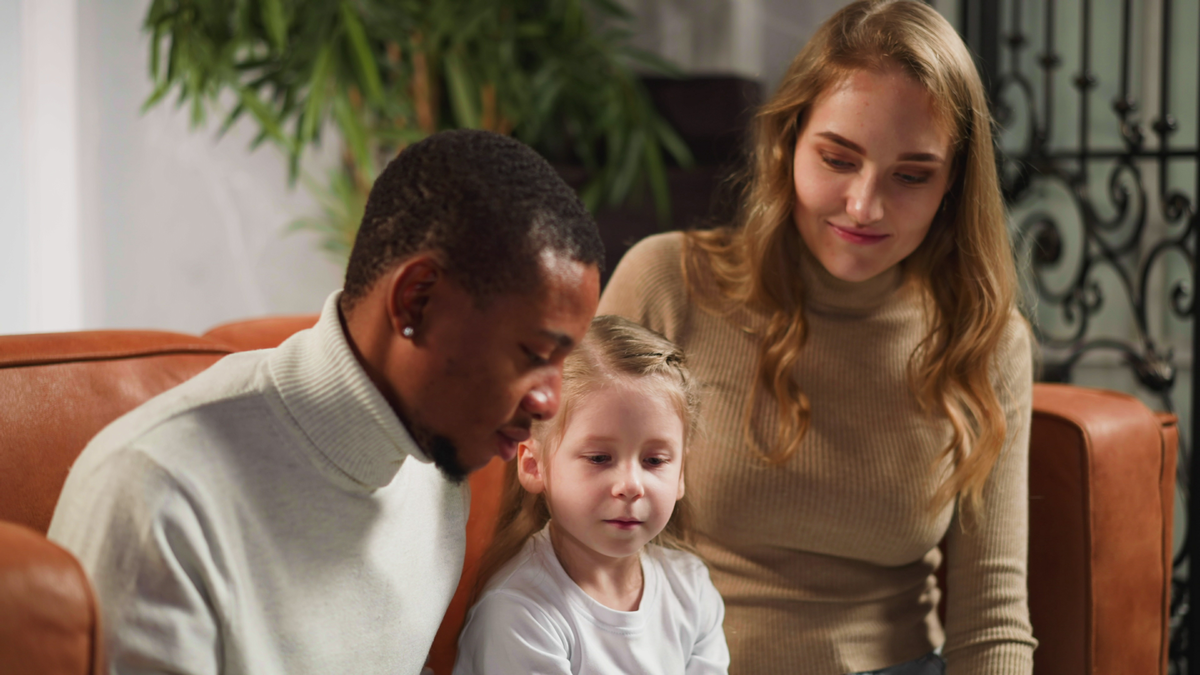
A blended family is the most American thing ever. Image: Storyblocks
That is the opposite of 50 years ago when light-skinned boxer Muhammad Ali made dark skin color taunts against his opponent, Joe Frazier. Frazier's kids were called "gorilla" in school by other black kids because Ali did it. Years later, when called to account for his treatment of darker people, he said it was just psychological warfare but maybe it was appropriated racial oppression.
Most kids learn resilience from parents. Talk to an Italian whose family moved here 100 years ago and they have a great deal of cultural pride yet their ancestors were hated by existing people in cities when they arrived because they didn't speak English and were taking 'their' jobs. Then all Italians endured the stigma of the organized crime reputation.(3) They do not feel less American now, they feel like they have made America more Italian. Or at least more New Jersey Italian.(4)
If the Irish made the country their own, and then Italians also, why don't black people who've been here far longer? The real answer is that they have. There are 2,400,000 black millionaires in the US (the world leader by far) and when you take out inherited wealth, black people close a lot of ground and Asians and white people are about the same. Claims of problematic racism play to 1950s stereotypes, when Democrats were still allowed their Jim Crow laws and segregated water fountains, but any of us pretending we suffer like our ancestors is appropriating oppression.(5) My great-grandmother was an Iroquois adopted by a white family. She was literally called "The Squaw" by women of her generation and the following one in my family. People looking down on me because I was poor can't really be compared to her experience but if I really needed to feel like I faced struggle, I'd pretend they were the same.
America today is the least racist country in the world. Some Europeans will object to that with nationalistic reflex, just like some claim air conditioning is stupid and they care about Ukraine, but they know it is true.(6) Asians won't object at all, they nod their head vigorously. Some American black people will object vigorously, which is the point. Even if you have not been oppressed you may have appropriated it and feel like you act differently because of it. Which may impact your kids.
How entrenched is appropriated oppression? A writer talking about this study will get emails yelling at them for writing about it if they are the wrong skin color, and be told they are part of the problem. Especially by humanities academics whose careers are in talking about racism.
But the data are there regardless of whether or not you think some surveys can only be mentioned by some skin colors. In this, 201 pairs of Black parents and adolescent children enrolled in the Ethnic and Racial Dynamics in Black Families project were surveyed for emotional responses about negative perceptions of their race plus beauty standards, like superiority associated with skin tones. If that sounds like another form of Implicit Bias testing, the worst joke psychology pulled on culture of the last 30 years, you may be correct, but that doesn't mean it can't be valid - as long as you calibrate it to what it can and cannot show.
Respondents also compared their own skin color to photographs on a 1 to 10 scale, ranging from the lightest to the darkest possible. The results were that even though they were mostly people with college or graduate degrees, they still reported racism-related levels of stress.(7) And the lighter-skinned the families were, the less likely they were to promote self-worth in their children.
Surveys are not science, never have been, and never will be, but because our experiences are our own, it's all we have. And some will even reframe the feelings of others through a preferred narrative. That darker-skinned people felt better necessitated a bizarre rationalization by the authors; they posit that darker people "internalized anti-Blackness" and avoided the issue. That sounds bad, and it may be for academics projecting onto the person doing it, but the kids seem to be better off when they are not told every other racial group dislikes them. So maybe Americans need to internalize a lot more instead of making everything a social pathology, or at least a psychological malady. Having it good makes it possible to make perfection the enemy of the terrific.
Still, their action item is positive. Smith et al. advocate that “interventions that help parents process and resist appropriated racial oppression may be key to fostering resilience and racial pride in the next generation" and that is true. As the old saying goes, 'if your only tool is a hammer every problem is a nail' and that also applies to race and appropriated victimization.
What truly matters is what we pass on to our kids. I may have been discriminated against because of my clothes growing up but that didn't get passed on to my children. They dress like hobos on purpose and feel no shame.
Citation: McNeil Smith, S., Codamon, A., Alexander, C. S., Anderson, J., & Jones, S. C. T. (2026). Linking Parents’ Appropriated Racial Oppression to Their Racial-Ethnic Socialization Practices: An Intergenerational Examination Among Black Parent-Child Dyads. Journal of Social and Personal Relationships, DOI: 10.1177/02654075261457
NOTES:
(1) A science audience is confused by this but it does explain a basketball player like Chris Webber wanting to leave Sacramento because there are 44 percent white people and he grew up in a city where white people were only 11 percent. To him, fewer than 80 percent people of his own color might be a lack of diversity.
(2) Only in college admissions is it likely to be real. Multiple Supreme Court cases have told colleges to stop discriminating against Asian students because they are the 'wrong' minority.
(3) As an example of how appropriated oppression lingers regardless of skin color, Joe Kennedy, Sr. was a Prohibition criminal, but used that wealth to become a prominent Democrat. Yet he felt like he suffered in reputation due to his grandfather emigrating from Ireland when a million Irish immigrants took a lot of east coast jobs from Americans. He became determined to make one of his kids President of the United States. After his namesake, Joe Jr., a fighter pilot, died in World War II, he got his other son a seat in the House of Representatives, then the Senate, and finally John F. Kennedy became the first Irish-Catholic President in American history. Joe made his appropriated oppression a motivating factor.
(4) Now Italians are such a part of the world cultural fabric that Andrea Bajani can write The Anniversary, about a terrible Italian family, and it will be a bestseller. None of that fuzzy-wuzzy 'nonna making Sunday pasta' stuff. That couldn't have happened decades ago because it would have been bad for the cultural brand.
(5) Even I subconsciously do it. I won't go to a grocery store without wearing a sport coat and my mom said she noticed my hang-up early on. Though not a racial minority, we were in poverty and when we left our town of 200 people it was obvious. People 'looked down' on us, but we were the same color. It was the clothes, or so I thought. She was not shocked when before my senior year of high school I worked all summer baling hay for farmers and mowing lawns so I could have nice clothes.
(6) Every former slave and their descendants is a citizen. In France, if your parents were immigrants you'd better have lived there the entire time and then you may apply at age 18. Only if you are a successful athlete or rich are you certain to be allowed to become French.
(7) People's experiences are their own. When I was being raised in the south, I never heard racist language about black people but Alabama Governor George Wallace was the front-runner for the 1972 Democratic party presidential nomination, and he had been a KKK member. My family were Democrats but hated that they were still considered a backwards people about race in the south when northern Democrats had instituted the Great Society. Wallace got shot and that ruined his chances but that he was the front-runner at all should have been worrisome. Like their antisemitism of today, Democrats of the time didn't see that presidents having to federalize their state National Guards to institute civil rights was a problem, but it is obvious in hindsight.
The Republican, Richard Nixon, got 520 electoral votes in 1972. His Democratic party opponent got 17.
The odd thing is that Nixon would eventually resign when he was implicated in spying on the Democratic party - in a race he was certain to win. But he was the clearest case of being cheated in known presidential history: The 1960 election, when Senator Lyndon Johnson of Texas and Mayor Richard Daley of Chicago manufactured enough votes to flip those two to states to their party. The 51 electoral votes from Texas and Illinois both needed to reach 269 needed ended up with Kennedy. The vote difference was 8,858 in Illinois. All from Chicago. In Texas, the margin was over 40,000 but had so many irregularities that today it could not have happened. Allies of Johnson, for example, had precincts reporting for Kennedy-Johnson with nearly twice votes as many as there were actual voters.
His real oppression became appropriated oppression about everything and it ruined his legacy.