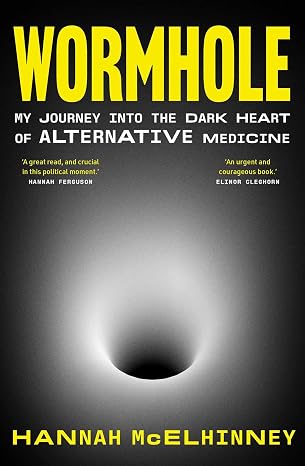
Wormhole begins quickly. Hannah McElhinney’s cousin, who has travelled to Malaysia for a medical treatment, has sepsis. She’s in a coma. One page later, she’s dead. The pacing of the book’s opening matches the quick, often uncertain feeling of experiencing a medical emergency with a loved one.
Then the book rewinds, revealing McElhinney’s relationship with her cousin Lauren. Diagnosed with chronic fatigue syndrome (CFS) around 16 and fibromyalgia a year or so later, Lauren became convinced, in her early 30s, she was suffering from chronic Lyme Disease.
The disease’s existence is hotly contested in Australia, despite many people reporting symptoms. (Local ticks do not carry the bacterium responsible for it.) Lauren, like many others in her situation, struggled to find the support she needed from traditional medical systems in Australia.
The trip to Malaysia was not her first dip in the alternative medicine and wellness pool. Over a single Christmas lunch, she had told McElhinney about poo transplants, fermented foods and coffee enemas.
She also tried drinking bleach, among other things. While McElhinney unpacks her cousin’s journey after her death, she discovers communities online that have formed around trying to find answers for their Lyme Disease symptoms.
Looking for answers
McElhinney initially finds comfort in looking for answers. She takes the reader with her as she tries to understand how Lauren was suffering. In the aftermath of Lauren’s death, McElhinney was supporting her dad and aunt, who lost a niece and daughter, while also grieving the loss of her friend and cousin.
She states: “I knew everyone grieved differently. Perhaps this was how I did it. No tears, just tabs.”
“Just tabs” refers to McElhinney’s intense internet research in her quest for the truth of her cousin’s death, following the breadcrumbs she left behind. McElhinney discovers the online groups Lauren joined and the “health professionals” she may have interacted with. Then she falls into a very different wormhole of her own – and it consumes her life.
McElhinney states her intentions openly. “When it was time for Lauren to undergo the ‘treatment’, she told nobody […] probably because she knew they would try to stop her,” she writes. “She was right; I would’ve tried to stop her. I’d like to stop someone else if I’m able to.”
Her cousin died and she didn’t have to. And the pathway to her death was not uncommon.
McElhinney interviews friends and family members to try to understand Lauren’s illness and her experiences with traditional and non-traditional medicine. In the process, she finds many others suffering with chronic illness, also doing their best to find ways to manage their daily struggles.
She follows her Lauren’s online footsteps too. Wormhole investigates the role of online communities in health and illness. These communities provide connection and information for people suffering from illness. Many function as places for people to share their experiences and seek advice from others.
But the communities come shrouded in a dark cloud. McElhinney writes of people sharing dangerous recommendations and selling suspect cleanses, like a series of vitamin supplements costing hundreds of dollars. Alternative treatments are often shrouded “with a lot of sophisticated-sounding language that imitates what you might find in an academic journal”. The academic language veils the snake oil; this complexity is fundamental to their success.
If a treatment for a debilitating illness has too many steps and complicated directions, its failure can be attributed to the sick person not trying hard enough, or not following the directions closely. The blame is placed on the person trying to get better, rather than on the “treatment” that has never been proven to work.
Chronic Lyme Disease
McElhinney found her cousin’s posthumous trail through Facebook groups about Chronic Lyme Disease, which seemed to function as a memorial of Lauren’s experience with her health. “It seemed like people in these groups created a sense of identity and belonging around their illness,” McElhinney writes. There, she saw her cousin sharing about treatments, asking for advice, and talking about her fears.
Old social media posts live on, long after a person is gone: a profile and its history still exists after death. McElhinney demonstrates this by bringing Lauren’s voice into the book through the posts, even though she is not around to contribute herself.
But Lauren didn’t have Chronic Lyme Disease, McElhinney tells us. An autopsy revealed she had died as a result of unnecessary alternative medical treatments. The treatment she was given while in Malaysia left her with brain damage caused by hypoxia. Her heart was failing, she had sepsis and signs of a stroke. Her family travelled to Malaysia and life support was removed.
The autopsy revealed no sign of Lyme Disease bacteria in her brain. The unnecessary alternative treatments had killed her.
Temptation of an easy fix
McElhinney’s memoir was unnervingly familiar to me. Like Lauren, I had sepsis and spent an extended period in hospital. During this time, I received messages from well-meaning but deeply misguided people making health recommendations to help “heal” me. What healed me in the end was an intensive course of IV antibiotics, not the fruit and vegetable pills and essential oils people offered me.
As embarrassing as it is to admit, I was tempted by the messages at the time. Despite considering myself a critical thinker, and going on to complete a PhD on health narratives and wellness misinformation, the temptation of an easy fix was just that: tempting.
While my condition was far different from Lauren’s, it also stemmed from being turned away from traditional medicine, when a doctor dismissed my symptoms as anxiety. (My shaking, misinterpreted as a panic attack, was septic shock.)
Many women have similar experiences in the medical system. Women’s pain is often dismissed or taken less seriously. It isn’t hard to believe that a woman like Lauren would turn to alternative and risky medical practices in search of answers.
McElhinney seems to acknowledge this, too. She reflects on conversations with her cousin and explores her own health throughout the book. The wellness wormhole can suck in anyone close to the edge – and it’s hard to get out without help, and health.
By Edith Jennifer Hill, Lecturer, Learning & Teaching Innovation, Flinders University. This article is republished from The Conversation under a Creative Commons license. Read the original article.