Around the pink- and red-hued madness of overpriced flowers and heart-shaped everything that is Valentine's Day, even a rocket man1 needs a little love.2 Unfortunately for NASA, the Stardust spacecraft beamed down an unexpected photo of its intended Valentine, the potato-shaped comet Tempel 1. (And no wonder - what girl wants to be photographed if she's told she has the figure of a potato?)Instead of a space age love song3, scientists received the a photo of a tiny speck:
A scientist and journalist by training, I enjoy all things science, especially science-related humor. My column title is a throwback to Jane Austen's famous first line in Pride and Prejudice - I like to explore whether truths really are, or if they …
Anyone in their late 20s who lived in Minnesota in 1991 remembers the record-setting Great Halloween Blizzard, which dropped several feet of snow across the state and bestowed upon children a few rare snow days.1For folks living in the upper Midwest today (particularly the Great Lakes region), we're experiencing what one of my colleagues called a "land hurricane" and Mother Nature is setting more records. It is already becoming one of the strongest storms on record, and it's just getting going.When the skies of October turn gloomy2
If you want something done right, do it yourself. Or, if you're tired of waiting for someone else to do it, give it the ol' college try yourself. So saith two local governments, anyway.Two unrelated stories caught my eye, and I thought them interesting enough to share. I'm willing to bet you have examples of such local action in your region. The first deals with my hometown (and current place of residence), the charming Hennepin County in Minnesota. The second comes from that bastion of fun and civilization among Iowa's corn- and soybean fields, Iowa City (where I lived for a lovely summer while on a biochemistry fellowship). Imagine no teen pregnancy, I wonder if you can...1
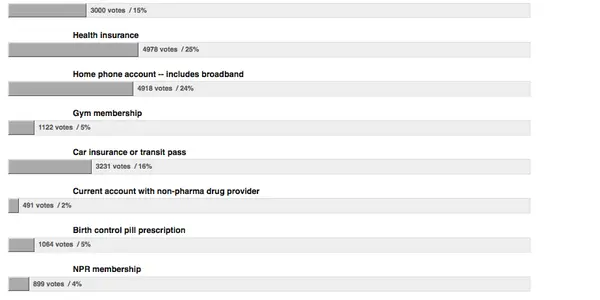
A new poll by Nature and Scientific American, out in SA's October 2010 issue, notes that scientists have had a tough year - the "leaked 'Climategate' e-mails painted researchers as censorious," the H1N1 outbreak "led to charges that health officials exaggerated the danger to help Big Pharma sell more drugs," and the Harvard investigation that found holes in a professor's data. Nature and SA wanted to know - does the public1 still trust scientists?The two polled readers using an internet survey on their Web sites, and more than 21,000 people responded.2 Here are the results:How much do people trust what scientists say?
Metastatic melanoma is a deadly diagnosis - you are, to be frank, screwed. Any glimmer of hope, however murky, is thus latched onto fervently. Unfortunately, cancer treatments aren't a picnic, many providing only a little extra time on earth and awful side effects.In diseases like metastatic melanoma, where the prognosis is dismal, it's easy to hype any drug that comes along. Words like "breakthrough" are tossed about the news media, which dilutes the power of the word when an actual advancement comes along.1 A new drug in clinical trials might just fit the bill, though, so I may take the word off the shelf and use it, albeit cautiously.Metastatic melanoma - the not-so-good, bad and ugly
As a resident of the Elysian Fields that is the Twin Cities, I have been deluged by the Favreian Circus descending upon our fair binary metro area, and I. Am. So. Over. It.The bacchanal over Number Four's return has spread through the sports-writing world at ludicrous speed1 as has the dissolution of decades-long hatred among Vikings fans toward the former Cheesehead - hypocrites, the lot of you - but thus far I haven't come across a story that discusses regression toward the mean, which could be a factor in the upcoming NFL season.
It really isn't necessary for me to have an opinion on any topic at hand - it's so much easier to consult the latest poll to know how my fellow humans feel about an issue (and by extension, how I should feel about it too). Hermann Hesse writes that the bourgeoisie "substitute majority for power, law for force, and the polling booth for responsibility," so I should be able to substitute the results of an online poll for the firing of my own synapses.1
Watch out, Jayson Blair - there's a new sheriff in town, and it's going to cross-reference your work to make sure you haven't plagiarized your material.Plagiarism, using others' work but putting it forth as your own, has been a problem since folks started putting pen to paper (or chisel to stone). Even stalwart heroes like Helen Keller and Martin Luther King, Jr. have been accused of the big P. But pretend you're an editor at a scientific journal - how are you supposed to know, without spending a lot of time, if the submitted article you're reviewing has taken chunks from an article published in a competing journal? Enter CrossRef's CrossCheck, a service that uses iParadigms' iThenticate plagiarism software.
The fairy tale Little Red Riding Hood has been interpreted in myriad ways, particularly as sexual awakening or sexual coming of age (either biologically or socially, depending on which bath-house you pray in). Perhaps if the crimson-caped interloper existed today, she'd wear fire-engine red circle lenses to accent her childlike, doe-eyed innocence.
Rules for writing can vary from basic grammar principles to austere proverbs like Hemingway's "Write what you know!" In my previous article, I listed the first 12 rules of prose as delineated by freelance journalist (and science writer) Tim Radford. Here are the remaining 13. Enjoy!13. Words like shallow, facile, glib and slick are not insults to a journalist. The whole point of paying for a newspaper is that you want information that slides down easily and quickly, without footnotes, serial caveats, obscure references and footnotes to footnotes.1
Little nuggets of (k)nowledge can often be the most simple and common sense ideas, but it takes someone else to put them into a coherent sentence. Tim Radford is a freelance journalist who has written for the Guardian, The Lancet, New Scientist and others, and even won the Association of British Science Writers award for science writer of the year four times. Awards do not a great writer make, but they're an indication that he does a decent job communicating, no?
While going through old boxes of miscellaneous detritus, I came upon several sheets of paper from my health journalism grad school days. The scribes packed a lot of wisdom into those articles and bullet points, and I'll share various nuggets of knowledge in upcoming articles.1
Music is omnipresent and plays an enormous role in our everyday lives. It transports us, soothes us, energizes us, evokes memories instantaneously like few things in this world have the power to do (smell being an exception).Music can bind us together and create shared experiences, or it can divide us (metalheads versus country fans). But why? Mark Changizi wrote an excellent article on the origins of music and four hurdles for a scientific theory of music, touching on these questions: why do we have a brain for music; why is music emotionally evocative; why do we dance; and why is music structurally organized as it is?