Adaptive Complexity

Michael White

Michael White

Welcome to Adaptive Complexity, where I write about genomics, systems biology, evolution, and the connection between science and literature, government, and society. I'm a biochemist and a postdoctoral fellow in the Department of Genetics and the Ce…
RSS Feed
Sea Slugs Generating Green Energy

Sea Slugs Generating Green Energy

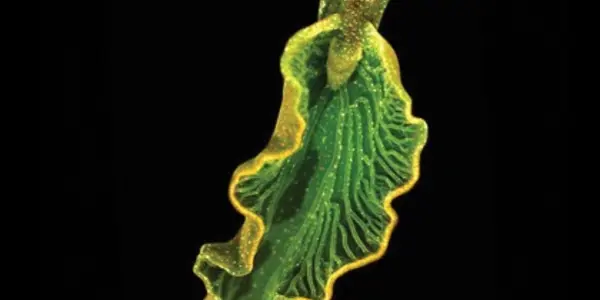
Photosynthesizing sea slugs take 'you are what you eat' to an extreme: by eating photosynthesizing algae, these "solar-powered" sea slugs are able to live off photosynthesis for months. How does this work? Is this just a straightforward case of symbiosis between algae and sea slugs?It turns out that this is not a case of symbiosis: this is a case of the amazing and ubiquitous power of viruses to dramatically reshape the genetic landscape.Cheap, powerful sequencing has enabled scientists to sample the viral world like never before. Our understanding of marine viruses, in particular, has exploded as researchers have sequenced whatever they can find in samples of seawater.

You Can't Replace Scientific Thinking With Computers

You Can't Replace Scientific Thinking With Computers

I've lamented multiple times the negative influence on scientific culture of some trends in the use of computational tools to analyze large datasets, particularly in biology.Over at Nobel Intent, John Timmer brings up another issue related to computational models of complex phenomena: reproducibility:

Biomedical Science In 2020

Biomedical Science In 2020

What will geneticists and molecular cell biologists be doing in 2020? 10 years ago, genomic technologies like DNA microarrays were just beginning to change the way molecular biologists worked, and the draft sequence of the human genome was a year from publication. Over the next decade, genomics, in the form of high-throughput tools, and large sequence databases, completely transformed the day-to-day work of just about everyone in the basic biomedical sciences.

The Math Behind A Cell Switch

The Math Behind A Cell Switch

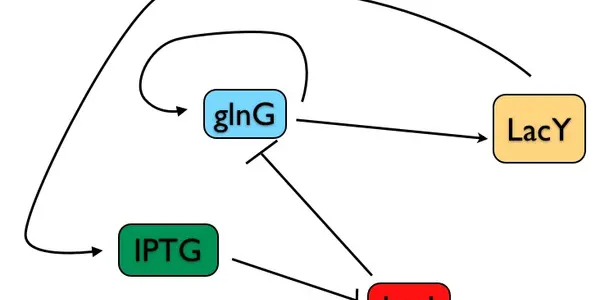
Earlier this week I argued that biological systems posses dynamical properties that are biologically important, and understandable primarily through mathematical modeling. As an example, I discussed a paper that explored the advantages of double positive feedback loops in bistable switches.I glossed over the math behind the model because of space and time constraints. (Constraints on a blog, you wonder? Well, I ran out of time, and once a blog post gets beyond 1000 words, the number people who read it to completion probably drops exponentially for every word over 1000.)

Engineering A Cell Switch

Engineering A Cell Switch

Why should we bother building mathematical models of biological systems? Scientists from other fields might wonder why one would as such a question - physicists, climate scientists, economists, engineers, and chemists all use mathematical models to understand the world. Some biologists do too - individual proteins are studied with quantum mechanical models by biophysicists, enzyme reactions are modeled by biochemists, physiologists have mathematical models of the circulatory system, and population geneticists model the evolution of gene frequencies in populations.

Lean Bacon And A Domesticated DNA Parasite

Lean Bacon And A Domesticated DNA Parasite

Here is a molecular biology discovery that we can chalk up to our increasing love of lean bacon:"ZBED6, a Novel Transcription Factor Derived from a Domesticated DNA Transposon Regulates IGF2 Expression and Muscle Growth", in PLoS Biology.If you're a bacon lover, you may not realize how much your culinary satisfaction is intertwined with genetics. The drive to breed leaner pigs has led to the search for genetic variants that affect muscle mass and fat deposition in pigs. Some years back, in order to find such genetic variants, a Swedish research group crossed European Wild Boars and Large White domestic pigs.

H1N1 Big Picture

H1N1 Big Picture

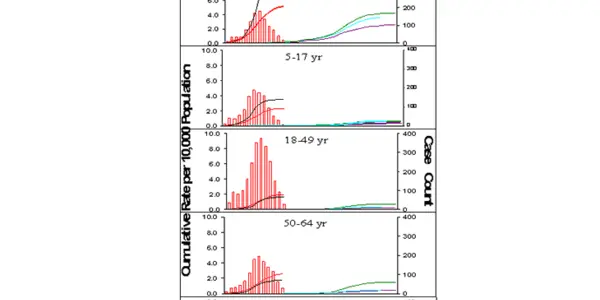
Last week I talked about some H1N1 numbers from the CDC. The numbers I highlighted were by and large from either the CDC's focused surveillance sites, or based on reports voluntarily submitted by various hospitals, providers, etc.  Carl Zimmer has highlighted the CDC's effort to estimate the big picture - total infections, hospitalizations, and deaths nationwide. At this point, the CDC says there has been no seasonal flu - almost all flu cases have been H1N1.

Why Scientists Should Blog

Why Scientists Should Blog

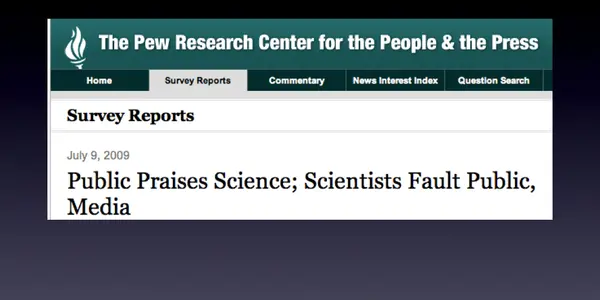
Back in August, I gave a talk at the Pacific AAAS meeting explaining why research scientists need to blog. After a long delay to put my incomprehensible notes in to readable (but still somewhat fragmented) form, here is my argument for why scientists need to blog:Expert Blogging in the Science Communication EcosystemMy talk is about scientists writing science directly for the public. Specifically, I want to get at the question, "What can blogging by scientists bring to the science communication ecosystem of newspapers, TV, and magazines?"

Rush Limbaugh Vs H1N1

Rush Limbaugh Vs H1N1

Via Chris Mooney, I learn that Rush Limbaugh, whose ability to smell out a conspiracy is on par with the ability of the male silk moth to sniff out the presence of a female from miles away, has called the whole H1N1 thing a hoax:

Soy And Breast Cancer

Soy And Breast Cancer

What's the relationship between soy consumption and breast cancer? Some major news from JAMA:

Biologists Going Quantitative

Biologists Going Quantitative

Molecular biologists and mathematical models frequently don't mix well, especially when the molecular biologists in question were trained before the rise of genomics, back when most labs only needed a computer for designing new vector sequences, writing papers, and checking email. Behind this skepticism is the intuition that biology is extremely messy (true), and difficult to quantify (also true). Also contributing is the long history of the cell as a molecular black box; for a long time, we had no idea what was going on inside the cell in molecular terms (somewhat analogous to doing chemistry without knowing about atoms), and in fact we still don't know the molecular role of a good chunk of the protein-coding genes in the human genome.

How To Not Get Blinded With Science

How To Not Get Blinded With Science

From The Times, a journalist global warming skeptic changes his tune:I thought global warming was all bog-standard, apocalyptic nonsense when it first emerged in the 1980s. People, I knew, like nothing better than an End-of-the-World story to give their lives meaning. I also knew that science is dynamic. Big ideas rise and fall. Once the Earth was the centre of the universe. Then it wasn’t. Once Isaac Newton had completed physics. Then he hadn’t. Once there was going to be a new ice age. Then there wasn’t.