Chemistry Wide Open

jcbradley

jcbradley

Jean-Claude Bradley is an Associate Professor of Chemistry and the E-Learning Coordinator for the College of Arts and Sciences at Drexel University in Philadelphia, PA. He teaches organic chemistry and runs UsefulChem, an open source science project …
RSS Feed
Crowdsourcing Drug Development

Crowdsourcing Drug Development

Yesterday I had the privilege of attending a workshop at the NIH on the National Cancer Institute Clinical Development of Small Molecules:
This one-day workshop will provide specialized training and information to NCI-supported investigators who plan to undertake clinical development of novel concepts and who are directly involved with implementing translational clinical research.

Scientific American Article On Science 2.0

Scientific American Article On Science 2.0

Mitch Waldrop has written an informative piece on the Science 2.0 movement in Scientific American:Science 2.0: Great New Tool, or Great Risk?Consistent with the content of the article, Mitch invites feedback:Welcome to a Scientific American experiment in "networked journalism," in which readers—you—get to collaborate with the author to give a story its final form.

The Value of Chemistry Results

The Value of Chemistry Results

Chemical research has traditionally been organized in either experiment-centric or molecule-centric models.

This makes sense from the chemist's standpoint.

When we think about doing chemistry, we conceptualize experiments as the fundamental unit of progress. This is reflected in the laboratory notebook, where each page is an experiment, with an objective, a procedure, the results, their analysis and a final conclusion optimally directly answering the stated objective.

When we think about searching for chemistry, we generally imagine molecules and transformations.

Subcellular Drug Transport Now Open Notebook Science

Subcellular Drug Transport Now Open Notebook Science

I recently reported on a new collaborator who agreed to work with us in the open on modelling subcellular drug transport.

I am very pleased to report that Gus Rosania has now created an entire wiki (1CellPK) for his lab to use as an open notebook.

More Open Collaboration for Drug Design

More Open Collaboration for Drug Design

Rajarshi Guha has yet again made a key contribution to our UsefulChem project by connecting us with Gus Rosania at the University of Michigan. Gus is interested in a fully open collaboration to help us further prioritize our drug targets based on predicted subcellular drug transport:

It is the first time I hear about Open Notebook Science, but it sounds like a fantastic idea!

My research group studies the subcellular transport of small molecules.

Camphor in Second Life

Camphor in Second Life

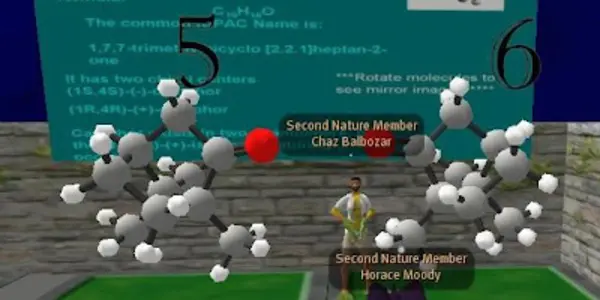
This term, the students in my organic chemistry class were presented with an opportunity to do an extra credit assignment using Second Life to represent concepts they learned in the course.

When I was an undergraduate, finding molecules in articles was mainly done using the Chemical Abstracts books. A convenient way to find a specific molecule would be to look up the molecular formula and find the corresponding IUPAC name. Theoretically, one could figure out the IUPAC name from scratch but this can be very tricky for complex molecules and prone to error.

Crowdsourcing Chemistry Proposal

Crowdsourcing Chemistry Proposal

I recently submitted a Letter of Intent for the NSF Cyber-Enabled Discovery and Innovation competition. Kevin Owens is a co-PI and will assist with the laboratory automation component. ChemSpider will contribute the database support. The pre-proposal is due in early January 2008 and we'll be writing it openly here. Comments are welcome.

We would ultimately like to enable the chemistry community to directly control the actions of a robot to help us understand some chemistry problems.

Crystals for Malaria

Crystals for Malaria

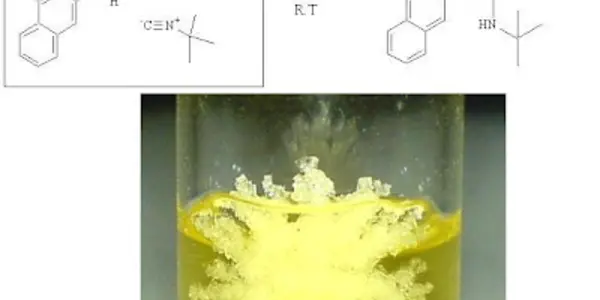
We've reached an important milestone on our CombiUgi project involving the synthesis of falcipain-2 inhibitors. In my last update I described how our focus was more on doing many reactions in parallel and only looking for Ugi products that precipitate in pure form within a few days.

It took little longer than I hoped. In order to do more reactions, we reduced our efforts towards monitoring. One of the assumptions that we made was to trust a bottle's label to accurately describe its contents.

Science and Uncertainty

Science and Uncertainty

Most of us are familiar with the mantra of how science progresses:

A hypothesis can never be completely proved by any finite set of experiments but it can be falsified by a single result.

In mathematical proofs, clear cut algorithms can usually be applied to prove unequivocally the falsehood of a theorem (notwithstanding Godel's incompleteness theorems :)

But in real research in the physical sciences, that is not exactly how scientists process reports of experimental results.

Cameron Neylon's Open Notebook Science Talk

Cameron Neylon's Open Notebook Science Talk

Cameron Neylon gave a very thoughtful talk at Drexel on Friday about using blogs to capture the science going on in his group then deciding to open his laboratory notebooks to the world.

He was refreshingly honest about his progress and motivations. For example, at one point he noted that a gel image was missing on one of the posts. Instead of glossing over it, he pointed out how this just makes transparent how difficult it is to properly maintain a laboratory notebook.

Science is About Mistrust

Science is About Mistrust

I have mixed feelings about the proliferation of the term "Open Notebook Science".

I started using the term a year ago to describe our UsefulChem project because it had no hits on Google and so it offered an opportunity to start with a fresh definition. There are currently over 43 000 hits for that term and it is nice to see that the first hit is still the post with the original definition.

The first part of the term, "Open Notebook", is meant to be taken literally. It refers to the ultimate information source used by a researcher to record their work.

Wired Article on Dark Data

Wired Article on Dark Data

Tom Goetz wrote a thoughtful article "It's Time to Free the Dark Data of Failed Scientific Experiments" in Wired this week.

So what happens to all the research that doesn't yield a dramatic outcome —or, worse, the opposite of what researchers had hoped? It ends up stuffed in some lab drawer. The result is a vast body of squandered knowledge that represents a waste of resources and a drag on scientific progress. This information — call it dark data — must be set free.

...

There are some islands of innovation. Since 2002, the Journal of Negative Results in Biomedicine has offered a peer-reviewed home to results that go negative or against the grain.