More men than women develop Parkinson’s disease and new work presented at the Federation of European Neuroscience Societies says that it is do to sex differences in how brain cells change.
Parkinson’s disease affects about 9 million people and becomes increasingly prevalent with age. Though some try to argue there is a lifestyle cause, science shows it is twice as common in men than women regardless of behavior. Men also seem to experience a faster decline in thinking abilities after diagnosis.
The new work suggests it is due to different DNA methylation in men. DNA methylation is akin to a dimmer switch in DNA, turning the activity of genes up or down. In prior research, a small group of agricultural worker blood samples, which included 71 with Parkinson's Disease and 147 without, found that women with the disease had changes to DNA methylation in 69 regions of the genome, compared to only two in men. The new study looked at post-mortem brain samples of 73 people with the disease (45 men and 28 women) compared to a control group of 24 (15 men and nine women) without it, examing neurons - the brain’s communication nerve cells - plus the astrocytes, oligodendrocytes and microglia nerve cells which maintain neurons.
In astrocytes and oligodendrocytes, there was a sex difference in the activity of genes linked to mitochondria and nerve fibers was different between sexes, regardless of what region of the brain they were in. Parkinson's invoked some common stress response but at the cellular level the differences between sexes were clear.
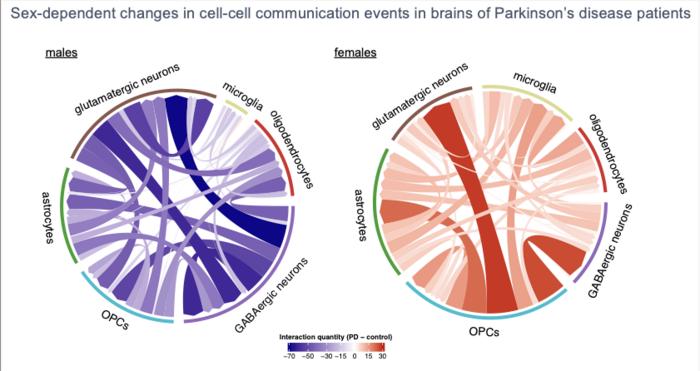
Cell-cell communication plot showing how different brain cells communicate with each other in people with Parkinson’s disease compared to individuals without the disease. It highlights that these cell-to-cell interactions change in Parkinson’s, suggesting altered communication in the brain. When looking separately at males and females, the patterns differ, indicating that the disease may affect brain cell communication in sex-specific ways. Credit: Dr Julia Schulze-Hentrich
“Most importantly, our results indicate that it is crucial to recognise that biology varies between the sexes in PD research and that, wherever possible, researchers should analyse data separately in males and females instead of pooling everyone together. This is crucial to see whether an association, effect or outcome differs by sex. It also helps identify gaps in evidence because many studies still under-report or pool sex-specific outcomes," said Dr. Julia Schulze-Hentrich of Saarland University in Germany. “For patients, the main benefit is more personalised care, as sex-specific analysis can help clinicians predict which symptoms are more likely, monitor problems earlier, and choose treatments that fit a patient’s risk profile better.”
Reference: “Sex differences in glial cells contribute to the molecular etiology of Parkinson’s disease”, by Julia M. Schulze-Hentrich, Federation of European Neuroscience Societies (FENS) Forum 2026 Cell-Cell Communication and Plasticity scientific symposia, 09:45 – 11:15 hrs CEST, Wednesday 8 July, Hall C