In the 1980s, scientists captured the precise mechanics of a protein machine. It looked strange, to researchers its tall thin structure with stubby legs invoked the enchanted broomstick that stole the show in "The Sorcerer's Apprentice" segment of Disney's 1940 Fantasia film.
They called this motor protein Kinesin-1. It travels on protein tracks called microtubules that extend throughout the cell, a speedy 100 steps per second, hauling biology from the trunk of the cell to the faraway tips of every branch. When it goes wrong, cells sicken and die, which can lead to paralysis, seizures, and cognitive defects.
Prevent that from happening and adenosine triphosphate (ATP), the common energy currency of all living cells that our mitochondria create from fat, sugar, and protein, stays moving - and keeping that happening has been the goal of over 40 years. The cell has to turn kinesin-1 on when needed, it naturally exists in a turned-off state. To turn it on, it attaches a protein called MAP7 onto its back. By using cryo-electron microscopy to take thousands of pictures of the turned-off protein a new study produced a clear picture of how kinesin-1 looks when it’s turned off.
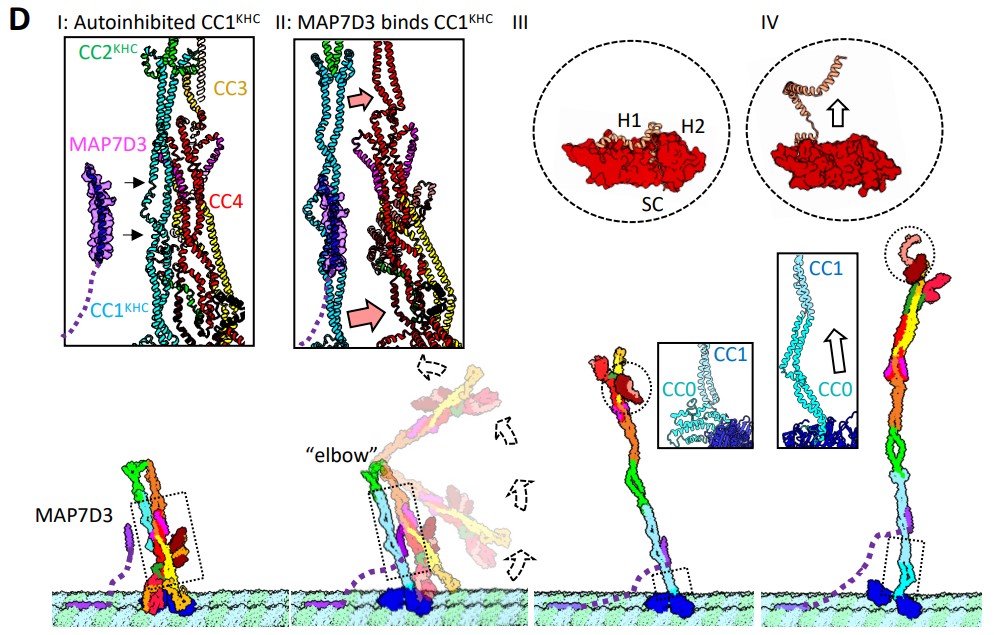
They were intrigued. When turned off, the enchanted broomstick of ATP is folded in half, with its top end wedged between its legs for storage and a connector keeping it fixed. That shape acts as a lock, preventing the legs from moving and obstructing the docking site where cargo attaches. They found that when MAP7 attaches to kinesin-1, it wedges in and pops the rubber band loose. Then the enchanted broomstick unfolds, the legs are freed, exposing the top section where cargo is attached.
This is a basic research development, it won't translate to cures for neurodegenerative diseases such as amyotrophic lateral sclerosis (ALS), Charcot-Marie-Tooth Disease Type 2, and hereditary spastic paraplegia 10. Mutations in kinesin-1 often underlie these diseases, and some of them exert their ill effects by preventing the protein from turning on or off.
Control the enchanted broomstick and we might be able to prevent the mutations in the sorceror's cauldron from getting out of hand.
Citation: Md Ashaduzzaman, Yuqi Tang, Kyoko Okada, Stephen D. Fried, Richard J. Mckenney, Jawdat Al-Bassam, 'Structural Basis of Kinesin-1 Autoinhibition and Its Control of Microtubule-Based Motility', bioRxiv 2025.07.15.665000; doi: 10.1101/2025.07.15.665000