You Feel Colder As You Age: The Science Reason Why
Older people report feeling colder, enough that it is clearly happening, but why has been a mystery. Until now.
Older people report feeling colder, enough that it is clearly happening, but why has been a mystery. Until now.


Your Jack-o'-Lantern may scare away more than just birds - the skin of that pumpkin contains a substance that could put a scare into microbes that cause millions of cases of yeast infections in adults and infants each year, says a new study in the Journal of Agricultural and Food Chemistry.Kyung-Soo Hahm, Yoonkyung Park and colleagues note that some disease-causing microbes are becoming resistant to existing antibiotics so scientists worldwide are searching for new antibiotics. Past studies had hinted that pumpkin, long used as folk medicine in some countries, might have antibiotic effects.

Are accident rates higher for people with a particular gene variant? Bad drivers may, in part, have their genes to blame, suggests a new study by UC Irvine neuroscientists.People with a particular gene variant performed more than 20 percent worse on a driving test than people without it – and a follow-up test a few days later yielded similar results. About 30 percent of Americans have the variant.
The performative and improvisatory aspects of music compares favorably with the temporal, polyphonic aspects of scholarly research, says University of Illinois professor of education Liora Bresler.Understanding that could improve both research and education, she says. Bresler, who studied musicology and was a pianist before becoming an education professor, said that knowing there was an audience to perform for "really intensifies the relationship between the music and the performer." This, she said, is analogous to how a teacher should think of a lecture or a researcher a presentation at a conference.

Wolfgang Fink, visiting associate in physics at the California Institute of Technology in Pasadena (Caltech, to you) says a paradigm shift in planetary exploration is coming - and it involves space robots. Fink and a team at Caltech, the U.S. Geological Survey and the University of Arizona are developing software along with a robotic test bed that can mimic a field geologist or astronaut - the software, they say, will allow a robot to think on its own.

When Charles Darwin published On the Origin of Species by Means of Natural Selection, or The Preservation of Favoured Races in the Struggle for Life 150 years ago next month, he avoided conjecture about the origin of life and "To my mind it accords better with what we know of the laws impressed on matter by the Creator" shows that he had limits on the cultural firestorm he wanted to create in the name of science.
Virtually every study in the last two years has blamed neighborhoods for obesity rather than the people who eat too much - but living near a variety of restaurants, convenience stores, supermarkets and even fast food outlets actually lowers your risk for obesity, according to a new study from the University of Utah.Surprisingly, people who live more than a half mile away from any food outlets are the ones who tend to be fatter. The study suggests that placing restrictions on fast food outlets may not be effective, but that initiatives to increase healthy neighborhood food options may reduce individuals' obesity risks, especially if focused on low-income neighborhoods.
On Memorial Day, May 26, 2008, the "Roadrunner" supercomputer exceeded a sustained speed of 1 petaflop/s, or 1 million billion calculations per second. "Petaflop/s" is computer jargon—peta signifying the number 1 followed by 15 zeros (sometimes called a quadrillion) and flop/s meaning "floating point operation per second." Shortly after that it was named the world's fastest supercomputer by the TOP500 organization at the June 2008 International Supercomputing Conference in Dresden Germany.

Nepotism has a bad connotation in the workplace or French politics but being surrounded by relatives does lead to better group dynamics and more cooperation in some animals, and certainly spiders, according to a new study published in BMC Evolutionary Biology.In a new study, the researchers found that Stegodyphus tentoriicola spiders are far more efficient at foraging for food and cooperate better when they’re related to each other and, as with humans and other animals, relatedness may favor the evolution of less selfish behavior, more collaboration and better group dynamics.
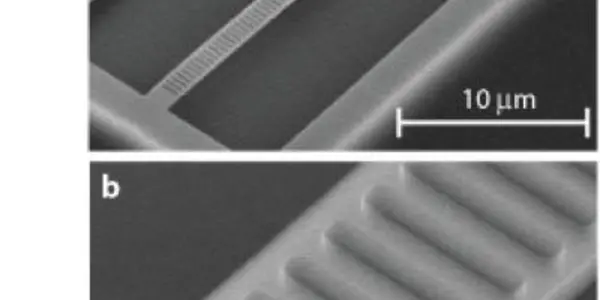
Caltech researchers have created a nanoscale crystal device that allows them to confine both light and sound vibrations in the same tiny space.The interactions between sound and light in this optomechanical crysta can result in mechanical vibrations with frequencies as high as tens of gigahertz, or 10 billion cycles per second. Being able to achieve such frequencies gives these devices the ability to send large amounts of information, and opens up a wide array of potential applications—everything from lightwave communication systems to biosensors capable of detecting (or weighing) a single macromolecule.
Body builders will tell you that protein is key to bigger, stronger muscles. For the truly elite, that may be the case but for the all but 50 of you who are not elite muscle builders, a recent study by University of Texas Medical Branch at Galveston metabolism researchers provides evidence that a more normal eating pattern is going to get you the same results as wolfing down protein shakes; something your commission-based, fitness-center trainer does not want you to read.The study's results, obtained by measuring muscle synthesis rates in volunteers who consumed different amounts of lean beef, show that only about the first 30 grams (just over one ounce) of dietary protein consumed in a meal actually produce muscle.
"Speciation is one of the most fascinating, unsolved problems in biology," says Harmit Malik, Ph.D., an associate member of the Hutchinson Center's Basic Sciences Division. The first appearance of new beings on Earth - the mystery of mysteries - is a great puzzle for scientists and philosophers alike.
Exercise makes cigarettes less attractive, says a new study from the University of Exeter. Exercise can lessen the power of cigarettes and smoking-related images to grab the attention of smokers, the authors write in the journal Addiction. They did a study involving 20 moderately heavy smokers who had abstained from cigarettes for 15 hours before the trial. During two visits to the laboratory participants began by being shown smoking-related and neutral images, and then spent either 15 minutes sitting or exercising on a stationary bike at a moderate intensity. Afterwards, they were again shown the images.