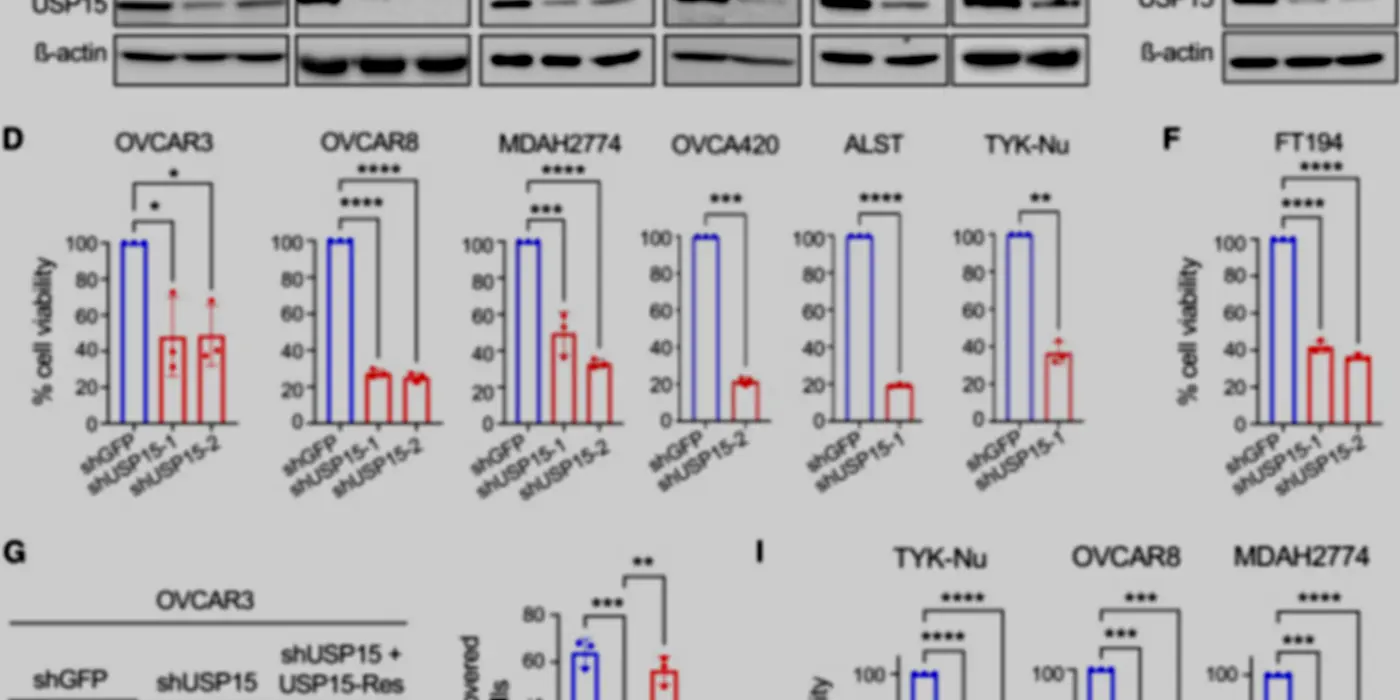
Enzyme USP15 Limits Ovarian Cancer Cells And Boosts Chemotherapy
Ovarian cancer is devastating, five-year survival rate under 30%, when detected after it has spread. New basic research may improve that.
Ovarian cancer is devastating, five-year survival rate under 30%, when detected after it has spread. New basic research may improve that.


Avian influenza viruses do not thrive in humans because the temperature inside a person's nose is too low, according to research published today in PLoS Pathogens. The authors of the study, from Imperial College London and the University of North Carolina, say this may be one of the reasons why bird flu viruses do not cause pandemics in humans easily.There are 16 subtypes of avian influenza and some can mutate into forms that can infect humans, by swapping proteins on their surface with proteins from human influenza viruses.
As if you need another reason for parental guilt, a new article in Bioscience Hypotheses speculates that our feelings could impact our reproduction and affect our children. Dr Alberto Halabe Bucay of Research Center Halabe and Darwich, Mexico, suggests that a wide range of chemicals that our brain generates when we are in different moods could affect 'germ cells' (eggs and sperm), the cells that ultimately produce the next generation. Such natural chemicals could affect the way that specific genes are expressed in the germ cells, and hence how a child develops.
The dual launch of the far-infrared space telescope Herschel and cosmic background mapper Planck on an Ariane 5 rocket from Europe's Spaceport in French Guiana is the beginning of two of the most ambitious missions ever attempted to unveil the secrets of the darkest, coldest and oldest parts of the Universe. Herschel has the largest mirror ever launched into space and will examine a little known part of the electromagnetic spectrum to learn more about the birth of stars and galaxies as well as dust clouds and planet-forming discs around stars - and will look for water, a key component of life similar to ours.
Monkeys playing a game similar to "Let's Make A Deal" have revealed that their brains register missed opportunities and learn from their mistakes. The researchers watched individual neurons in a region of the brain called the anterior cingulate cortex (ACC) that monitors the consequences of actions and mediates resulting changes in behavior. The monkeys were making choices that resulted in different amounts of juice as a reward. Their task was like the TV show "Let's Make a Deal" with the experimenters offering monkeys choices from an array of hidden rewards. During each trial, the monkeys chose from one of eight identical white squares arranged in a circle. A color beneath the white square was revealed and the monkey received the corresponding reward.
To study small RNA, snippets of RNA that act as switches to regulate gene expression in single-celled creatures, you need lab-cultured microorganisms but a new method of obtaining marine microbe samples while preserving the microbes' natural gene expression has shown the presence of many varieties of small RNAs. The discovery of its presence in a natural setting may make it possible finally to learn on a broad scale how microbial communities living at different ocean depths and regions respond to environmental stimuli.

NASA's Kepler spacecraft has begun its search for other Earth-like worlds. The mission, which launched from Cape Canaveral, Fla., on March 6, will spend the next three-and-a-half years staring at more than 100,000 stars for telltale signs of planets. Kepler has the unique ability to find planets as small as Earth that orbit sun-like stars at distances where temperatures are right for possible lakes and oceans.
A bowl of whole-grain cereal is as good as a sports drink for recovery after exercise. Research published in BioMed Central’s open access Journal of the International Society of Sports Nutrition has shown that the readily available and relatively inexpensive breakfast food is as effective as popular, carbohydrate-based ‘sports drinks’.

2008 excavations at Hohle Fels Cave in the Swabian Jura of southwestern Germany recovered a female figurine carved from mammoth ivory from the basal Aurignacian deposit. The figurine is the earliest depiction of a human and one of the oldest known examples of figurative art worldwide and is at least 35,000 years old.If you're looking closely at the Venus of Hohle Fels below, you may also notice those are breasts, which radically changes our views of the context and meaning of the earliest Paleolithic art; maybe it's porn-eolithic.
A new report published in Cell says that a heart beat and blood circulation are critical signals for the production of blood-forming, or hematopoietic, stem cells in the developing embryo.
New research sheds light on how cocaine regulates gene expression in a crucial reward region of the brain to elicit long-lasting changes in behavior. The study in Neuron provides insight into the molecular pathways regulated by cocaine and may lead to new strategies for battling drug addiction.It is well established that addictive drugs induce persistent changes in the brain's reward circuits. Previous research has indicated that addiction to drugs such as cocaine is associated with altered gene expression in the nucleus accumbens (NAc), a region of the brain that is involved in motivation, pleasure, and reward.

You probably envision ocean currents as a 'conveyor belt' - that's okay, so do oceanographers. But at least in the Atlantic, it doesn't work quite the way scientists have believed, according to new research led by Duke University and the Woods Hole Oceanographic Institution. Their analyses showed that much of this water, originating in the sea between Newfoundland and Greenland, rather than flowing southward from the Labrador Sea, is diverted generally eastward by the time it flows as far south as Massachusetts. From there it disperses to the depths in complex ways that are difficult to follow.
Laboratory experiments have demonstrated the immunological effects of ginseng, say researchers writing in the Journal of Translational Medicine. Their studies show that the herb, much used in traditional Chinese and other Asian medicine, does have anti-inflammatory effects.The scientists treated human immune cells with different extracts of ginseng. They found that of the nine ginsenosides they identified, seven could selectively inhibit expression of the inflammatory gene CXCL-10. Allan Lau concludes, "Further studies will be needed to examine the potential beneficial effects of ginsenosides in the management of acute and chronic inflammatory diseases in humans."