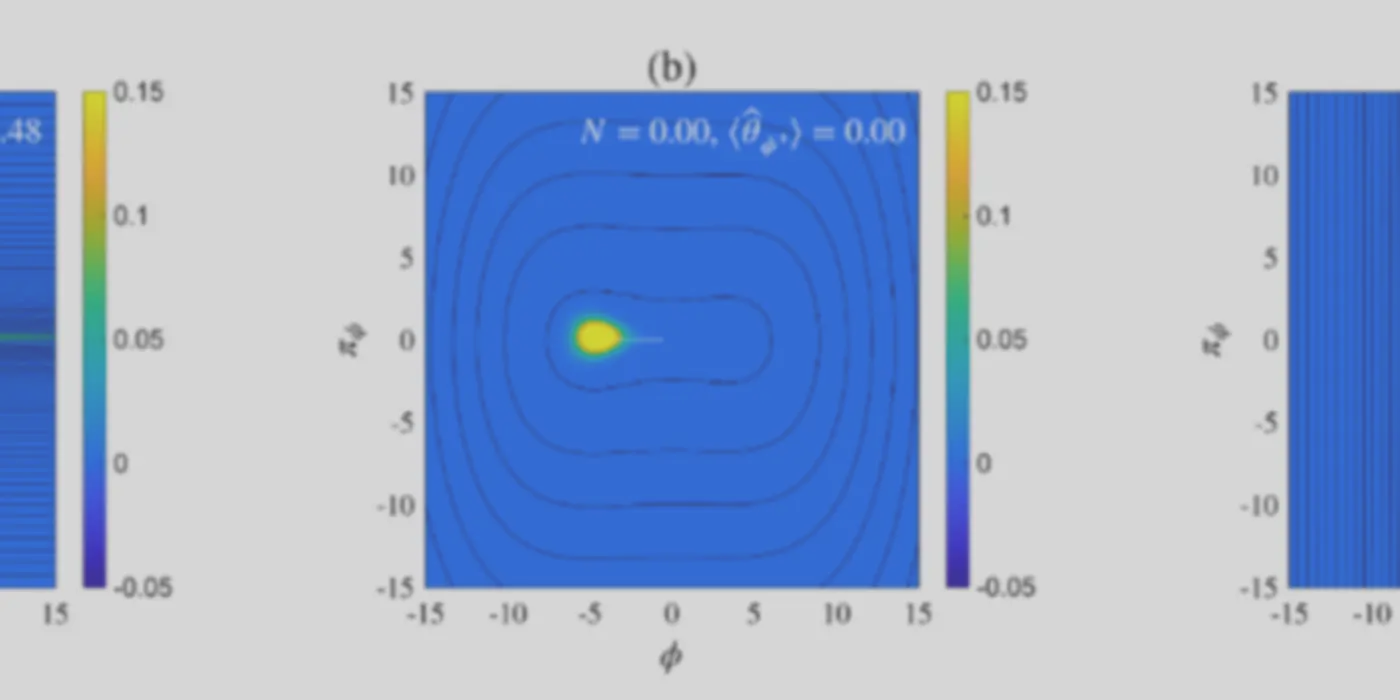
Sorry Higgs, There May Be A New Contender For Low Energy States
If we're trapped in a false vacuum, there's still hope to break free of cosmic lockdown
If we're trapped in a false vacuum, there's still hope to break free of cosmic lockdown


Registration is open for NASA's 16th annual Great Moonbuggy Race, taking place April 3-4, 2009, in Huntsville, Ala. The race was founded at NASA's Marshall Space Flight Center in Huntsville in 1994. The U.S. Space and Rocket Center hosts the two-day event. The nationally renowned space museum and tourist attraction constructs a punishing course - a half-mile of hills and craters simulating the lunar surface - on the looping sidewalks and paths around its grounds.

While the stock market has been on a roller coaster ride, economists and business columnists have spilled a lot of ink assigning responsibility for the ongoing financial calamity. As always, hindsight is 20/20 vision but researchers at Argonne National Laboratory are trying to create new economic models that will provide policymakers with more realistic pictures of different types of markets so they can better avert future economic catastrophes.

Research into the development of invisibility devices has spurred two physicists’ thought on the behaviour of light to overcome the seemingly intractable problem of optical singularities which could soon lead to the manufacturing of a perfect cat’s eye.A research paper published in a New Journal of Physics’ focus issue ‘Cloaking and Transformation Optics’ called ‘The Transmutation of Singularities in Optical Instruments’, written by Thomas Tyc, Masaryk University, and Ulf Leonhardt, the University of St. Andrews and Singapore National University, shows that it is possible to reflect light from all directions.
By manipulating the appearance of a chronically achy hand, researchers have found they could increase or decrease the pain and swelling in patients moving their symptomatic limbs. The findings in Current Biology reveal a profound top-down effect of body image on body tissues, according to the researchers.
Defective calcium metabolism in nerve cells may play a major role in a fatal genetic neurological disorder that resembles Huntington’s disease, researchers at UT Southwestern Medical Center have found in a mouse study.
Each year, coal-burning power plants, steel factories and similar facilities in the United States produce more than 125 million tons of waste, much of it fly ash and bottom ash left over from combustion. Mulalo Doyoyo has plans for that material.An assistant professor in Georgia Tech’s School of Civil and Environmental Engineering, Doyoyo has developed a new structural material based on these leftovers from coal burning. Known as Cenocell™, the material offers attributes that include high strength and light weight – without the use of cement, an essential ingredient of conventional concrete.
Older people who spent at least 14 hours a week taking care of a disabled spouse lived longer than others. That is the unexpected finding of a University of Michigan study forthcoming in Psychological Science, a journal of the Association for Psychological Science.The study supports earlier research showing that in terms of health and longevity, it really is better to give than to receive.
When a pregnant woman goes into early labor, her obstetrician may give her drugs to quiet the woman's uterus and prevent premature birth.New research shows, however, that one popular drug works no better than a placebo at maintaining pregnancy after the initial bout of preterm labor is halted, say scientists at the Stanford University School of Medicine, Lucile Packard Children's Hospital and Santa Clara Valley Medical Center. The new trial is the first-ever placebo-controlled test of nifedipine, a muscle relaxant originally developed to lower blood pressure, and its effect on premature delivery with prolonged treatment.
Science fiction writers have long envisioned sailing a spacecraft by the optical force of the sun’s light. But, the forces of sunlight are too weak to fill even the oversized sails that have been tried. Now a team led by researchers at the Yale School of Engineering&Applied Science has shown that the force of light indeed can be harnessed to drive machines — when the process is scaled to nano-proportions. Their work opens the door to a new class of semiconductor devices that are operated by the force of light. They envision a future where this process powers quantum information processing and sensing devices, as well as telecommunications that run at ultra-high speed and consume little power.
As you gorge on food this Thanksgiving and throughout the holiday season, you might not want to think about the fat content of all the goodies you've indulged in. Nevertheless, your brain will be keeping tabs directly, suggests a report in the issue of Cell. Researchers have discovered in studies of rats that one type of lipid produced in the gut rises after eating fatty foods. Those so called N-acylphosphatidylethanolamines or NAPEs enter the bloodstream and go straight to the brain, where they concentrate in a brain region that controls food intake and energy expenditure.

With hard bony shells to shelter and protect them, turtles are unique and have long posed a mystery to scientists who wonder how such an elegant body structure came to be. Since the age of dinosaurs, turtles have looked pretty much as they do now with their shells intact, and scientists lacked conclusive evidence to support competing evolutionary theories. Now with the discovery in China of the oldest known turtle fossil, estimated at 220- million-years-old, scientists have a clearer picture of how the turtle got its shell.

Saturn's moon Enceladus may indeed hide an underground reservoir of water.Scientists at Jet Propulsion Lab in California, the University of Colorado and the University of Central Florida in Orlando teamed up to analyze the plumes of water vapor and ice particles spewing from the moon. They used data collected by the Cassini spacecraft's Ultraviolet Imaging Spectrograph (UVIS). Cassini was launched from the Kennedy Space Center in 1997 and has been orbiting Saturn since July 2004. The team, including UCF Assistant Professor Joshua Colwell, found that the source of plumes may be vents on the moon that channel water vapor from a warm, probably liquid source to the surface at supersonic speeds. The team's findings are reported in Nature.