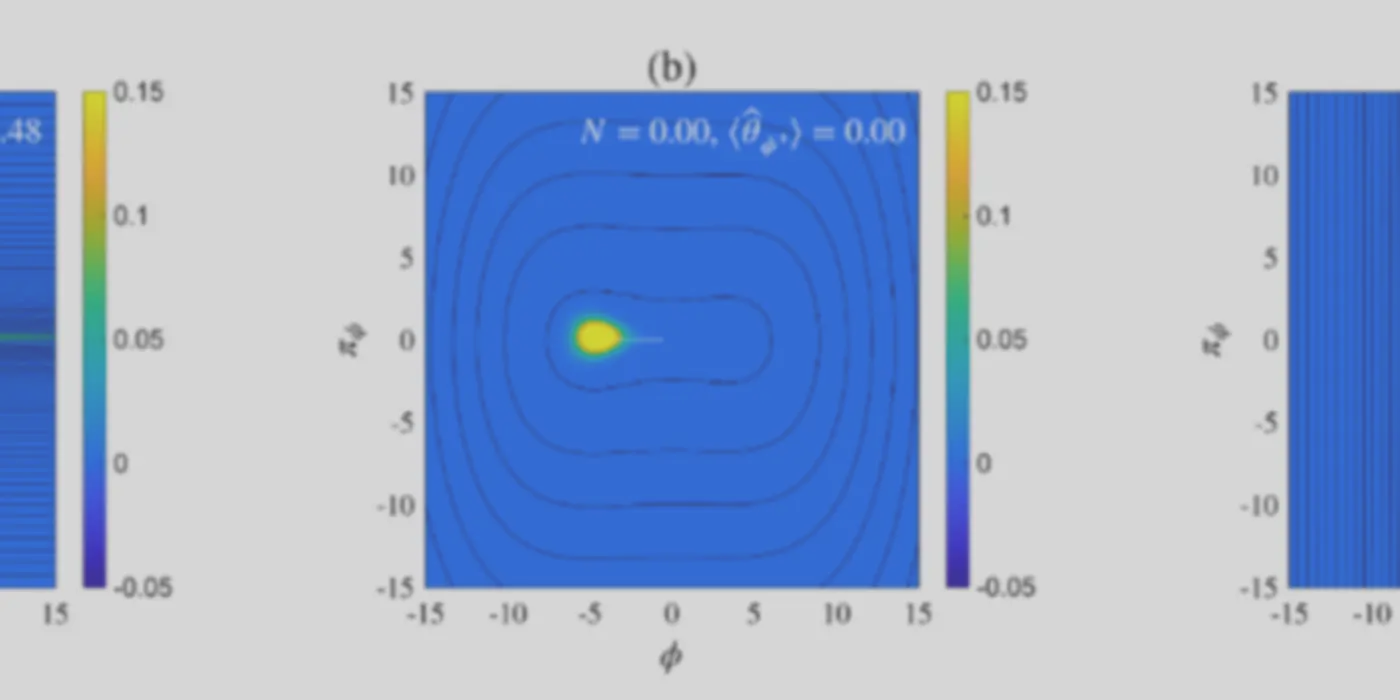
Sorry Higgs, There May Be A New Contender For Low Energy States
If we're trapped in a false vacuum, there's still hope to break free of cosmic lockdown
If we're trapped in a false vacuum, there's still hope to break free of cosmic lockdown


Tetra-Amido Macrocyclic Ligands (TAMLs) are environmentally friendly catalysts with a host of applications for reducing and cleaning up pollutants, and a prime example of "green chemistry."
Carnegie Mellon University's Terry Collins, the catalyst's inventor, believes that the small-molecule catalysts have the potential to be even more effective than previously proven. Collins will discuss how iron-TAMLs (Fe-TAMLs) work and areas for further research, citing evidence from mechanistic and kinetic studies of the catalyst on Monday, Aug. 18 at the 236th national meeting of the American Chemical Society in Philadelphia.
An international team of researchers led by Monash University has used chemicals found in plants to replicate a key process in photosynthesis paving the way to a new approach that uses sunlight to split water into hydrogen and oxygen.
The breakthrough could revolutionise the renewable energy industry by making hydrogen – touted as the clean, green fuel of the future – cheaper and easier to produce on a commercial scale.
Professor Leone Spiccia, Mr Robin Brimblecombe and Dr Annette Koo from Monash University teamed with Dr Gerhard Swiegers at the CSIRO and Professor Charles Dismukes at Princeton University to develop a system comprising a coating that can be impregnated with a form of manganese, a chemical essential to sustaining photosynthesis in plant life.
Organic semiconductor or “plastic” LEDs are much cheaper and easier to fabricate than existing inorganic LEDs now used in traffic signals, some building lighting and as indicator lights on computers, TVs, cell phones, DVD players, modems, game consoles and other electronics.
A new study by University of Utah physicists suggests it will be more difficult than thought to make highly efficient light-emitting diodes (LEDs) using organic materials. Their findings hint such LEDs would convert no more than 25 percent of electricity into light rather than heat, contrary to earlier estimates of up to 63 percent.
Sometimes you can improve on nature. Researchers have used a spice-based compound to develop synthetic molecules that are able to kill cancer cells and stop the cells from spreading - in the lab, anyway.
The miracle spice? Turmeric; specifically curcumin, a naturally occurring compound it contains.
Centuries of anecdotal evidence and recent scientific research suggest curcumin has multiple disease-fighting features, including anti-tumor properties. However, when eaten, curcumin is not absorbed well by the body. Instead, most ingested curcumin in food or supplement form remains in the gastrointestinal system and is eliminated before it is able to enter the bloodstream or tissues.
To track atmospheric change caused by human activity, researchers have long studied a variety of materials, from tree rings to air trapped in glacial ice. A problem has been "noise" - natural variability caused by sampling and random events that affect atmospheric chemistry. Noise can make it hard to tease out trends from the data.
Joseph Bump, a PhD candidate in forest science at Michigan Tech, and his colleagues speculated that those trends would be picked up by top predators as well as by trees. And they further suspected that measurements from predators would show much less noise.
It's not enough to be responsible for a carbon footprint, according to a Carnegie Mellon study, there's a whole carbon trail that needs to be taken into account and doing so will spur more companies and people into action.
In other words, we need to turn that carbon calculator knob up to 11.
Part of the problem with the global skepticism backlash is that there is no universally accepted way of calculating someone's carbon footprint - depending on which group created the calculator your carbon footprint could be either mild or so bad Al Gore is camped outside your house.
Biological clocks are the body's complex network of internal oscillators that regulate daily activity/rest cycles and other important aspects of physiology, including body temperature, heart rate and food intake. Besides sleep disorders, research in this field may eventually help treat the negative effects of shift work, aging and jet lag.
Biologists at the University of Virginia have discovered a switching mechanism in the eye that plays a key role in regulating the sleep/wake cycles in mammals.
The new finding demonstrates that light receptor cells in the eye are central to setting the rhythms of the brain's primary timekeeper, the suprachiasmatic nuclei, which regulates activity and rest cycles.
People taking prescription antidepressants appear to drive worse than people who aren't taking such drugs, and depressed people on antidepressants have even more trouble concentrating and reacting behind the wheel, according to the conclusions of a study released Sunday at the Annual Convention of the American Psychological Association.
University of North Dakota psychologists Holly Dannewitz. PhD, and Tom Petros, PhD, recruited 60 people to participate in a driving simulation in which participants had to make a series of common driving decisions, such as reacting to brake lights, stop signs or traffic signals while being distracted by speed limit signs, pylons, animals, other cars, helicopters or bicyclists.
The simulation tested steering, concentration and scanning. Thirty-one of the participants were taking at least one type of antidepressant while 29 control group members were taking no medications with the exception of oral contraceptives in some cases.
A new study of Chinese-Caucasian, Filipino-Caucasian, Japanese-Caucasian and Vietnamese-Caucasian individuals concludes that biracial Asian Americans are twice as likely as monoracial Asian Americans to be diagnosed with a psychological disorder.
"Up to 2.4 percent of the U.S. population self-identifies as mixed race, and most of these individuals describe themselves as biracial," said Nolan Zane, a professor of psychology and Asian American studies at UC Davis. "We cannot underestimate the importance of understanding the social, psychological and experiential differences that may increase the likelihood of psychological disorders among this fast-growing segment of the population."
Zane and his co-investigator, UC Davis psychology graduate student Lauren Berger, found that 34 percent of biracial individuals in a national survey had been diagnosed with a psychological disorder, such as anxiety, depression or substance abuse, versus 17 percent of monoracial individuals. The higher rate held up even after the researchers controlled for differences between the groups in age, gender and life stress, among other factors.
Jennifer Cheavens, assistant professor of psychology at Ohio State University and Laura Dreer of the University of Alabama at Birmingham say that hope can battle depression and discussed some of the latest research during a symposium Saturday Aug. 16 in Boston at the annual meeting of the American Psychological Association in Boston.
How do you measure 'hope' in people, depressed or not?
Cheavens uses a 12-item questionnaire developed by her mentor, the late C.R. Snyder of the University of Kansas. In this measure, hope has two components: a map or pathway to get what you want, and the motivation and strength to follow that path.
“If you feel you know how to get what you want out of life, and you have that desire to make that happen, then you have hope,” Cheavens said.
While many studies have examined cheating among college students, new research looks at the issue from a different perspective – identifying students who are least likely to cheat.
The study of students at one Ohio university found that students who scored high on measures of courage, empathy and honesty were less likely than others to report their cheating in the past – or intending to cheat in the future.
Moreover, those students who reported less cheating were also less likely to believe that their fellow students regularly committed academic dishonesty.
A possible future way to prevent relapses into drug dependence has been discovered by researchers at Linköping University and the German cancer research center DKFZ. The target is the dopamine-producing nerve cells in the midbrain.
Earlier research has shown that these cells become more excitable when a person takes drugs. To find out the functional meaning of this, these researchers used a mouse model for cocaine dependence. When they blocked the cells’ receptors for glutamate - the brain’s most important signal substance -the risk of relapsing into addiction vanished. The findings are being published in the highly ranked journal Neuron.
Dopamine-producing nerve cells are central to the brain’s reward system.