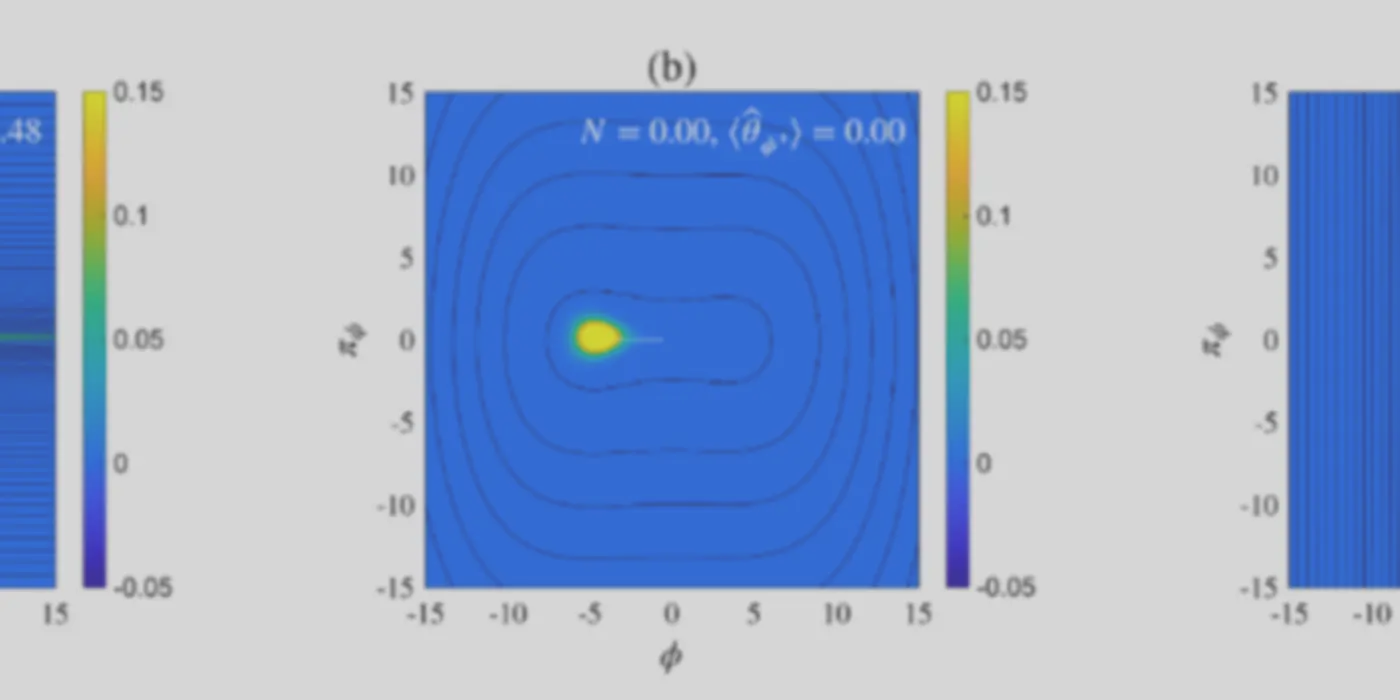
Sorry Higgs, There May Be A New Contender For Low Energy States
If we're trapped in a false vacuum, there's still hope to break free of cosmic lockdown
If we're trapped in a false vacuum, there's still hope to break free of cosmic lockdown


A University of Utah study is shedding light on an important, unsolved physics problem: the relationship between chaos theory – which is based on 300-year-old Newtonian physics – and the modern theory of quantum mechanics. The study demonstrated a fundamental new property – what appears to be chaotic behavior in a quantum system – in the magnetic "spins" within the nuclei or centers of atoms of frozen xenon, which normally is a gas and has been tested for making medical images of lungs.
The new study in Physical Review Letters was led by Brian Saam, an associate professor of physics and associate dean of the University of Utah's College of Science.
Quantum mechanics – which describes the behavior of molecules, atoms electrons and other subatomic particles – "plays a key role in understanding how electronics work, how all sorts of interesting materials behave, how light behaves during communication by optical fibers," Saam says.
In 1990, Theresa (Terri) Schiavo had a cardiac arrest that caused irreversible brain damage which led to a persistent vegetative state diagnosis. A few years later, this diagnosis became a source of conflict over the interruption of artificial nutrition.
The "Schiavo Case" was widely discussed from a medical, ethical and social standpoint in the United States and elsewhere. In an article to be published in the September 23 issue of Neurology, , a team of bioethicists composed of Dr. Éric Racine of the Institut de recherches cliniques de Montréal (IRCM) and experts from Stanford University, in California, and the University of British Columbia examines the media coverage featuring this famous case.
A team of researchers from Massachusetts General Hospital (MGH) has used brain imaging, genetics and experimental psychology techniques to identify a connection between brain reward circuitry, a behavioral measurement of preference and a gene variant that appears to influence both.
The report in the August 4 issue of Archives of General Psychiatry describes how variations in a gene involved with the brain's reward function are associated with the activity of a key brain structure and, in parallel, with the effort study participants 'invest' in viewing emotion-laden facial images. The findings have implications for how genes may influence healthy or dysfunctional behavior involving choices in many different areas.
Scientists at the University of Sheffield writing in the journal Bioinformatics,say they have shown how bacteria could be used as a future fuel, a milestone in producing truly sustainable fuels in the future.
Like all living creatures, bacteria sustain themselves through their metabolism, a huge sequence of chemical reactions that transform nutrients into energy and waste. With mathematical computer models the Sheffield team have mapped the metabolism of a type of bacteria called Nostoc. Nostoc fixes nitrogen and, in doing so, releases hydrogen that can then potentially be used as fuel. Fixing nitrogen is an energy intensive process and it wasn't entirely clear exactly how the bacterium produces the energy it needs in order to perform. Now the new computer system has been used to map out how this happens.
Overall alcohol use—particularly consumption of beer—is declining in the US, according to a new study published in the August 2008 issue of The American Journal of Medicine. Researchers examined 50 years of data and found several changes in alcohol intake but no change in alcohol use disorders.
Americans are drinking significantly less beer and more wine, while hard liquor use has remained fairly constant. More people now report that they are non-drinkers. People born later in the 20th century drink more moderately than older people. As we age, our individual alcohol consumption goes down.

Did you know that Norwegian trees require only a few minutes to replace the timber used to produce the first edition of Aftenposten - equivalent to the time we spend making our morning coffee.
Norway is full of forests and the trees are growing. With just one-third of the growth logged, there is plenty of growth each year. In fact, since sheep and other domestic animals no longer graze the scrub, the landscape is actually starting to be overgrown.
Meanwhile, paper production is less and less profitable, hurting the forestry industry. But that won't last, say a group of experts. In fact, the value of Norwegian wood is going to go up.
The reason, they say, is second generation biodiesel and bioethanol. First generation production of fuel from rapeseed(Brassica napus) and maize has faced strong criticism. Producing fuel on valuable topsoil in the face of greater worldwide food demand is unpopular.
But as much criticism as biofuels have taken, there is no question the world has huge areas that can be better utilized, and timber from agriculture and forestry can produce more useful growth.
Mimmi Throne-Holst, research scientist at SINTEF in Norway, is one of those who believe that Norwegian forests can provide the fuels of the future and that Norway should prioritize this because of considerable experience with bio refinery (Borregaard, Norske Skog) and large-scale production.
A 'cloud computing', applications and services provided seamlessly on the Internet, approach to malicious software detection developed at the University of Michigan could make old antivirus software techniques a relic of the past.
Traditional antivirus software is installed on millions of individual computers around the world but according to researchers, antivirus software from popular vendors is increasingly ineffective.

Yesterday, newspapers were telling us half of apes and monkeys face extinction and today we find out we could be overwhelmed by them.
The Wildlife Conservation Society released a census showing massive numbers of these great apes alive and well in the Republic of Congo.
Western lowland gorillas are one of four recognized gorilla sub-species, which also include mountain gorillas, eastern lowland gorillas, and Cross River gorillas. All are classified as "critically endangered" by the IUCN, except eastern lowland gorillas, which are endangered.

When Yale astrophysicist Kevin Schawinski and colleagues at Oxford University enlisted public support in cataloguing galaxies, they never envisioned the strange object Hanny van Arkel found in archived images of the night sky.
The Dutch school teacher, a volunteer in the Galaxy Zoo project that allows members of the public to take part in astronomy research online, discovered a mysterious and unique object some observers are calling a "cosmic ghost."
When van Arkel posted about the image that quickly became known as "Hanny's Voorwerp" ( Dutch for "object") on the Galaxy Zoo forum, astronomers who run the site began to investigate and soon realized van Arkel might have found a new class of astronomical object.

A new Carnegie Mellon University brain imaging study of dyslexic students and other poor readers shows that the brain can permanently rewire itself and overcome reading deficits, if students are given 100 hours of intensive remedial instruction.
The study, published in the August issue of the journal Neuropsychologia, shows that the remedial instruction resulted in an increase in brain activity in several cortical regions associated with reading, and that neural gains became further solidified during the year following instruction.
"This study demonstrates how remedial instruction can use the plasticity of the human brain to gain an educational improvement," said neuroscientist Marcel Just, director of Carnegie Mellon's Center for Cognitive Brain Imaging (CCBI) and senior author of the study. "Focused instruction can help underperforming brain areas to increase their proficiency."
Despite concerns that the terrorist attacks of September 11, 2001 would increase intolerance toward Muslims, the opposite is true, according to new research by University of British Columbia (UBC) and Stanford University researchers published this week in Journal of Personality and Social Psychology.
Paul Davies, a professor of psychology at UBC's Okanagan campus, and co-investigators Claude Steele and Hazel Rose Markus from Stanford University created a research program to examine the relationship between foreign threats, national identity and citizens' endorsement of models for both foreign and domestic intergroup relations.
New research from The University of Western Ontario reveals how the brain processes the 'rewarding' and addictive properties of nicotine, providing a better understanding of why some people seemingly become hooked with their first smoke. The research, led by Steven Laviolette of the Department of Anatomy and Cell Biology at the Schulich School of Medicine & Dentistry could lead to new therapies to prevent nicotine dependence and to treat nicotine withdrawal when smokers try to quit.
The researchers found one brain pathway in particular uses the neurotransmitter 'dopamine' to transmit signals related to nicotine's rewarding properties. This pathway is called the 'mesolimbic' dopamine system and is involved in the addictive properties of many drugs of abuse, including cocaine, alcohol and nicotine.