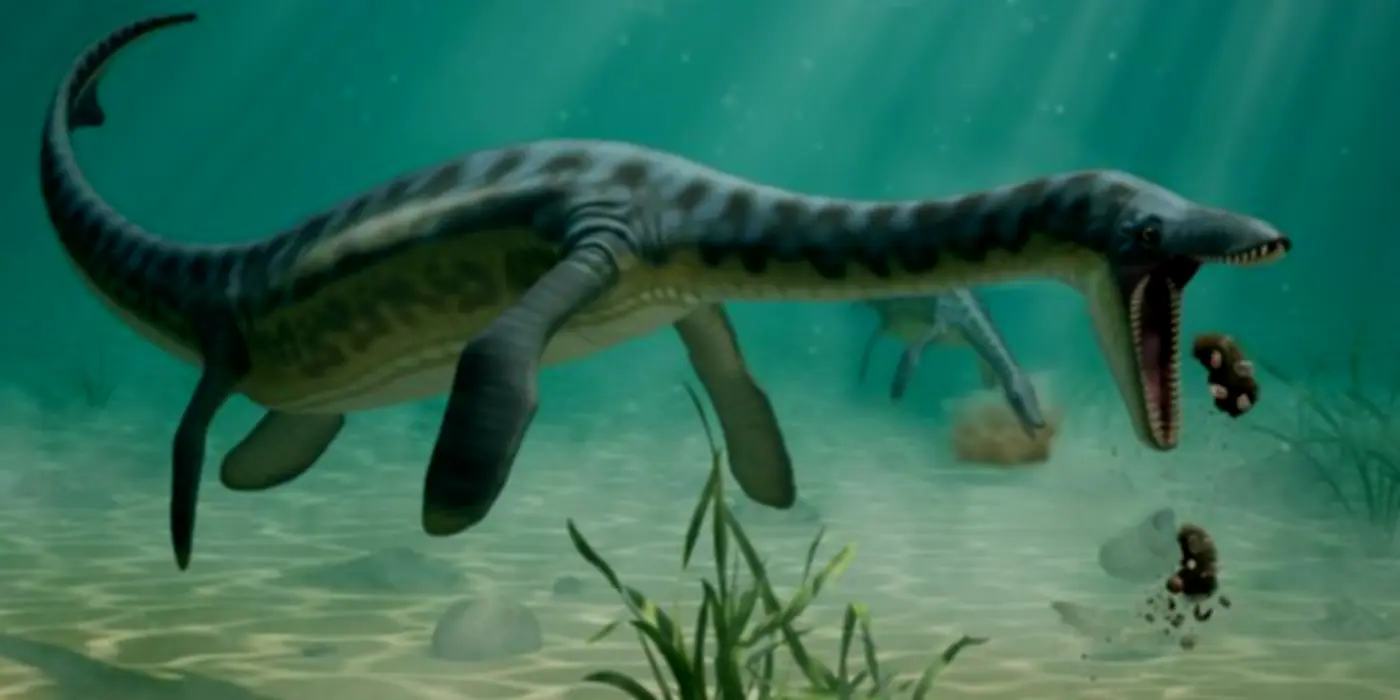
Jurassic Puke: Plesiosaurs Knew Not To Vomit Where They Eat
Jurassic monsters sometimes needed to vomit. When they did, they went to shore.
Jurassic monsters sometimes needed to vomit. When they did, they went to shore.


How does a stem cell decide what specialized identity to adopt – or simply to remain a stem cell? A new study suggests that the conventional view, which assumes that cells are “instructed” to progress along prescribed signaling pathways, is too simplistic. Instead, it supports the idea that cells differentiate through the collective behavior of multiple genes in a network that ultimately leads to just a few endpoints – just as a marble on a hilltop can travel a nearly infinite number of downward paths, only to arrive in the same valley.
The findings, published in the May 22 issue of Nature, give a glimpse into how that collective behavior works, and show that cell populations maintain a built-in variability that nature can harness for change under the right conditions. The findings also help explain why the process of differentiating stem cells into specific lineages in the laboratory has been highly inefficient.
Led by Sui Huang, MD, PhD, a Visiting Associate Professor in the Children’s Hospital Boston Vascular Biology Program (now also on the faculty of the University of Calgary), and Hannah Chang, an MD/PhD student in Children’s Vascular Biology Program, the researchers examined how blood stem cells “decide” to become white blood cell progenitors or red blood cell progenitors.

The description of an ancient amphibian that millions of years ago swam in quiet pools and caught mayflies on the surrounding land in Texas has set to rest one of the greatest current controversies in vertebrate evolution. The discovery was made by a research team led by scientists at the University of Calgary.
The examination and detailed description of the fossil, Gerobatrachus hottoni (meaning Hotton’s elder frog), proves the previously disputed fact that some modern amphibians, frogs and salamanders evolved from one ancient amphibian group called temnospondyls.
“The dispute arose because of a lack of transitional forms. This fossil seals the gap,” says Jason Anderson, assistant professor, University of Calgary Faculty of Veterinary Medicine and lead scientist in the study.

New imaging research shows that brain activity differs in sleep-deprived and well-rested people. The study, in the May 21 issue of The Journal of Neuroscience, shows that individuals who are sleep-deprived experience periods of near-normal brain function, but these periods are interspersed with severe drops in attention and visual processing.
They have shown for the first time what happens to the visual perceptions of healthy but sleep-deprived volunteers who fight to stay awake, like people who try to drive through the night. The scientists found that even after sleep deprivation, people had periods of near-normal brain function in which they could finish tasks quickly. However, this normalcy mixed with periods of slow response and severe drops in visual processing and attention.
During imaging, participants did a task that required visual attention. Researchers showed them large letters composed of many smaller letters. Participants were asked to identify either the large or small letters and to indicate their responses by pushing a button.

Using data from NASA’s New Horizons spacecraft and two telescopes on or near Earth, an international team of scientists has found that one of the solar system’s largest and newest storms – Jupiter’s Little Red Spot – has some of the highest wind speeds ever detected on any planet.
Jupiter’s "LRS" is an anticyclone, a storm whose winds circulate in the opposite direction to that of a cyclone – counterclockwise, in this case. It is nearly the size of Earth and as red as the similar, but larger and more well known, Great Red Spot (GRS). The dramatic evolution of the LRS began with the merger of three smaller white storms that had been observed since the 1930s. Two of these storms coalesced in 1998, and the combined pair merged with a third major Jovian storm in 2000. In late 2005 -- for reasons still unknown -- the combined storm turned red.

Researchers from the Laboratory of Intelligent Systems at Ecole Polytechnique Fédérale de Lausanne (EPFL) have unveiled unveiling a grasshopper-inspired jumping robot that weighs a miniscule 7 grams but can jump 1.4 meters - more than 27 times its body size. That's ten times farther for its size and weight than any existing jumping robot.
These jumpers could be fitted out with tiny sensors to explore rough, inaccessible terrain or to aid in search and rescue operations. "This biomimetic form of jumping is unique because it allows micro-robots to travel over many types of rough terrain where no other walking or wheeled robot could go," explains EPFL Professor Dario Floreano. "These tiny jumping robots could be fitted with solar cells to recharge between jumps and deployed in swarms for extended exploration of remote areas on Earth or on other planets."
A "CatCam” that captures feline-centric video of a forest and a new mathematical model are two elements of a new effort to explain how the brain’s visual circuitry processes real scenes.
The new model of the neural responses of a major visual-processing brain region promises to significantly advance understanding of vision.
The researchers sought to develop the new model because until now, studies of the visual system have used simple stimuli such as dots, bars and gratings.
Two new exoplanets mean that the COROT mission(1) has now found a total of four new exoplanets in its 510 day journey. COROT started observations of its sixth star field at the beginning of May and, during this observation phase which will last 5 months, will simultaneously observe 12,000 stars.
The two new planets are gas giants of the hot Jupiter type, which orbit very close to their parent star and tend to have extensive atmospheres because heat from the nearby star gives them energy to expand. But an oddity dubbed ‘COROT-exo-3b’ has raised particular interest among astronomers. It appears to be something between a brown dwarf, a sub-stellar object without nuclear fusion at its core but with some stellar characteristics, and a planet. Its radius is too small for it to be a super-planet.
We all know that coffee can cure everything.
Now it turns out that even a coffee roasting process - torrefaction - could give biomass a power boost, increasing the energy content of some energy crops by up to 20 percent, making biofuels merely bad instead of awful.
The study, carried out by engineers from the University of Leeds, examined the combustion behavior of crops grown specifically for energy creation when put through the mild torrefaction thermal process usually associated with coffee production.

Plant-eating animals in highly seasonal environments, such as the Arctic, are struggling to locate nutritious food as a result of climate change, according to research in Proceedings of the Royal Society B.
The research, which focused on caribou, suggests that not only are these animals arriving at their breeding grounds too late in the season to enjoy the peak availability of food - the focus of previous research by Post - but they also are suffering from a reduced ability to locate the few high-quality plants that remain before these plants, too, become unavailable.
The team focused their research on caribou in West Greenland as an example of an herbivore species in a seasonal environment. Closely related to wild reindeer, caribou are dependent on plants for all their energy and nutrients. In the spring, they switch from eating lichens buried beneath the snow to munching the new growth of willows, sedges, and flowering tundra herbs. As the birth season approaches, they are cued by increasing daylight to migrate into areas where this newly-emergent food is plentiful.

Astronomers have seen the aftermath of spectacular stellar explosions known as supernovae before, but until now no one has witnessed a star dying in real time. While looking at another object in the spiral galaxy NGC 2770, using NASA’s orbiting Swift telescope, Carnegie-Princeton fellows* Alicia Soderberg and Edo Berger detected an extremely luminous blast of X-rays released by a supernova explosion.
They alerted 8 other orbiting and on-ground telescopes to turn their eyes on this first-of-its-kind event.
“We were in the right place, at the right time, with the right telescope on January 9th and witnessed history,” remarked Soderberg. “We were looking at another, older supernova in the galaxy, when the one now known as SN 2008D went off. We would have missed it if it weren’t for Swift’s real-time capabilities, wide field of view, and numerous instruments.”
New research by the Gladstone Institutes of Cardiovascular Disease (GICD) and the University of California, San Francisco (UCSF), has revealed the genetic determinants of fat storage in cells, which may lead to a new understanding of and potential treatments for obesity, diabetes, and heart disease. While scientists have long understood that lipid droplets contribute to fat build up in cells, the genes involved in droplet biology have been a focus of extensive research.
In a study published in Nature, scientists in the laboratories of Drs. Robert V. Farese, Jr., of Gladstone and UCSF, and Peter Walter, of UCSF, devised a genetic screen to identify genes responsible for fat storage in cell of fruit flies, and potentially other species.
New research in the Society of Chemical Industry’s Journal of the Science of Food and Agriculture shows that oregano oil works as well as synthetic insecticides to combat infestation by a common beetle, Rhizoppertha dominica, found in stored cereals.
Not only does oregano oil work as well as synthetic versions but it has none of the associated side effects of synthetic insecticides on the environment.
Growing resistance to synthetic insecticides combined with potential environmental damage and new government directives on changes to the way chemicals are registered means that scientists are increasingly looking at natural alternatives that can be produced in the large scale quantities needed for agricultural industry use.